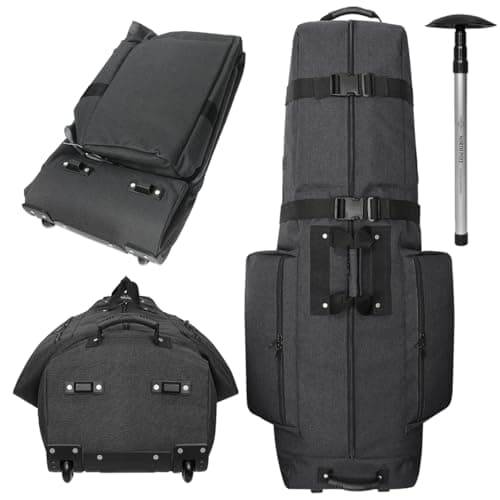
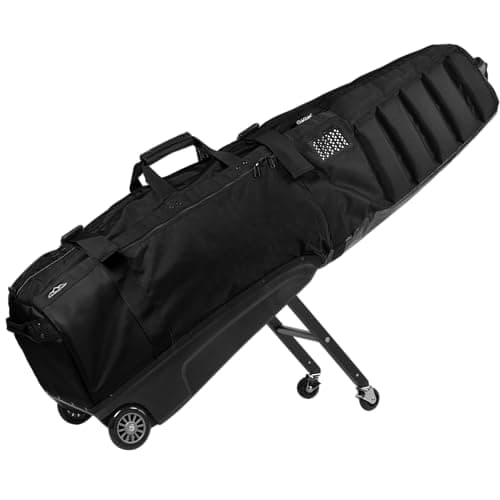
Both of these are soft-sided wheeled travel bagsbuilt to get your clubs to a golf trip in one piece — and both do it well — so this isn’t soft-versus-hard; it’s premium-versus-value. The Sun Mountain ClubGlider Meridian is the premium answer: a retractable-leg system drops a second set of wheels so the loaded bag effectively rolls itself through an airport, taking the weight off your arm. The CaddyDaddy Constrictoris the value answer: a padded bag with a dense foam top and lockable zippers that covers the essentials — protection, wheels and security — for a good deal less. How much you fly decides which one is worth it.
Choose the Sun Mountain ClubGlider Meridian if…
You fly with clubs with any regularity, and the walk through the terminal — not just the time in the hold — is the part you want solved. The ClubGlider’s retractable legs are its whole reason to exist: extend them and a second set of wheels drops so the bag glides on its own while you barely support it, which is a genuine back-saver across a long terminal with a full-size cart bag inside. It’s well padded where it counts, with a reinforced top to guard the club heads — the part most exposed in transit — and the build quality is clearly premium. You pay for it, and it takes up real space at home between trips, but if you take golf trips often, the effortless handling earns that price every single time. The full look is in our Sun Mountain ClubGlider review.
Choose the CaddyDaddy Constrictor if…
You fly with clubs occasionally and want real protection and security without the premium price. The Constrictor covers the things that actually protect your clubs: a dense foam padded top guards the club heads, lockable zippers add a bit of security and deter casual tampering, and it rolls on wheels and packs down between trips — all at a mid-tier price. What you give up is the effortless handling of a leg system: its wheels and grab handle are fine, not the glide of the ClubGlider, so you still bear the bag’s weight through the airport. For a once-or-twice-a-year trip, that’s a small price for a big saving, and it’s a lot more bag than a bare budget cover — the padding and locks are exactly what a bare cover leaves out.
How they’re actually different
They protect your clubs similarly — both are padded soft-sided bags with a guarded top, and neither is a rigid hard case — so the real gaps are handling and price. Handlingis the big one: the ClubGlider’s retractable legs let it carry its own weight, where the Constrictor rolls and hauls like a normal wheeled bag. Price is the other: the Constrictor undercuts the ClubGlider by a wide margin, which is the whole reason to consider it. Security and storageare close — the Constrictor leans on its lockable zippers, the ClubGlider on its premium build and capacity. And both take up space at home, though the leg-system bag is the bulkier thing to store. Match the handling you need to how often you fly, and the price gap tells you the rest.
| What matters | Sun Mountain ClubGlider | CaddyDaddy Constrictor |
|---|
| Handling | Retractable legs — glides on its own wheels | Wheels + grab handle — you carry the weight |
| Protection | Padded, reinforced top (soft-sided) | Dense foam padded top (soft-sided) |
| Security | Premium build; full-size capacity | Lockable zippers |
| Best for | Frequent flyers who want the easiest handling | Occasional flyers who want padding + locks for less |
| Price | Premium | Value |
The frequency test settles it
The cleanest way to choose is to count your trips. If you fly with clubs several times a year — buddies’ trips, destination golf, a winter migration south — the ClubGlider’s leg system pays you back on every terminal walk, and the premium stops feeling like a splurge and starts feeling like a tool you use. If you fly once or twice a year, you’ll spend far more of the bag’s life storing it than rolling it, and the Constrictor’s padding and locks protect your clubs just as well for the flight itself at a fraction of the cost. The break-even isn’t about how much you love golf; it’s about how many airports you actually cross with your clubs in tow. Be honest about that number and the choice is nearly automatic.
What neither one is
Both are soft-sided bags, which means neither is the maximum-protection option. They protect well — padded tops, guarded heads — but if you fly constantly on rough-handling airlines with expensive clubs and want the most crush resistance money buys, a rigid hard case still wins on that one axis, at the cost of weight and a big box to store. That trade is worth understanding before you buy either of these; our hard vs soft travel bag guideweighs it in full. Whichever soft bag you choose, do the one thing that protects clubs more than the bag itself does: drop in a cheap “stiff arm” support rod so an end-drop loads the rod, not your shafts. The full packing routine is in how to fly with golf clubs.
Handling is the feature you pay for
It’s worth dwelling on what the ClubGlider’s premium actually buys, because it’s a single, specific thing: handling. A loaded golf travel bag is heavy and unwieldy, and dragging one on two wheels puts all that weight on your arm and shoulder across a long terminal, a jet bridge and a rental-car lot. The retractable-leg system drops a second set of wheels so the bag stands and rolls on its own; you steer it instead of hauling it. The Constrictor has wheels and a grab handle and moves perfectly well, but you feel the weight the whole way. If your trips involve big airports, tight connections and a lot of walking with the bag in tow, that difference is real and repeated on every leg. If your idea of traveling with clubs is wheeling a bag from the car to a curbside check-in twice a year, you’ll rarely notice what the legs would have saved you — which is exactly why the ClubGlider is a frequent-flyer’s bag and the Constrictor an occasional traveler’s.
Living with the bag between trips
A travel bag spends far more of its life in a closet than in an airport, and that’s a fair thing to weigh. The ClubGlider is a premium, full-size bag that swallows a loaded stand or cart bag — and it takes up real space at home for the fifty weeks a year you’re not flying, the leg system making it the bulkier of the two to store. The Constrictor is a soft bag that packs down more readily between trips, which suits a golfer with less storage to spare. Capacity for the flight itself is close — both hold a full set inside their travel wrapper — so the practical question is whether you have somewhere to keep a big premium bag, and whether you’ll fly often enough that it earns the shelf space. If storage at home is tight and trips are rare, that alone can tip the decision toward the Constrictor.
Skip the decision entirely if…
Skip both if you fly with clubs so rarely that any real travel bag is overkill — a bare budget cover plus a support rod and a few towels will get you there once a year, and we say so plainly in the travel bag roundup. And skip both if maximum protection is your only priority and you don’t mind hauling and storing a rigid box — a hard case is the more single-minded tool there. The ClubGlider-vs-Constrictor choice is for the golfer who wants a padded, wheeled soft bag and is only deciding how much to spend on handling. Before you fly, check what your airline charges to bring clubs in our airline golf-club fee reference.
The honest verdict
Buy the Sun Mountain ClubGlider Meridian if you fly with clubs often and want the easiest handling in the category — the retractable legs are a genuine back-saver, and frequent travelers feel the value every trip. Buy the CaddyDaddy Constrictor if you fly occasionally and want a padded, lockable, wheeled bag that protects your clubs for the flight without the premium price. Both protect similarly; the money buys handling, not more safety, so the decision comes down to how many airports you cross. Frequent flyer, pay for the legs; occasional flyer, save the money and pack a support rod. We base this on Sun Mountain’s and CaddyDaddy’s published specifications and aggregated owner feedback; we don’t run a test lab.