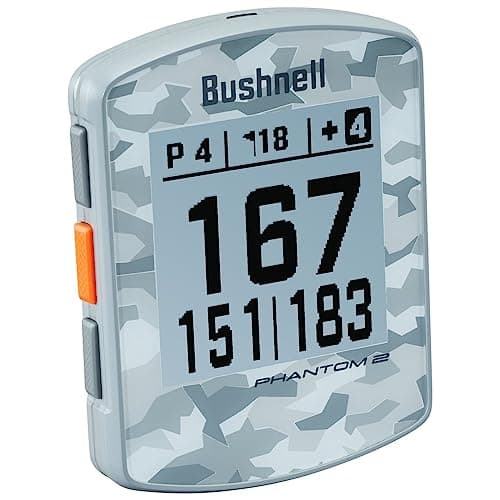
The Bushnell Phantom 2 is the golf GPS for the player who wants distances but not a watch — a chunky, clip-and-go handheld that sticks to the cart bar and shows big, legible front, center and back numbers to the green. It’s the friendliest display in the category for aging eyes, it carries Bushnell’s 38,000+ preloaded courses with no subscription for the basics, and its integrated BITE magnet means it lives on the cart rail rather than in a pocket. It’s deliberately simple — a distance button, not a phone-style map — and whether that’s the appeal or the limitation is the whole review.
What it is
The Phantom 2 is a handheld golf GPS: a small, rugged, one-hand device that reads your position and shows the yardages to the front, center and back of the green, plus basic hazard distances, from Bushnell’s mapped course database. It’s a GPS, not a laser — you don’t aim it at a target, you glance at preloaded course distances. Bushnell lists 38,000+ preloaded courses and a GreenView feature with a movable pin, so you can shift the target toward where the flag actually sits, and — importantly — there’s no subscription for the basics. The integrated BITE magnet sticks it to a steel cart bar or a belt, and auto hole advance moves it to the next hole so you’re not fiddling with buttons. It’s not a watch and it’s not a phone app: you don’t wear it and you don’t hold it up to aim.
Where it shines
The Phantom 2’s best trait is legibility. Its screen shows big, clear front, center and back numbers — the friendliest display here for anyone whose eyes have stopped enjoying a tiny watch face or a phone in the sun. There’s no squinting and no menu-diving to reach the number you want: you look, you get the yardage to the green, you play. For a lot of golfers — particularly older players, or anyone who finds a small wrist display fiddly — that big, simple readout is the entire reason to choose a handheld over a watch.
Two more things make it pleasant to live with. The integrated BITE magnet — the same idea Bushnell puts on its lasers — clicks it onto a cart bar or a steel post so it’s always to hand between shots rather than buried in a bag, and auto hole advance means it follows you around the course without input. And it inherits the category’s best feature: no subscription. Bushnell lists 38,000+ preloaded courses with GreenView and a movable pin, with no fee for the basics, so the price you pay is the price you pay — none of the yearly-fee creep that shadows some distance apps.
Where it falls short
The trades are exactly what you’d expect from a simple handheld. First, it’s a small screen of numbers, not the full mapping experience of a phone app — you get the distances and basic hazards, not a rich, zoomable color map of every contour of the hole. If seeing the shape of a dogleg matters to you, a phone app or a mapping device does more. Second, and fundamental to every GPS: it reads to the mapped green, not the flag. GreenView’s movable pin helps you aim the number at where the flag sits, but it’s still working from the map, not measuring the actual pin the way a laser does — so it gives you a reliable number to the green, not the pinpoint yardage to a tucked flag. Neither is a defect; both are the deliberate limits that keep it simple, rugged and cheap.
Handheld, watch or laser?
Two decisions sit behind the Phantom 2. The first is format: a handheld versus a watch. A GPS watch keeps the number always in your eyeline on your wrist, which most players find the most convenient way to get distances; a handheld like the Phantom 2 trades that wrist-glance for a bigger, more legible screen and a device you clip on rather than wear — better for aging eyes, or for anyone who dislikes a strap. The clip-on Garmin Approach G12 splits the difference with a tiny numbers-only body; we cover it in the Garmin G12 review. The second decision is GPS versus laser: if you want an exact number to the stick, a laser is the tool and the Phantom 2 will never do that; if you want speed, the whole green’s numbers at once and no aiming, GPS is the better fit — our rangefinder vs GPS guide walks that in full.
Who should buy it
Buy the Phantom 2 if you want subscription-free GPS distances in a big, legible, clip-on package and you don’t want a watch on your wrist. It suits the golfer who values a large, easy-to-read number over a small one, the player who’d rather clip a device to the cart than wear anything, and anyone who wants the basics done rugged and simple with no yearly fee. The BITE magnet and auto hole advance make it genuinely low-effort to use, and the movable-pin GreenView covers most of what a recreational golfer actually reads off a GPS.
Who should skip it
Skip it if you want the shot tracking and deep stats a Shot Scope gives, or the pinpoint pin distances a laser gives — the Phantom 2 is a simple, glance-and-go distance button, nothing more, which is exactly its appeal but also its ceiling. Skip it, too, if you’d actually prefer a watch: the wrist form keeps the number in your eyeline and many players find it more convenient, and the whole no-subscription field — watches and handhelds alike — is ranked in our best GPS watchesroundup. And if what you really want is an exact yardage to a tucked pin, that’s a laser’s job, not a GPS’s.
The verdict
The Bushnell Phantom 2 is a neat, honest answer to a narrow request: big, subscription-free GPS distances with no watch and a magnet that parks it on the cart. If that’s exactly what you want, it’s an easy recommendation and does its one job cleanly. If you want rich maps, shot tracking and stats, or a pinpoint number to the flag, it’s the wrong tool by design — a mapping app, a Shot Scope, or a laser suits those needs better. Decide whether the big-screen, clip-on handheld format is the appeal, and the Phantom 2 either is or isn’t your device. We base this on Bushnell’s published specifications and aggregated owner feedback — we don’t run a test lab.
Handheld, watch or phone — which GPS format?
A golf GPS comes in three shapes, and the Phantom 2 is the handheld. A GPS watch keeps the yardage on your wrist, always in your eyeline, which is why it’s the most popular format for players who don’t mind wearing one. A handheld like the Phantom 2 trades that wrist-glance for a bigger, more legible screen and a clip-on body — the friendlier choice for aging eyes, or for anyone who finds a small watch face fiddly. A phone app is the cheapest way in but eats your battery and pulls your phone out on every hole. For a golfer who wants a large, clear number, no watch, and no yearly fee, the handheld is the sweet spot — and the magnetic Phantom 2 is Bushnell’s clean take on it. If you’re weighing a handheld against a watch or the tiny clip-on Garmin, the whole no-subscription field is ranked in our best GPS watches roundup.
GPS to the green, or a laser to the pin?
Whichever GPS format you choose, remember what a GPS is and isn’t. The Phantom 2 reads to the mapped green — front, center and back — not to the actual flag; GreenView’s movable pin lets you nudge the number toward where the flag sits, but it’s still working from the map, not measuring the pin. That’s accurate enough for most of what a recreational golfer does, and for pace of play, hazards and knowing the whole green at a glance it’s genuinely better than a laser. What it can’t do is put an exact number on a tucked pin — for that you need a laser. Plenty of players carry both: a handheld or watch for pace and the number to the middle, a laser for the precise approach. Our rangefinder vs GPS guidewalks the whole decision if you’re still choosing between the two tools.