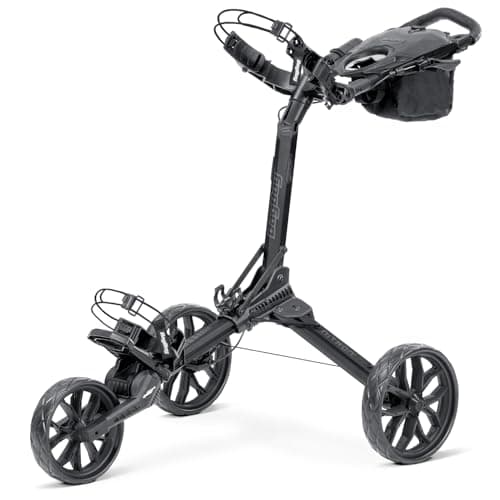
The Bag Boy Nitron is a premium three-wheel push cart with one headline feature you feel every single round: an air-assisted mechanism that means the cart nearly opens itself. Setting up and folding a push cart is the fiddliest part of owning one, and the Nitron all but removes it — release the cart and it essentially unfolds in a single motion. If the thing that would put you off a push cart is the faff of wrestling a frame open in the car park, this is the cart built to fix exactly that. It won’t change your golf, but it removes the small friction that stops people from walking.
What the air-assisted open actually does
Most push carts open in a deliberate sequence — release a catch, unfold the frame, lock the rear wheels, click the handle into place. None of it is hard, but doing it before and after every round is the part owners quietly grumble about, and it’s the moment a reluctant walker eyes the riding cart instead. Bag Boy’s answer is an air-assisted piston that carries the frame open for you: let the cart go and it rises into shape on its own, so setup and fold stop being a chore and become an afterthought. Bag Boy describes this near-automatic open as the Nitron’s signature convenience, and it is the single thing that separates it from a cheaper cart. A cart you never dread setting up is a cart you actually keep using — and over a season, that matters more than any line on the spec sheet.
Who a push cart suits in the first place
Before the Nitron specifically, it’s worth being honest about who a push cart is for at all. A push cart is the middle ground between carrying and riding: if your course lets you walk and you’d rather not bear a bag on your shoulder for four hours, a push cart takes the weight off entirely while you still get the walk and the exercise. Carrying keeps you lightest and most mobile; a riding cart takes the walk away; a push cart splits the difference. If you ride a riding cart every round, a push cart is money spent on a problem you don’t have — put it toward the bag instead. But if you walk, or want to, it’s some of the best money in the bag, and the Nitron is one of the easiest to live with. The whole field, three-wheel and four-wheel, is ranked in our best push carts roundup.
Three wheels, and how it rolls
The Nitron is a three-wheel cart, and that shapes how it moves and folds. Three wheels — one at the front, two at the back — steer nimbly and turn tight, so the cart weaves between bunkers and tee boxes without fuss, and three-wheelers tend to fold more compact than four-wheel carts, which suits a smaller trunk. On the course the Nitron tracks straight and pushes without constant correction, so you’re not fighting the handle all round. The trade that comes with any three-wheel design is slope stability: parked across a hill, a three-wheeler can feel a touch less planted than a four-wheel cart, which sits on a wider base. It’s a minor point for most walkers on most courses, but if you play steep terrain and park on inclines a lot, it’s worth knowing. The wheel-count decision in full is in our three-wheel vs four-wheel push cart guide.
Storage and the little things
Bag Boy fits the Nitron with a useful top console and storage — a spot for your phone, tees, balls, a scorecard and a drink within easy reach while you walk — so the cart earns its keep beyond simply carrying the bag. It’s the kind of everyday convenience you stop noticing precisely because it’s always there, and it’s the sort of thing a bare, cheaper cart makes you do without. Match the cart to the bag, too: a cart bag or a stand bag both strap onto a push cart, and our push cart roundup shows where the Nitron lands against the value four-wheeler and the other premium three-wheeler.
Where it gives up to a Clicgear
The Nitron’s natural rival is the Clicgear Model 4.5, and the honest picture is that each wins on something different. Where the Nitron gives ground is durability reputation and the accessory ecosystem: Clicgear has the stronger long-term durability name — a big reason so many older Clicgears are still rolling years later — and a deeper catalog of clip-on accessories, from umbrella holders to coolers, that bolt straight onto its mounting system. If you plan to keep a cart for many seasons and build it out with add-ons, that’s where the Nitron trades away. What the Nitron gives back is setup: nothing else opens as effortlessly. We put the two premium three-wheelers head to head in Clicgear vs Bag Boy Nitron, and the short version is that it’s a priorities question — easiest setup versus longest-haul durability and expandability — not a better-or-worse one.
Who should skip it
Skip the Nitron if the fastest, most effortless setup isn’t something you’ll value — its air-assisted open is the main reason to pay up, and if that convenience leaves you cold, a simpler cart does the core job for less. Skip it if you want the most compact possible fold for a tight trunk, or simply the lowest price; a value four-wheel cart like the CaddyTek Explorer V8 includes more extras in the box for less money, though it folds bulkier. Skip it, too, if maximum slope stability is your priority — a four-wheel base sits more planted parked on a hill. And skip a push cart entirely if you ride a riding cart every round: it’s money spent on a problem you don’t have, and the bag is the better place for it. We base this on Bag Boy’s published specifications and aggregated owner feedback; we don’t run a test lab.
The verdict
For the walker who wants the least fiddly premium push cart to set up, the Bag Boy Nitron is an easy recommendation — the air-assisted open is a genuine, repeated convenience, and the cart rolls straight, stores a round’s worth of odds and ends, and turns nimbly on its three wheels. Pay up for it specifically because you want that effortless setup, not because premium means better golf; it carries the bag no better or worse than a good value cart does. If long-haul durability and a deep accessory catalog matter more, the Clicgear is the traditional pick; if value and slope stability matter more, a four-wheeler is. See where the Nitron lands against both in our best push carts roundup.
Is an air-assisted open worth paying for?
It depends entirely on how much the setup ritual bothers you. Every push cart has to be unfolded before the round and folded after it, and on most carts that’s a short sequence of catches and clicks — not hard, but a small friction you repeat every single time you play. The Nitron’s air-assisted piston removes almost all of it: release the cart and it carries itself open. If you’re the sort of walker who’ll happily unfold a frame by hand and would rather keep the money, the convenience isn’t worth a premium to you, and a simpler cart is the honest call. But if the faff is the very thing that nudges you toward a riding cart instead of walking, an open you don’t have to think about can be what keeps you on foot — and that’s worth more than a spec sheet suggests. Weigh it against the price; the whole field, with live prices, is in the best push carts roundup.
Three wheels or four — and where the Nitron fits
The Nitron is a three-wheel cart, and that’s central to who it’s for. Three wheels fold more compact and steer more nimbly, which suits a tight trunk and a course you weave around; the trade is that a three-wheeler sits a touch less planted than a four-wheel cart when parked across a slope. A four-wheel cart flips both: steadier on a hill, but bulkier folded, and value four-wheelers usually cost less. None of that is a proxy for quality — a foot brake, straight-tracking wheels, easy setup and useful storage exist in both camps, so don’t treat three-versus-four as shorthand for good-versus-bad. If you’re still deciding, our three-wheel vs four-wheel push cart guide walks the whole choice, and Clicgear vs Bag Boy Nitron puts the Nitron against the other premium three-wheeler on the trade-offs that actually decide it.