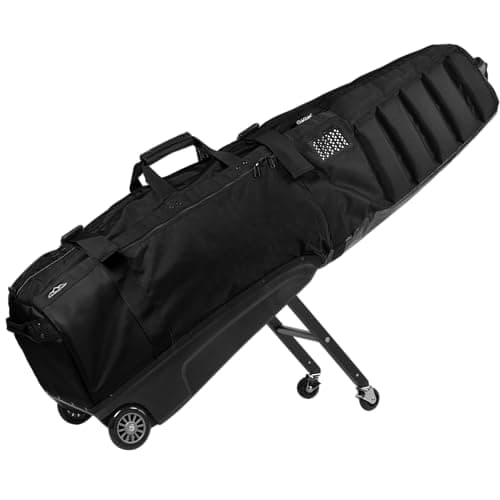
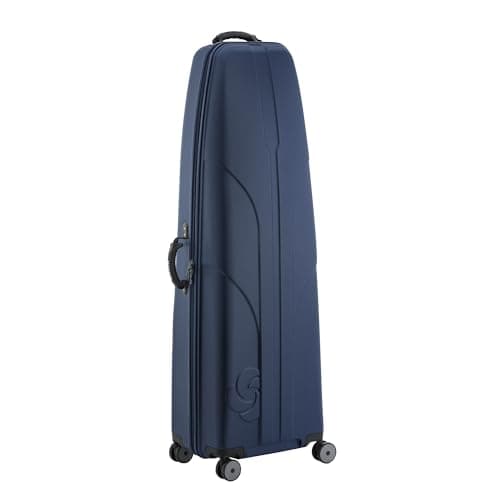
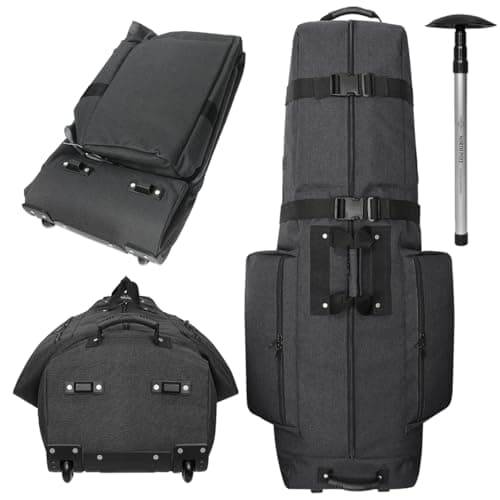
For most golfers the answer is a soft-sided travel bagwith a padded top, because soft sides flex around whatever golf bag you own and the fit question largely goes away — the CaddyDaddy Constrictor below is the pick that does that at a sane price. The fit question only becomes a real problem when you buy a rigid case, and then it becomes the main problem. This page gives you the three measurements that settle it: your bag’s widest point, your longest club, and the airline’s linear-inch limit. Take two minutes with a tape measure before you order and this category stops generating returns.
Measurement one: your golf bag’s widest point
Not the body — the widest point. On most modern cart bags that is the molded carry handle across the top of the divider, which can be meaningfully wider than the bag itself. This is the number that fails, and the manufacturers know it: SKB publishes on its own product page that the Deluxe ATA Staff case will not accommodate newer cart or stand bags whose molded top handles exceed twelve inches across, and points those buyers at a larger model. Samsonite quotes its hardside cases as taking 10.5-inch top bags. If your bag’s top measures thirteen inches across the handle, a case rated for 10.5 inches is not a tight fit, it is not a fit.
Measure across the top opening at its widest, including any rigid handle, and write the number down. Then check it against the case’s published interior dimension, never its exterior.
Measurement two: your longest club
Stand your driver on the floor and measure to the butt end of the grip. Most men’s drivers land in the 45 to 46 inch range off the rack, but a long-drive build or a custom extension can run past 47, and that is enough to matter: the SKB Staff ATA publishes a 49.5 inch interior length and Samsonite quotes its hardside cases as taking clubs up to 48 inches. A soft bag has more give here, but “give” means the end of the grip pushes into the fabric, which is exactly where you do not want pressure in transit.
If you are at the long end, favor a soft bag or a case with published interior length to spare. This is also the measurement that decides whether a support rod will fit above your longest club, which is the accessory that protects your shafts in an end-drop.
Measurement three: the airline’s linear-inch limit
This is the one that catches people at the counter, and it applies to the loaded travel bag rather than your clubs. Carriers publish a maximum size in linear inches— length plus width plus height added together. Delta publishes that items whose outside dimensions exceed 115 linear inches are not accepted at all. Golf equipment usually travels as a standard checked bag with the oversize fee waived, which is the concession that makes this category workable, but the hard maximum still applies, and a very large rigid case loaded with a cart bag can approach it.
Weight is the sibling problem. American publishes 50 lb before an overweight fee with a 70 lb hard maximum; Delta publishes 50 lb before an excess-weight charge. That allowance covers the travel bag, the golf bag and everything inside — so an eighteen-pound empty shell has eaten more than a third of it before a single club goes in. Our airline golf-club fee reference keeps the per-carrier detail current, and how to fly with golf clubs covers the packing side.
The published numbers, side by side
Straight from each listing’s own specification — these are the figures to measure yourself against, not our estimates:
| Case | Type | Published fit | Empty weight |
|---|
| SKB Deluxe ATA Staff | Full hard shell | Interior 49.5in x 12.25in x 16in; not for molded top handles over 12in | 18 lb (SKB published) |
| Samsonite hardside cases | Full hard shell | Fits 10.5in top bags, clubs up to 48in | Not published on the listing |
| Soft-sided bags (Constrictor, ClubGlider) | Soft | Flex around the bag; check listed length against your driver | Lighter than a shell — varies by model |
So what size should you buy?
If you own a cart bag with a wide molded top, buy soft, or buy a case whose published interior width exceeds your measurement with room to spare. If you own a stand bag and fly often, a shell is realistic — measure anyway. If you have a long driver, prioritize published interior length. And whatever you buy, weigh it loaded before you leave for the airport, because the overweight fee is usually larger than the price difference between two bags. Three picks that cover the three common answers follow.
The one-size-fits-most answer
If you do not want to think about this again: a padded soft-sided bag plus a telescoping support rod fits every golf bag made, folds flat in a closet, stays well inside every carrier’s linear-inch limit, and protects against the end-drop that actually breaks shafts. It is not the maximum protection available — a rigid shellis — but it is the configuration that has no fit risk and no storage problem, which is why it is the default recommendation on this site for anyone taking one or two trips a year.
Measure before you order, not after it arrives
The pattern in this category is depressingly consistent: the bag is fine, the clubs are fine, and the buyer is filing a return because a molded handle is an inch too wide. Both numbers — widest point, longest club — take two minutes to collect and they eliminate the only failure mode that is entirely within your control. Published interior dimensions beat marketing copy every time; if a listing does not publish an interior dimension and you need a rigid case, treat that as a reason to buy a different case.