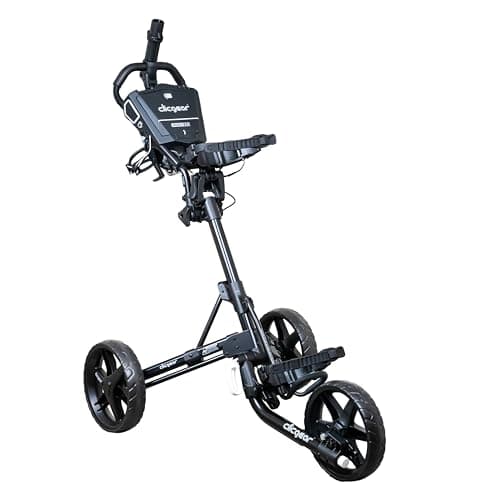
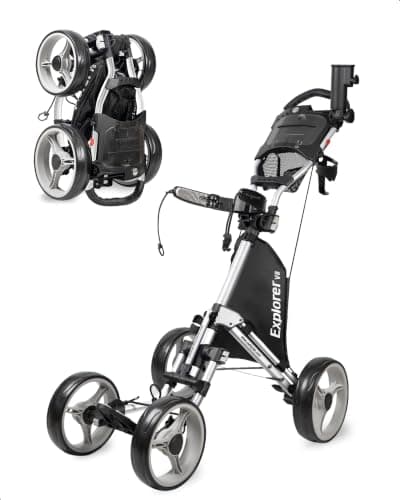
A push cart has one job — take the bag off your shoulder so you can walk without carrying — and both of these do it well. What separates them is philosophy and price. The CaddyTek Explorer V8 is the value four-wheeler: a stable, folding cart that arrives loaded with the extras most carts charge for, at a fraction of the premium price. The Clicgear Model 4.5is the premium three-wheeler: a cart bought for its long-term durability, its genuinely compact fold, and an accessory ecosystem nothing else in the category matches. Neither is trying to be the other, so this isn’t a better-or-worse question — it’s a spend-now-or-keep-for-years one.
Choose the CaddyTek Explorer V8 if…
You want the most cart for the least money, and you’d rather not buy a single accessory to feel like you have a complete cart. The V8’s headline is what comes in the box: CaddyTek lists a foot brake, a cooler basket, umbrella and drink holders and a scorecard console as standard, where a premium frame often leaves you buying those clip-ons one at a time. Its four wheels are the other half of the pitch — they track straight and sit planted, and you notice that stability most parked on a slope, where a three-wheeler can want to creep. Setup is a simple one-click fold rather than anything automatic, and the finish is value-grade rather than plush, but nothing about the way it does the core job feels cheap. For a walker who wants to spend once and have everything, this is the cart, and it’s why it takes the value pick in our CaddyTek Explorer V8 review.
Choose the Clicgear Model 4.5 if…
You plan to keep a cart for years, you drive a smaller car, or you want to build the cart out over time. Clicgear’s reputation is built on durability — it’s why so many older models are still rolling — and if you keep gear for the long haul, that longevity is what the premium buys. It also folds compact and square, packing smaller than most three-wheel carts and far smaller than any four-wheeler, which genuinely matters if trunk space is tight. And it is the hub of the deepest accessory ecosystem in push carts: Clicgear says its mounting system takes clip-on umbrella holders, coolers and storage that bolt straight on, so you can tailor the cart to exactly how you play. The trade you accept is a more deliberate setup sequence and a higher sticker before you’ve added a thing. You buy the Clicgear for the years and the add-ons, not for a cheaper day’s walking.
How they’re actually different
Four things separate them, and none of them is your golf score. Wheel count is the root of it: three wheels (Clicgear) fold smaller and steer nimbler; four wheels (CaddyTek) sit more planted and track dead straight. Fold sizefollows from that — the Clicgear packs the smaller, squarer bundle, the V8 the bulkier one. Durability and finish run to the Clicgear: it feels more premium in the hand and has the stronger long-haul reputation. And value runs hard the other way: the V8 costs far less and includes more in the box, where the Clicgear is among the pricier carts before a single accessory. Match those four to what you actually care about and the choice makes itself.
| What matters | CaddyTek Explorer V8 | Clicgear Model 4.5 |
|---|
| Wheels | Four — planted, tracks straight | Three — nimble, turns tight |
| Fold size | Bulkier folded | Compact and square |
| Included extras | Loaded — brake, cooler, holders, console | Storage net + console; deep add-on catalog |
| Durability & finish | Value-grade, holds up well | Premium build, long-haul reputation |
| Price | Value | Premium |
What both carts get right
It’s easy to frame this as premium-versus-value and miss that both carts clear the bar that matters. Both have a foot brake to hold the cart still on a slope, both give you a console and storage for a phone, tees, balls and a drink, both fold down without a fight, and both track straight enough that you’re not fighting the handle all round. The core job — carry the bag, roll easily, park safely, fold away — is done well by either. That’s worth saying because the price gap can imply the cheaper cart must be missing something fundamental. It isn’t. What the premium buys is longevity, a smaller fold and an accessory system, not a cart that does the basic job noticeably better on the day.
Wheel count is the fork in the road
Because wheel count drives so much of this, it’s worth being blunt about what it does and doesn’t decide. A four-wheel base like the V8’s is steadier when the cart is stationary on a hill, which is the moment three-wheelers most often let you down — park one across a slope and it can roll. A three-wheel cart like the Clicgear turns on its single front wheel, so it feels more agile weaving between bunkers and tee boxes, and it’s the design the compact-fold and premium end of the market is built around. Neither pushes meaningfully harder than the other on the flat; a well-made cart of either layout rolls easily and holds its line. If you play hilly courses and park on inclines a lot, that’s a real point for four wheels; if you value a small folded footprint and tight steering, that’s the case for three. Our three-wheel vs four-wheel guidewalks the whole decision if you’re still torn.
How you get to a “complete” cart
The other axis worth thinking through is how you end up with a cart that has everything you want on it. The V8 gets there in one purchase — the extras are included, so the price you see is close to the price you pay to have it all. The Clicgear gets there differently: the base cart is more expensive, and the umbrella holder, cooler and storage are add-ons you buy as you want them. That’s not a trick — it’s a genuinely deeper catalog, and it lets you tailor the cart precisely — but it does mean the true cost of a fully kitted Clicgear climbs well above its sticker. Budget for the cart you actually want, not just the frame, and the gap between the two widens rather than narrows.
Storage, the brake and the little things
Neither cart is short on the small features that make a round smoother, and it’s worth knowing they’re close here. Both give you a foot brake to hold the cart still on a slope, a console up top for your phone, tees and a scorecard, and provision for a drink and an umbrella — the V8 includes its cooler basket and holders in the box, while the Clicgear offers a storage net and console and sells the rest as clip-ons. On the course you won’t find one dramatically better organized than the other; the difference is again whether the kit is bundled or bought. One practical note: because the V8 arrives with more attached, it’s the heavier, bulkier thing to lift into a trunk, where the Clicgear’s squarer, more compact fold is easier to stow and slots into a smaller boot. If you’re loading a cart in and out of a car every round, that handling difference is a quiet point in the Clicgear’s favor — and the flip side of the V8’s everything-included appeal.
Skip the decision entirely if…
Neither of these is your cart if what you really want is the fastest, most effortless setup — that’s the Bag Boy Nitron’s air-assisted open, which nearly unfolds the cart for you, and we put it head to head with the Clicgear in Clicgear vs Bag Boy Nitron. And if you don’t walk enough to justify either — if you ride a riding cart most rounds — a push cart is money spent on a problem you don’t have; put it toward the bag instead. Sort out whether you’re even a push-cart walker first, then come back and pick a wheel count. The full field, both designs ranked with live prices, is in the best push carts roundup.
The honest verdict
Buy the CaddyTek Explorer V8 if you want a stable, fully-loaded cart at a value price and don’t mind a bulkier fold or a value-grade finish — for most walkers, that’s the smart money. Buy the Clicgear Model 4.5 if you’ll keep a cart for years, need it to pack down small, or want to build it out with accessories, and you’re happy to pay a premium for that durability and compactness. The honest truth is that both will roll a bag around a course for a long time; the choice is whether you optimize for price and included extras today, or for longevity, fold size and add-ons over the years. Neither answer is wrong — they’re just different priorities wearing different numbers of wheels. We base this on CaddyTek’s and Clicgear’s published specifications and aggregated owner feedback; we don’t run a test lab.