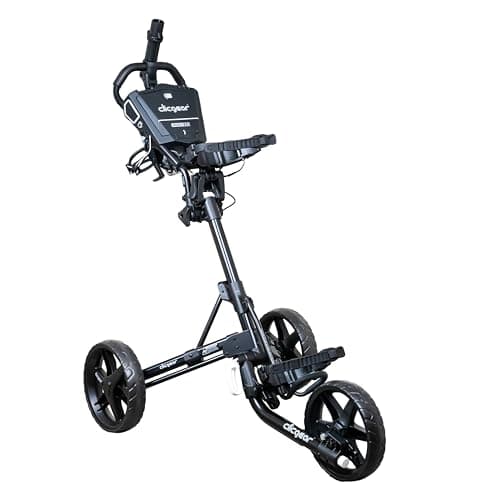
The Clicgear Model 4.5 is the push cart the rest of the category measures itself against: the benchmark for durability and a genuinely compact fold, with an accessory ecosystem nothing else comes close to. It isn’t the cheapest cart, and it isn’t the fastest to set up, but it folds smaller and squarer than almost anything, it has the reputation for lasting years, and it takes a deep catalog of clip-on add-ons that bolt straight on. Judge it on what it’s built to be — a cart you keep for the long haul and tailor to how you play — and it earns its premium.
What the Model 4.5 actually is
The Model 4.5 is a premium three-wheel push cart built around longevity and compactness. Clicgear lists it with a compact, square fold, a storage net and top console, and an accessory-mount systemthat accepts a deep range of clip-on add-ons. The whole design philosophy is different from a value cart’s: instead of packing the box with included extras at the lowest price, Clicgear builds a durable, expandable platform you buy once and keep, then adapt over the years. Three wheels — one front, two rear — steer nimbly and turn tight, and the cart folds down into a small, tidy bundle. It’s a cart for the walker who thinks in seasons, not just this round.
Where it shines: the fold and the durability
Two things make the Clicgear the benchmark. First, the fold: it packs compact and square, into a smaller, more regular shape than most three-wheel carts and far smaller than any four-wheeler, which genuinely matters if you drive a small car or share a boot with the family shopping. A cart that swallows the trunk is a cart you resent; one that folds into a neat cube slots in and out without a fight. Second, durability: Clicgear’s long-standing reputation for lasting is the main reason so many older models are still rolling around courses years after they were bought. If you keep gear for the long haul and hate replacing it, that longevity is the core of what the premium buys — it’s a cart that’s designed to outlast several cheaper ones.
The accessory ecosystem
The Clicgear’s third strength is one no value cart can match: a genuinely deep catalog of clip-on accessories that bolt straight onto its mounting system. Umbrella holder, cooler, extra storage, a seat, mounts for a rangefinder or a drink — Clicgear says the platform takes a wide range of add-ons, so you can tailor the cart precisely to how you play and where. That expandability is why the Clicgear is a cart you grow into rather than out of: you buy the frame, then build the exact cart you want over time. It’s the opposite approach to a loaded value cart that arrives with everything included, and it suits a different buyer — one who wants the best base and the freedom to customize, and is happy to add pieces as they go.
Build and the honest note on specs
The Model 4.5 feels premium in the hand in a way value carts don’t — the frame, the wheels and the folding action have the solid, engineered feel that backs up the durability reputation. As with everything on this site, we’re reporting Clicgear’s published specifications and the weight of aggregated owner feedback rather than a bench test of our own; we don’t run a lab. What both point to is a cart that rewards ownership over years: the compact fold and the build quality are the sort of things you appreciate on the thousandth use as much as the first, and the accessory system means the cart you own in three years can be a more capable thing than the one you unboxed.
Where it falls short
The trade-offs are real and worth stating plainly. First, price: the Clicgear is among the more expensive push carts before you’ve added a single accessory, and a fully kitted one climbs well above its sticker. Second, setup: it opens in a more deliberate sequence than the near-automatic air-assisted open of a Bag Boy Nitron — not hard, but a few steps rather than one motion, which you repeat every round. Neither is a flaw so much as the cost of what the cart is: you pay up front and set up by hand in exchange for durability, a compact fold and expandability. If those aren’t the things you value, you’re paying for strengths you won’t use.
Who should buy it
Buy the Clicgear Model 4.5 if you plan to keep a cart for years, you drive a smaller car and value a compact fold, or you want to build the cart out with clip-on accessories over time. It’s the pick for the walker who thinks long-term: the durability means you buy once, the fold means it lives easily in a small trunk, and the ecosystem means you tailor it to your golf. It’s the durability-and-accessories benchmark in our best push carts roundupfor exactly these reasons. If that long-haul, customizable ownership is what you’re after, the premium is money well spent.
Who should skip it
Skip the Clicgear if you want the quickest one-motion setupor you’re on a budget. If effortless open-and-fold is your priority, the Bag Boy Nitron’s air-assisted mechanism is the cart to want — the two go head to head in Clicgear vs Bag Boy Nitron. And if all you want is a stable cart that rolls straight and folds down, without paying up for longevity and an ecosystem, a value four-wheeler does the core job for far less with more included — the CaddyTek Explorer V8 vs Clicgear comparison shows exactly what the price gap buys. Skip a push cart altogether, too, if you ride a riding cart every round.
The verdict
For the walker who buys for the long haul, the Clicgear Model 4.5 is the benchmark it’s reputed to be: it folds compact and square, it has the durability that keeps carts rolling for years, and it takes an accessory catalog nothing else matches. You pay a premium and you set it up by hand, and those are fair costs for what it delivers. Pay up for the Clicgear because you want a cart you’ll keep and customize, not because pricier means a better day’s walking — it carries the bag no better than a good value cart, but it’ll still be carrying it long after a cheaper one has been replaced.
Is a premium push cart worth it?
It depends entirely on what you want from a cart over the years, not just this season. What a premium cart like the Clicgear buys you is durability, a compact fold and an accessory ecosystem— not a cart that does the basic job of carrying the bag any better on the day. If you keep gear for a long time and hate replacing it, drive a small car where fold size matters, or like the idea of tailoring the cart with clip-on add-ons, the premium earns its place and then some. If you just want a stable cart that rolls straight and folds down, and you’d rather keep the money, a value four-wheeler covers the core job for far less — and there’s no shame in that being the right answer for you. Match the spend to how long you’ll keep it and how much you’ll customize it; the whole field, with live prices, is in the best push carts roundup.
Durability and the accessory catalog: buying a platform
The Clicgear rewards a particular way of thinking about a cart — as a platform you build out, not a finished product you unbox. That’s worth planning for. A base Clicgear is more expensive than a value cart, and the umbrella holder, cooler, seat and storage add-ons are bought as you want them, so the true cost of a fully kitted one climbs above the sticker — budget for the cart you actually want, not just the frame. In exchange you get a cart that lasts and that you can adapt: add an umbrella mount for a wet-weather course, a cooler for summer, extra storage for long walks. If you’d rather have everything included in the box at the lowest price, that’s the value four-wheeler’s pitch, and the CaddyTek Explorer V8 vs Clicgear comparison weighs the two philosophies directly.