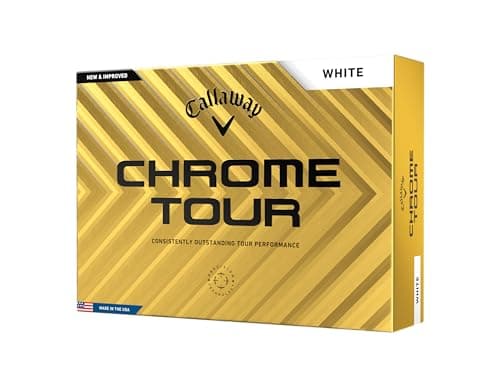
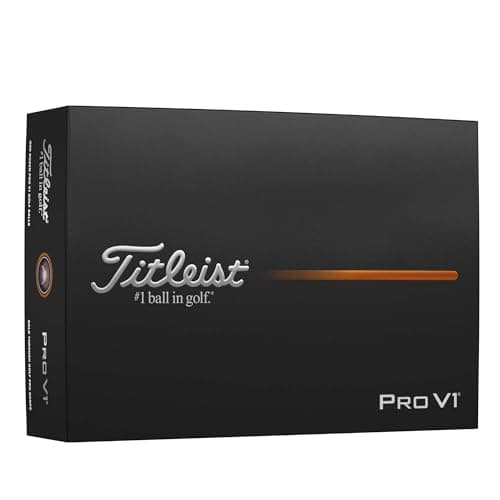
This is the tour-ball comparison worth running, and it is not the one most golfers think they are running. Callaway’s answer to the Titleist Pro V1 is not the Chrome Soft — that ball is built around soft feel and Callaway classes its own short-game spin as “high”, one notch below. The real rival is the Chrome Tour, a 4-piece urethane ball Callaway positions at maximumshort-game spin with a medium feel. Against the Pro V1’s three pieces and published 87 compression, that is a genuine difference in design philosophy, not a badge swap.
The honest verdict up front: for most golfers the Chrome Tour is the better buy, because it consistently sells for less per dozen than the Pro V1 while Callaway claims more greenside spin for it, and nobody playing to a mid handicap will find the gap between two premium urethane balls on their scorecard. The Pro V1 keeps the crown on two things that are real: cover durability and the fact that it is the one ball in golf whose behavior is universally understood, which matters more than it sounds if you have calibrated a short game around it.
Construction: three pieces against four
Both are cast urethane balls, which is the only line in this category that genuinely divides premium from the rest — urethane grips a wedge groove in a way ionomer cannot, and that is what you are paying for. Below the cover they are built differently, and both companies publish how.
The Pro V1 is a three-piece ball:a gradient rubber core that is softer at the center and firms toward the perimeter, a high-flex casing layer Titleist publishes as increasing ball speed and reducing spin from the tee, and a soft cast urethane elastomer cover inside a spherically-tiled 388 tetrahedral dimple pattern. The 2025 model runs Titleist’s Next Generation 2.0 ZG Process Core at a published 87 compression, slightly firmer overall than the model before it.
The Chrome Tour is a four-piece ball:a Hyper Fast Soft Core Callaway publishes as engineered for a better balance of long distance and soft feel, two mantle layers, and a High-Performance Tour Urethane Soft Cover inside Callaway’s Seamless Tour Aero dimple package. Callaway does not publish a compression number for it, so a direct firmness comparison against the Pro V1’s 87 is not available — and rather than guess, the honest description is Callaway’s own word for it: medium feel.
Does the extra layer matter? In principle yes, and in a specific way: an additional mantle gives a designer another lever to separate driver spin from wedge spin, which is the core problem of a tour ball. Low spin off a driver and high spin off a 56° wedge are contradictory demands, and more layers means more freedom to satisfy both. Whether you will feel it is a different question, and we are not going to claim we measured it — we have no lab and how we rank says so plainly. What we can report is what each company says it achieved.
What each company actually claims about spin
Callaway publishes a comparison chart across its own tour line, and it is the most useful single piece of evidence on this page because it is Callaway grading Callaway:
- Chrome Tour: medium feel, mid long-game spin, maximum short-game spin, 4-piece.
- Chrome Soft: soft feel, low long-game spin, high short-game spin, 3-piece.
- Chrome Tour X: medium-firm feel, mid long-game spin, high workability, 4-piece.
Read that and the positioning is unambiguous: within Callaway’s own range the Chrome Tour is the maximum-greenside-spin option, and Callaway states it is for “better players” chasing aggressive greenside performance with added spin through the bag and tour-level feel.
Titleist does not publish a comparable grid, but the Pro V1’s own description is consistent and has been for twenty years: a soft cast urethane elastomer cover delivering outstanding spin around the greens, with the casing layer specifically there to keep driver spin down. The Pro V1 is the lower-spinning, more penetrating of the two Titleist tour balls; the Pro V1x is the higher-flighted, higher-spinning one, and if you want that comparison we have it in Pro V1 vs Pro V1x.
So the fair summary is: both are maximum-category urethane balls, and Callaway claims the greenside edge in a document it wrote itself. Treat that as a strong indication rather than a measurement, and treat anyone quoting you exact RPM differences between two tour balls without a launch monitor in the room with some suspicion.
Price: the part that actually decides it
Here is where this comparison stops being close. In the current market the Chrome Tour sits a clear bracket below the Pro V1 per dozen, and that gap is the single most consequential number on this page — not because a few dollars matters, but because of how golf balls are consumed. Check the live prices on the cards above; both move, and both run promotions.
The math that matters is cost per round, not cost per dozen. If you lose three balls a round — a realistic number for a 12-to-18 handicap on a course with water — you are buying roughly a dozen every four rounds. Over a 40-round season that is ten dozen, and the price gap between these two multiplies by ten. At that point you are not choosing between two balls, you are choosing between a ball and a set of wedges. Our are expensive golf balls worth it guide works that arithmetic through properly.
The one counter-argument for the Pro V1 on cost is durability, and it is legitimate: the Pro V1 cover holds up better than most urethane covers before it scuffs, which matters if you retire balls on cosmetics rather than losing them. If you keep a ball for three rounds, a tougher cover genuinely narrows the price gap.
Which should you play?
- Play the Chrome Tour if you want maximum greenside spin, you are comfortable with a medium rather than a soft feel, and you would rather not pay the Pro V1 premium out of habit. This is the recommendation for most readers of this page.
- Play the Pro V1 if your short game is genuinely calibrated to it, you keep balls for multiple rounds and value cover durability, or you simply want the default and do not want to think about it again. None of those is a bad reason.
- Play neither if you shoot north of 90 and lose more than a sleeve a round. You are paying tour-ball money for spin your swing cannot unlock, and then hitting it into a pond. Our best golf balls under $30 a dozen roundup is the honest page for you, and the golf ball selector will match a ball to your swing speed in four questions.
One last practical note. Both of these balls are sold in multiple models with near-identical names — Pro V1 and Pro V1x, Chrome Tour and Chrome Tour X — and the X version of each is the firmer, higher-spinning sibling aimed at a different player. Read the sleeve, not the badge.
How to test two tour balls without a launch monitor
You can settle this for yourself in about twenty minutes, and the test is more reliable than any review including this one, because it uses your swing instead of someone else’s.
Buy one sleeve of each, not a dozen. Three balls of each is enough, and it costs a fraction of guessing wrong on two dozen.
Test the short game first, and only the short game. Full-swing differences between two premium urethane balls are small and swamped by your own variability. Greenside differences are the ones you can actually perceive. Hit twenty pitch shots of each from around 30 yards to the same flag and watch the second bounce: that is where cover and mantle construction show up, and it is the thing Callaway claims an advantage in.
Then putt them. Feel off the putter face is the most underrated difference between balls and the easiest to judge, because it needs no distance control at all. If one of the two sounds and feels wrong to you on a six-footer, that is a real finding and it should decide the purchase regardless of what any chart says.
Ignore driver distance entirely.It is the one place your perception will mislead you most, and the difference between two tour balls off the tee is inside the noise of your own strike quality. If you want that number properly, you need a launch monitor and 20 balls of each — our launch monitors under $1,000 roundup covers the devices that can actually resolve it.
And pick on compression only if you know your swing speed.The Pro V1’s published 87 is a real number, the Chrome Tour’s is not published, and neither is useful to you in isolation — compression explained covers what the figure does and does not tell you.