Skip to content
Divot&Draw

The Sticks · Golf Clubs

Callaway vs TaylorMade Irons

Two companies chasing the same golfer with two different arguments: Callaway sells you a face built from swing data, TaylorMade sells you a face built to stop curving. Four sets compared on published specs and live prices.

By Stephen V.Updated How we rank
#ad

We earn a commission when you buy through our Amazon links, at no extra cost to you. It never changes our rankings — and we'll tell you when the cheaper ball or club is the better buy. How this works.

Callaway and TaylorMade sell irons to the same person — a golfer who wants more distance and more forgiveness and does not want to look like they bought a shovel — and they argue for it in genuinely different ways. Callaway’s pitch is data: a face shaped by the pre-impact swing numbers of thousands of real golfers. TaylorMade’s current pitch is dispersion: a face deliberately tuned to shed the cut spin that fast faces create, so the ball curves less. Those are not marketing synonyms. They point at different misses, and that is the actual answer to “which brand should I buy”.

The honest short answer first. If you are buying today and value matters, Callaway wins— the previous-generation Paradym Ai Smoke is the same idea as Callaway’s current set for a few hundred dollars less, and it is the best buy of the four sets here. If gapping matters more than price, TaylorMade wins— the Qi Max is the only one of the four whose published pitching wedge is sane and which ships you the approach wedge that fills the gap below it. Everything after this is the reasoning.

One note on how this page is built, because brand comparisons are usually rigged by release date. We compare current against current (Callaway Elyte vs TaylorMade Qi Max) and previous against previous (Callaway Paradym Ai Smoke vs TaylorMade Qi). Putting a 2025 Callaway against a 2024 TaylorMade would tell you about model years, not about the two companies. If you want the field ranked by suitability rather than by brand, our best irons for mid-handicappers roundup includes Mizuno and Wilson in the same conversation, and best game-improvement irons covers the more forgiving end.

What each brand is actually claiming

Read the two companies’ own words and the difference is clear. Callaway publishes the Ai Smart Face as optimizing performance from the pre-impact swing data — speed, delivery, face orientation — of thousands of real golfers, and positions the Paradym Ai Smoke for players with average to high swing speeds “looking to maximize distance and improve dispersion”. The current Elyte is published for golfers “seeking distance and consistency” with “average to faster swing speeds”. In both cases the headline benefit is ball speed retention across the face, with dispersion listed second.

TaylorMade inverts that order in the Qi Max. Its published face claim is unusually specific: the patented face technology “controls face flexibility to reduce cut spin that can result from fast face iron designs, allowing golfers to experience straighter shots throughout the entire set”. Read that literally and TaylorMade is admitting something the category normally hides — that a very fast, very flexible iron face can add sidespin on an off-center strike, and that the fix costs a little of the speed everyone else is advertising. The previous Qi made a different argument again: the Cap Back Design with Toe Wrap Construction, which TaylorMade describes as blending “the advantages of a hollow-body iron with those of a traditional cavity back”.

So: Callaway is selling you speed that holds up when you miss the middle. TaylorMade is selling you a ball that curves less when you miss the middle. If your bad shots are short and weak, lean Callaway. If your bad shots are long and sideways, lean TaylorMade. That is a more useful split than any brand loyalty, and it is the one thing on this page the two companies will tell you themselves.

Lofts and set composition: where the real difference lives

Specs settle more of this than technology names do, and the numbers below are both brands’ own published figures, not ours. Through the middle of the set the two companies are within a degree of each other — Callaway Elyte 22° 5-iron, 29° 7-iron; TaylorMade Qi Max 21° 5-iron, 28° 7-iron. Nobody is going to feel that. The difference that matters is at the bottom.

  • Callaway Elyte:published 42° pitching wedge, 47° approach wedge — but the Amazon listing we link is the 6-club 5-PW build, so the 47° is a club you buy separately.
  • TaylorMade Qi Max:published 42.5° pitching wedge and 48° approach wedge, and the listing we link is the 7-club 5-PW+AW build— the approach wedge is in the box.
  • Callaway Paradym Ai Smoke:published 42° pitching wedge on a 6-club 5-PW listing. Same gap, same fix required.
  • TaylorMade Qi:published 43° pitching wedge with the approach wedge included — the strongest pitching wedge of the four, which is where its distance number comes from.

This is the single most expensive detail on the page and almost nobody mentions it. A 42° pitching wedge is roughly a 9-iron loft from twenty years ago. If your sand wedge is 56°, a 42° pitching wedge leaves a fourteen-degree hole in your bag, which is two clubs’ worth of distance you simply cannot hit. Both TaylorMade listings here hand you the 48° club that closes half of it. Both Callaway listings do not, and a single matching approach wedge is a real cost on top of the set price. Factor it in before you decide which brand is cheaper — our wedge roundup covers what to put in the gap.

Price: the comparison nobody runs honestly

Brand comparisons usually compare list prices, which is useless, because iron sets spend most of their lives discounted. The prices on this page are live from Amazon and they tell a consistent story across both brands: the previous generation is the buy, and Callaway’s previous generation is discounted harder than TaylorMade’s.

In rough brackets, as of this writing: the Paradym Ai Smoke sits in the upper-$600s, the Qi and the Elyte sit in the upper-$800s, and the Qi Max sits at four figures. That spread is wider than any performance difference between the four heads. Buying the Ai Smoke over the Qi Max is not a compromise — it is the same category of iron, one model year older, from a company making the same argument it made last year, for roughly two thirds of the price. Check the live numbers on the cards above before you act on any of this; these sets move.

The counter-argument for buying current is real but narrow. A current set holds resale value longer, is easier to extend with a matching single iron in two years, and is the one sitting in a fitter’s demo rack if you want to hit it before you commit. If those matter to you, buy the Elyte or the Qi Max and do not feel talked out of it. If they do not, you are paying a few hundred dollars for a model year.

Head to head: Elyte vs Qi Max (current)

Between the two current sets, the Qi Max is the better-specified set and the Elyte is the better-priced one, and both statements are solid.

The Qi Max ships seven clubs including the 48° approach wedge, on a KBS Max 85 MT steel shaft, with the straightness-first face claim and FLTD CG — a center of gravity placed lowest in the long irons and progressively higher through the scoring clubs. That last one is a genuinely correct answer to the real complaint about forgiving irons: the 5-iron will not climb and the 9-iron flies too high and goes nowhere. Moving the center of gravity through the set addresses both ends with one design decision.

The Elyte answers with a lower list price than the set it replaced — unusual, and worth saying out loud in a category where every launch costs more than the last — Callaway’s True Temper Vector 90 stock steel shaft, and a slightly weaker 29° 7-iron that gaps a touch more predictably into a wedge than the Ai Smoke it replaced. Against that: six clubs, not seven, and no approach wedge in the box.

Verdict:if you will buy a matching approach wedge anyway, the two sets land close and price decides it — Elyte. If you want the set to be complete out of the box and the gapping to be right without a second purchase, Qi Max, and accept that you are paying for the privilege.

Head to head: Paradym Ai Smoke vs Qi (previous generation)

This is the matchup most readers of this page should actually be deciding, because it is where the money is. Both are 2024 sets, both are still widely stocked, and both are discounted.

The Qi is the more interesting piece of engineering. Cap Back Design with Toe Wrap Construction replaces the steel back with a composite badge, borrowing the hollow-body recipe for a players-distance feel at a game-improvement price, with a Speed Pocket through the sole and per-iron HYBRAR Echo dampers aimed squarely at the two things golfers complain about in forgiving irons — a dead low strike and a clicky sound. It also ships the approach wedge.

The Ai Smoke is the better buy anyway, on price. It is Callaway’s Ai Smart Face generation, published for average-to-high swing speeds looking to maximize distance and improve dispersion, on a True Temper Elevate 95 MPH stock steel shaft with an all-new Dynamic Sole Design — a pre-worn leading edge and variable bounce, which is a real help on a fat strike from a tight lie. And it currently sits a clear bracket below the Qi.

Verdict:Ai Smoke, unless the 43° pitching wedge and included approach wedge of the Qi fit your existing wedge setup better — in which case buy the Qi and consider the difference the price of not having to re-gap your bag.

Which brand should you buy?

Neither company is better than the other at making irons, and anyone telling you otherwise is selling something. What they are is differently biased, and you can use that:

  • Buy Callaway ifyour miss is short and thin, you want the hardest discount available on a current-adjacent set, and you already own or will buy the wedge that fills the gap under a 42° pitching wedge.
  • Buy TaylorMade if your miss is a slice or a pull that curves, you want a complete, correctly gapped set out of one box, and you are willing to pay a model-year premium for it.
  • Buy neither ifyou are a high-handicapper still making heel-and-toe strikes most swings. Both of these families are game-improvement sets with real heads; the more forgiving option is a wider, more offset design — see best irons for beginners.

The short answer

Quick picks

#ProductBest forScorePrice
01
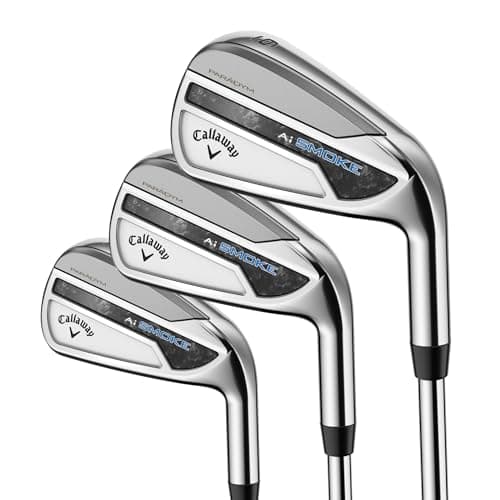
Callaway Callaway Paradym Ai Smoke Irons (Right Hand, 5-PW, Steel, Regular)
Callaway Paradym Ai Smoke Irons (Right Hand, 5-PW, Steel, Regular)

Last year's Callaway flagship at a real discount — the Ai Smart Face and the pre-worn Dynamic Sole, one generation behind the Elyte and priced like it.

The value buy from a major brand
8.0
$685.68Amazon
02
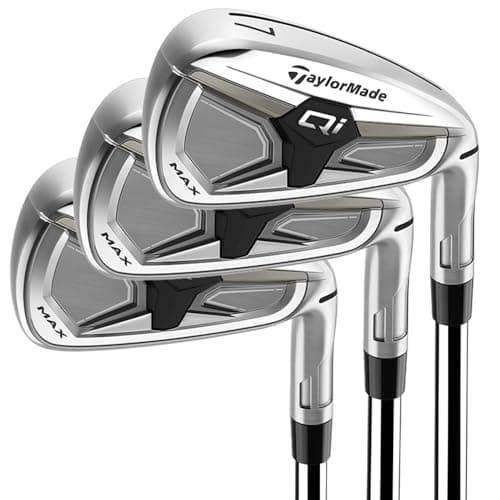
TaylorMade TaylorMade Qi Max Irons (5-PW+AW, Steel, Regular)
TaylorMade Qi Max Irons (5-PW+AW, Steel, Regular)

TaylorMade's current game-improvement set, and the straightest-hitting idea in this comparison: the face is deliberately tuned to shed cut spin rather than chase one more yard.

TaylorMade's current set, built around straightness
7.6
$1,077.99Amazon
03
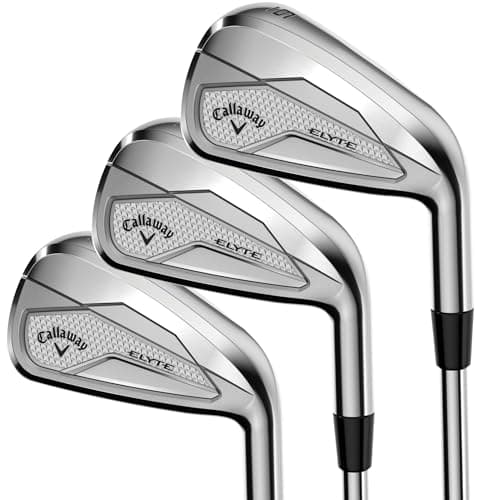
Callaway Callaway Elyte Irons (Right Hand, 5-PW, Steel, Regular)
Callaway Elyte Irons (Right Hand, 5-PW, Steel, Regular)

The current-generation pick: Callaway's newest iron set, with a slightly weaker middle-iron loft spread than the Ai Smoke it replaced and a list price that is lower, not higher.

Buying the current model
7.6
$849.99Amazon
04
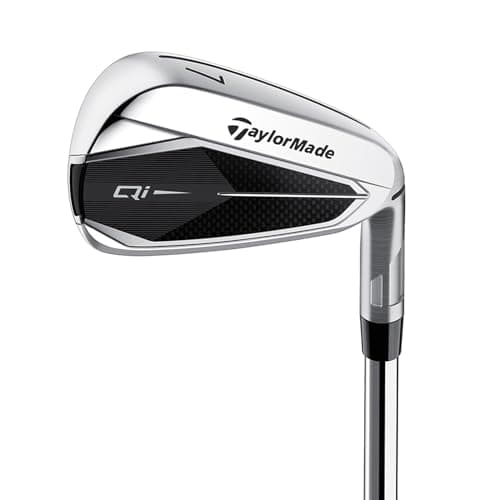
TaylorMade TaylorMade Qi Irons (5-PW+AW, Steel, Regular)
TaylorMade Qi Irons (5-PW+AW, Steel, Regular)

A players-distance construction at a game-improvement price: the Cap Back Design borrows the hollow-body recipe, and the 2024 model now sells below its own list.

Forgiveness without a game-improvement look
7.8
$899.00Amazon

#ad · Live prices from the Amazon Product API, as of October 9, 2026. Where we have no verified live price, we show none — we would rather leave a gap than print a number that has rotted.

In detail

The picks, in full

01
Callaway Callaway Paradym Ai Smoke Irons (Right Hand, 5-PW, Steel, Regular)

The value buy from a major brand

Callaway Paradym Ai Smoke Irons (Right Hand, 5-PW, Steel, Regular)

6 clubs, 5-iron to pitching wedge (this listing)Ai Smart Face (Callaway)Dynamic Sole Design, pre-worn leading edge22° 5-iron, 28° 7-iron, 42° PW; 2024 model
8.0/10

Last year's Callaway flagship at a real discount — the Ai Smart Face and the pre-worn Dynamic Sole, one generation behind the Elyte and priced like it.

Forgiveness
8
Distance
8
Feel
8
Playability
7
Value
9

Pros

  • Callaway describes them as best suited to golfers with average to high swing speeds looking to maximize distance and improve dispersion — a mid-handicapper's description — and because this is the previous generation, the live price on the card sits well under the list it launched at
  • The Ai Smart Face was designed from the swing data of thousands of real golfers rather than one tour profile, and the Dynamic Sole Design's pre-worn leading edge with variable bounce is the turf help that matters when your strike moves around
  • Longer blade lengths with a thinner topline and optimized sole widths: a genuinely forgiving head that does not look like a beginner's iron, which is most of why mid-handicappers buy Callaway

Cons

  • Previous generation — Callaway's current iron is the Elyte, so compare both live prices; the Ai Smoke is only the value play while the gap is real
  • A 6-club 5-PW build with no gap wedge, so you will need to buy or already own the club between the pitching wedge and your sand wedge

Skip this if…

…you want the current model, or you don't already own a gap wedge. The Elyte that replaced this set is a modest step rather than a reinvention, but if the discount closes, buy the current one — and if there's a hole under your pitching wedge, the 7-club sets on this page are better value.

$685.68View on Amazon

Price as of October 9, 2026. Prices change — Amazon's is the one that counts.

#ad · we may earn a commission from this link to Callaway Paradym Ai Smoke Irons (Right Hand, 5-PW, Steel, Regular)

02
TaylorMade TaylorMade Qi Max Irons (5-PW+AW, Steel, Regular)

TaylorMade's current set, built around straightness

TaylorMade Qi Max Irons (5-PW+AW, Steel, Regular)

7 clubs, 5-iron to approach wedge (this listing)ECHO Damper + internal stability bar (TaylorMade)KBS Max 85 MT steel, regular flex21° 5-iron, 28° 7-iron, 42.5° PW, 48° AW
7.6/10

TaylorMade's current game-improvement set, and the straightest-hitting idea in this comparison: the face is deliberately tuned to shed cut spin rather than chase one more yard.

Forgiveness
9
Distance
8
Feel
8
Playability
7
Value
6

Pros

  • TaylorMade's published pitch for the face is unusual and worth reading literally: it 'controls face flexibility to reduce cut spin that can result from fast face iron designs, allowing golfers to experience straighter shots throughout the entire set' — a distance iron sold on dispersion, not ball speed
  • FLTD CG puts the center of gravity lowest in the long irons and higher through the scoring clubs, which is the correct answer to the real mid-handicap problem: a 5-iron that won't get up and a 9-iron that flies too high
  • A 42.5° pitching wedge with a 48° approach wedge in the box — the most sensible gapping of the four sets compared here, and the only one that ships you the club that fills the gap

Cons

  • The most expensive set in this comparison by a clear margin, and it is the newest, so there is no discount cycle working in your favor yet
  • The near-identical Qi Max HL sits on Amazon at the same list price with lofts three degrees weaker — easy to buy the wrong one, and the HL is the better fit if your 5-iron already flies low

Skip this if…

…you are shopping on value. Last season's Qi is the same company's take on the same golfer for several hundred dollars less, and the gap between them will not show up on your card. Buy the Qi Max because you want a current set with sane gapping, not because it will score better.

$1,077.99View on Amazon

Price as of October 9, 2026. Prices change — Amazon's is the one that counts.

#ad · we may earn a commission from this link to TaylorMade Qi Max Irons (5-PW+AW, Steel, Regular)

03
Callaway Callaway Elyte Irons (Right Hand, 5-PW, Steel, Regular)

Buying the current model

Callaway Elyte Irons (Right Hand, 5-PW, Steel, Regular)

6 clubs, 5-iron to pitching wedge (this listing)Callaway's current iron line (2025)True Temper Vector 90 steel, Lamkin Crossline grip22° 5-iron, 29° 7-iron, 42° PW; 2025 model
7.6/10

The current-generation pick: Callaway's newest iron set, with a slightly weaker middle-iron loft spread than the Ai Smoke it replaced and a list price that is lower, not higher.

Forgiveness
8
Distance
8
Feel
8
Playability
7
Value
7

Pros

  • It is the current model, which matters more than it sounds: current sets hold value longer, are easier to extend with a matching single iron later, and are the ones sitting in a fitter's demo rack
  • Callaway publishes these as being for golfers seeking distance and consistency with average to faster swing speeds, and the loft spread (22° 5-iron, 29° 7-iron, 42° PW) is a touch weaker through the middle than the Ai Smoke's, which gaps more predictably into a wedge
  • Callaway launched it at a lower list price than the set it replaced, so the new-model premium here is smaller than the category norm

Cons

  • You pay current-generation money for a modest change over the Ai Smoke ranked above it; on pure value, last year's set is the better buy while the discount lasts
  • Another 6-club 5-PW build with no gap wedge, and Callaway's published stock steel shaft for the family is the True Temper Vector 90 — check the flex on the listing matches the one you play

Skip this if…

…value is your first criterion. The Ai Smoke it replaced is the same idea for less, and the difference between them will not show up in your scores — buy the Elyte because you want a current set, not because you expect it to perform differently.

$849.99View on Amazon

Price as of October 9, 2026. Prices change — Amazon's is the one that counts.

#ad · we may earn a commission from this link to Callaway Elyte Irons (Right Hand, 5-PW, Steel, Regular)

04
TaylorMade TaylorMade Qi Irons (5-PW+AW, Steel, Regular)

Forgiveness without a game-improvement look

TaylorMade Qi Irons (5-PW+AW, Steel, Regular)

7 clubs, 5-iron to approach wedge (this listing)Cap Back Design + Toe Wrap ConstructionSpeed Pocket through the sole (TaylorMade)21° 5-iron, 28° 7-iron, 43° PW; 2024 model
7.8/10

A players-distance construction at a game-improvement price: the Cap Back Design borrows the hollow-body recipe, and the 2024 model now sells below its own list.

Forgiveness
8
Distance
9
Feel
8
Playability
7
Value
7

Pros

  • TaylorMade describes the Cap Back Design with Toe Wrap Construction as blending the advantages of a hollow-body iron with those of a traditional cavity back, replacing the steel back with a composite badge — a players-distance feel with a game-improvement iron's help
  • The live price on this 2024 set runs well below the list TaylorMade launched it at, which makes it the best-value flagship here after the Callaway Ai Smoke
  • The Speed Pocket and the per-iron HYBRAR Echo dampers target the two complaints mid-handicappers make about forgiving irons: a dead low strike and a clicky sound

Cons

  • Superseded — TaylorMade ran the Qi for two seasons and replaced it with the Qi Max for 2026, so check both live prices before committing
  • A 43° pitching wedge is the strongest in this group, which is where the extra distance comes from; the included approach wedge is doing real work and you will still want to check the gap below it

Skip this if…

…you want the current model, or your wedges are already gapped tight. The Qi Max supersedes this set, and a 43° pitching wedge plays closer to a 9-iron than the number suggests — a weaker-lofted set like the Mizuno slots into an existing wedge setup more easily.

$899.00View on Amazon

Price as of October 9, 2026. Prices change — Amazon's is the one that counts.

#ad · we may earn a commission from this link to TaylorMade Qi Irons (5-PW+AW, Steel, Regular)

The cost of the brand decision, in numbers you can check

The brand question is usually argued on feel. Here is the arithmetic instead, because the money in this decision is not where buyers think it is.

The set price gap is the small number.Across the four sets here, the spread between the cheapest and the most expensive is roughly one bracket — upper-$600s to four figures. Real, but a one-off.

The gapping gap is the sneaky number.A matching approach wedge from either brand is a meaningful fraction of the set price. Both Callaway listings on this page are 5-PW builds, so that purchase is coming. Both TaylorMade listings include the approach wedge. Add the wedge to the Callaway price and the brands land closer together than the shelf suggests — which is the real reason we rank the Ai Smoke first rather than declaring Callaway the cheaper brand outright.

The shaft gap is the number to not get wrong. Every listing here is a specific build: a hand, a set composition, a shaft material and a flex. The Qi Max listing we link is right-handed, steel, regular, 5-PW+AW. A near-identical Qi Max HL exists at the same list price with lofts three degrees weaker, and a stiff-flex Qi Max exists at the same price too. Callaway ships an Ai Smoke HL alongside the standard set. Buying the wrong sibling is the most common and most annoying failure in this category, because the box arrives looking correct. Read the full title on the listing, not the brand and model.

What a fitting is worth here.Nothing on this page replaces hitting both. If there is a fitter within reach, the single most valuable thing you can do is test the Elyte and the Qi Max back to back and watch dispersion rather than carry distance — that is precisely the axis the two companies differ on, and it is the one a launch monitor shows you in ten swings. Our launch monitor roundup covers doing that at home, and how much to spend on golf clubs puts the whole purchase in the context of the rest of the bag.
How we ranked this

We don't run a testing lab — and we say so

We compiled published manufacturer specifications, official standards and aggregated owner reviews, computed the running costs the big test-labs leave out, and scored each pick against a published rubric. The scores are judgments from documented research — they are not lab measurements we took, because we don't have a lab and we're not going to pretend we do. You can check every number we publish.

Questions

Frequently asked

Are Callaway or TaylorMade irons better?
Neither is better; they are aimed at different misses, and both companies say so in their own published copy. Callaway leads on ball speed retention across the face, which helps a thin or heel strike that comes up short. TaylorMade’s current Qi Max leads on reducing cut spin so off-center strikes curve less, which helps a slice or a pull. Choose on your miss rather than the badge. On value, Callaway’s previous generation is discounted harder, so the best buy of the four sets here is the Paradym Ai Smoke.
Should I buy the current model or last year's irons?
Last year's, for almost everyone. Both brands follow the same cycle: a new iron set lists near four figures, then falls by roughly a third once its successor ships. The heads are not meaningfully different year to year — the Elyte replaced the Paradym Ai Smoke with a slightly weaker middle-iron loft spread, and Callaway launched it at a lower list price, not a higher one. Buy current only if you care about resale value, want to extend the set with a matching single iron in a couple of years, or want to hit it in a fitter's demo rack first.
Do Callaway and TaylorMade iron sets include a gap wedge?
It depends on the listing, not the brand, and this is the detail that costs buyers the most money. Both TaylorMade listings compared here are 5-PW plus approach wedge builds, so the 48°-ish club is in the box. Both Callaway listings are 5-PW builds, so it is not. With a published 42° pitching wedge and a typical 56° sand wedge, that leaves a fourteen-degree hole you cannot hit — so budget for a matching wedge when you price a Callaway set, or use our wedge roundup to fill it.
What is the difference between TaylorMade Qi Max and Qi Max HL?
Loft, mostly — the HL spec runs about three degrees weaker through the set, which raises launch and carry for slower swing speeds. The two sit on Amazon at the same list price with near-identical titles, so they are easy to confuse. If your 5-iron and 6-iron already fly low and land flat, the HL is the better fit; if your long irons climb fine, the standard Qi Max is. Read the full listing title before you buy.
Which irons have the stronger lofts, Callaway or TaylorMade?
TaylorMade, narrowly, and only in the previous generation. The 2024 Qi's published pitching wedge is 43°, the strongest of the four sets here; the Qi Max's is 42.5° and both Callaway sets are 42°. Stronger lofts produce longer numbers on a launch monitor and a bigger wedge gap in your bag — it is a trade, not an upgrade. The middle-iron lofts across all four sets are within a degree of each other, so nothing there will be noticeable.

Keep reading

Receipts

Sources

We do not run a testing lab, and we do not pretend to. Every spec number here comes from a manufacturer's published sheet or an official standard, cited above. Where we could not verify something, we say so on the page rather than quietly leaving it out. Read our full method.