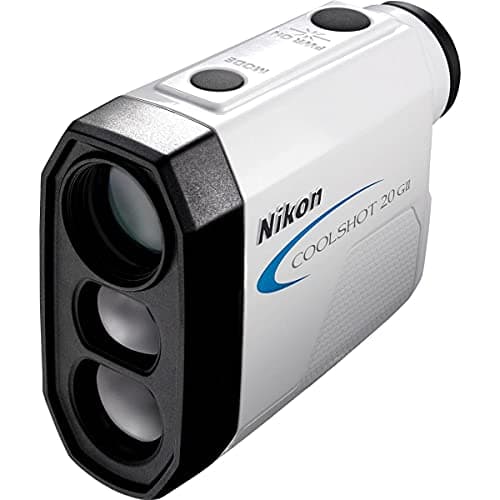
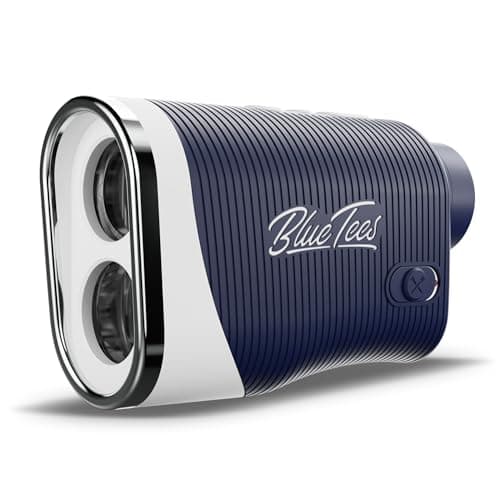
Two value 6x lasers that both put an accurate number on the flag, built around opposite philosophies about slope. The Blue Tees Series 3 Max+is the do-it-all value pick — a genuine slope switch you flip off for the rules, built-in magnetic plates and a pulse on a locked reading. The Nikon Coolshot 20 GII takes slope out of the equation entirely: it has none, which makes it always tournament-legal, and it spends its money on being tiny, light and optically clean instead. Both read to the flag; the question is whether you want elevation help you can switch off, or a laser with nothing to switch off at all. Check the live prices above, then match the trade-off to your golf.
What both share
The core is the same on each. Both are laser rangefinders, so both measure the exact distance to whatever you aim at — the flag, a bunker, a carry — rather than to a mapped green like a GPS. Both use 6x magnification, which is plenty for real golf distances, and both have honest, capable optics: Nikon’s multilayer-coated lenses and Blue Tees’ 6x glass each give a bright, usable view. Both are laser-simple in the ways that count — no course database, no subscription, no yearly fee — and both sit firmly at the value end of the market, well below a premium Bushnell. On the fundamental job of an accurate number to the flag, they’re level. Everything that separates them comes down to one design choice: slope, and the magnet and size that follow from how each brand spent its budget.
Choose the Blue Tees Series 3 Max+ if…
You want elevation help for casual rounds and the small conveniences, and you’re happy to switch slope off when it counts. The Series 3 Max+’s calling card is a genuine slope switch: flip it on and you get a “plays like” number for uphill and downhill shots, which is genuinely useful on a hilly course; flip it off with the external switch and the laser is a legal, distance-only unit for competition. It also adds built-in magnetic plates that hold it to a cart bar — rare at this price — and a pulse when it takes a reading. For a golfer who plays mostly casual golf on undulating courses and likes a laser that parks on the cart rail, it’s the more featured pick, and our full Blue Tees Series 3 review covers it in detail.
Choose the Nikon Coolshot 20 GII if…
You play competition, want zero rules risk, and value a laser you can genuinely pocket. Because the Nikon has no slope feature at all, it’s always tournament-legal — nothing to switch off, nothing to forget on the first tee, no chance of an accidental breach — which is real peace of mind a switchable laser can’t quite match. It’s also one of the smallest and lightest lasers here at a listed 4.6 oz, easy to drop in a pocket, and its multilayer-coated 6x optics with First Target Priority give a clean read that favors the flag over the trees behind it. You give up any elevation help and the magnet, but you get an honest, always-legal number to the flag from a genuinely compact body. Our full Nikon Coolshot 20 GII review covers it on its own.
How they actually differ
Three things separate them, and none is basic accuracy. The first, and the whole point, is slope: the Blue Tees has switchable elevation adjustment for casual rounds; the Nikon has none at all. That single choice cascades into everything else. The second is rules simplicity: the Nikon is always legal with nothing to disable, while the Blue Tees is legal only once you’ve switched slope off — easy, but a step you have to remember. The third is mounting and size: the Blue Tees has built-in magnetic plates to stick it to a cart bar but a slightly larger body, where the Nikon has no magnet but is smaller and lighter and drops into a pocket. So the Blue Tees buys features — slope, a magnet, a pulse — and the Nikon buys subtraction: no slope, no magnet, less to carry and nothing to think about on competition day.
Slope, and staying legal
This is where the two philosophies meet the rulebook, so be precise. Under Rule 4.3, using a slope or elevation feature in a counting round is a breach — so a slope laser is legal in competition only with the feature switched off. The Blue Tees handles that cleanly with its external switch: elevation help in casual play, a legal distance-only mode when it counts, all in one unit — but the legality depends on you remembering to flip it. The Nikon sidesteps the question entirely by having no slope to begin with: it’s always legal, so there’s nothing to switch and nothing to forget. If your golf is mostly casual and you want the “plays like” number, the Blue Tees’ switch is the feature; if you play events and want the least to think about, the Nikon’s missing slope is the feature. Either way, confirm your committee allows distance devices first — the full rule is in are rangefinders legal, and what slope actually calculates is in what is slope on a rangefinder.
Skip the decision entirely if…
You want the steadiest possible view because your hands shake on the lock — because neither of these has stabilization, and the stabilized TecTecTec ULT-S Pro fixes exactly that problem, weighed against the Blue Tees in ULT-S Pro vs Blue Tees Series 3. Skip both, too, if you want the crispest glass and the most decisive lock at range — that’s where a premium Bushnell pulls ahead, ranked in the best rangefindersroundup. And skip the laser question entirely if you’d rather glance at your wrist for the whole green than aim at the flag — that’s a job for a GPS from the best GPS watches roundup.
The honest verdict
Buy the Blue Tees Series 3 Max+ if you play mostly casual golf, want elevation help you can switch off, and like the magnet for the cart bar — it’s the more featured value laser, and the slope switch keeps it legal when you need it to be. Buy the Nikon Coolshot 20 GII if you play competition, want a laser that’s always legal with nothing to remember, and value a small, pocketable body with clean optics — its missing slope is a deliberate strength, not a gap. Both put the right number on the flag at a value price; the Blue Tees adds features, the Nikon removes complications. Decide whether elevation help or zero rules risk matters more for the golf you actually play, and the choice is clear.