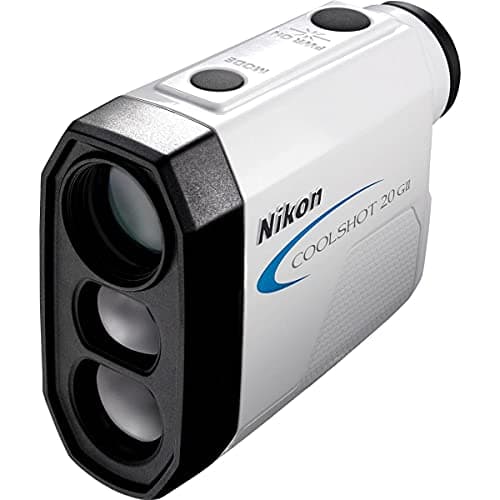
The Nikon Coolshot 20 GII is the laser for the golfer who wants a clean, accurate number to the flag and nothing to think about — no slope to switch, no menu to learn, no rule to worry about on the first tee. It’s the tiny, no-slope Nikon: always tournament-legal because there’s no elevation feature to disable, genuinely pocketable at a listed weight of roughly 4.6 oz, and fitted with the multilayer-coated 6x optics you’d expect from the name. It is deliberately bare-bones, and that is either exactly what you want or a dealbreaker — this review is about telling those two golfers apart.
What it is
Strip a rangefinder back to its essentials and you get something close to the Coolshot 20 GII. It’s a compact laser with 6x magnification and Nikon’s multilayer-coated glass, and its defining choice is a subtraction: it has no slope function at all. Where most modern lasers add an elevation-adjusting mode you must remember to switch off for competition, the Coolshot simply doesn’t have one, which is what makes it always tournament-legal. Nikon’s First Target Priority helps it favor the flag over the trees behind it — the near target rather than the far — and the whole thing is one of the smallest and lightest lasers you can buy, listed at roughly 4.6 oz. There’s no magnetic mount and no slope switch, because there’s nothing to mount for and nothing to switch.
Where it shines
Its greatest strength is the thing it leaves out. Because there’s no slope feature, there’s nothing to disable before a counting round — no switch to flip, no mode to check, no risk that you forget and breach a rule you didn’t mean to. For a competitive golfer, or simply anyone who’d rather not think about the rules, that’s genuine peace of mind a switchable-slope laser can’t quite match. The Coolshot is legal wherever a committee allows distance-measuring devices, straight out of the box, every round.
The rest of what it does well follows from being small and clean. At a listed 4.6 oz it’s one of the most pocketable lasers here — the kind you barely notice in a jacket or a bag pocket — and Nikon’s multilayer-coated 6x optics give a bright, clear view for the distances you actually play. First Target Priority is the sensible extra: it favors the nearer object, so a thin flagstick is more likely to register than the tree line behind it. And because it’s a laser, there’s no course database to buy and no subscription to renew — you point it at the target and it reads, the same on any course in the world, with no yearly fee attached.
Where it falls short
The Coolshot’s limits are the flip side of its simplicity, and they’re real. First, no slope means no elevation help — on a steep uphill approach or from an elevated tee, it gives you the straight-line distance and leaves the “plays like” math to you. That’s a deliberate trade for always-legal simplicity, but if you play hilly courses casually and would use elevation help, it’s a feature you’ll miss. Second, there’s no magnetic mount to park it on a cart bar between shots, and its weatherproofing is Nikon’s IPX4 rating — rainproof enough for a shower, not full waterproofing. And it doesn’t chase the premium extras at all: no lock-confirmation jolt, no 7x glass, none of the compensated-distance refinements a flagship stacks on. None of that is a defect; it’s the shape of a deliberately minimal laser.
Slope, and staying legal
The Coolshot’s whole rules story is that it doesn’t have one. Under Rule 4.3, using a slope or elevation feature in a counting round is a breach — which is exactly why switchable-slope lasers make such a fuss of their off switch. The Coolshot removes the question: with no slope function to begin with, there’s nothing to switch off and nothing to forget, so it’s always legal for distance measurement wherever devices are permitted. The catch is the other side of the same coin — you never get elevation help, even in a casual round where it would be perfectly allowed. If your golf is mostly competitive, that’s a feature, not a bug; if it’s mostly casual on hilly courses, it’s the reason to look at a switchable-slope laser instead. The full rule is in are rangefinders legal.
Who should buy it
Buy the Coolshot 20 GII if you want a simple, accurate, always-legal laser and you don’t care about slope. That’s a real and common golfer: the competitor who wants zero rules risk, the player who only wants a clean number to the flag, and anyone who values a genuinely pocketable laser they can carry without thinking about it. For that golfer the subtraction is the appeal — nothing to configure, nothing to switch, nothing to forget — and Nikon’s clean 6x optics and First Target Priority mean the core job is done well. It’s ranked among the value field in our best budget rangefinders roundup.
Who should skip it
Skip it if you want slope for practice or the hilly courses you play casually — because the Coolshot deliberately omits it, and a switchable-slope laser gives you both modes in one unit, elevation help on the range and a legal distance-only mode when it counts. Skip it, too, if you want the premium extras: a magnetic cart-bar mount, a lock-confirmation jolt, or the crispest glass and fastest lock at long range are what a premium laser adds, and the Coolshot doesn’t try to. And if what you actually want is a wrist-glance and the whole green at once rather than a pinpoint number to the pin, a GPS watch is the different tool — the full laser field, budget and premium, is ranked in the best rangefinders roundup.
The verdict
The Nikon Coolshot 20 GII is the honest answer to a specific want: a small, accurate, always-legal laser with nothing to manage. If that’s you, it’s an easy recommendation and does its one job cleanly. If you want slope for casual hilly rounds, a magnet, or premium optics, it’s the wrong laser by design — a switchable-slope value laser gives you more for a little more money. Decide whether always-legal simplicity or elevation help matters more, and the Coolshot either is or isn’t your laser. We base this on Nikon’s published specifications and aggregated owner feedback — we don’t run a test lab.
No slope: is the subtraction right for you?
The single decision with the Coolshot 20 GII is whether you want slope at all, because everything else about it is a clean, competent budget laser. Slope adjusts the yardage for uphill and downhill, and on a hilly course in a casual round it’s genuinely useful — it turns an elevation guess into a “plays like” number. The Coolshot doesn’t have it, which is exactly what makes it always tournament-legal: there’s nothing to switch off and nothing to forget. So the question is honest and simple. If you play competition, or you mostly play flat courses, or you’d just rather never think about the rules, the no-slope design is a feature and the Coolshot is a smart, simple buy. If you play hilly courses casually and would actually use elevation help, you’re better served by a switchable-slope laser that gives you both — full slope in practice, a legal distance-only mode when the round counts. Neither is wrong; be honest about which golfer you are before you buy. What slope actually calculates is in what is slope on a rangefinder.
The Coolshot, or a budget slope laser?
If you’ve decided the no-slope trade isn’t for you, the natural alternative at this price is a budget slope laser — and the closest rival is the TecTecTec VPRO500, which adds a genuine slope mode for a similar rock-bottom price. We put the two head to head in Nikon Coolshot 20 vs TecTecTec VPRO500, and the short version is that the choice is entirely about slope: the Nikon trades it away for always-legal simplicity, the TecTecTec keeps it but asks you to manage switching it off. If you’d like to see where the Coolshot lands against the wider cheap-laser field, the best budget rangefinders roundup ranks it among the value picks, and the full best rangefindersroundup places it against the premium units too. Whichever way you lean, the Coolshot’s core job — a clean, accurate 6x number to the flag — is one it does well; the only real question is whether you want the elevation feature it leaves out.