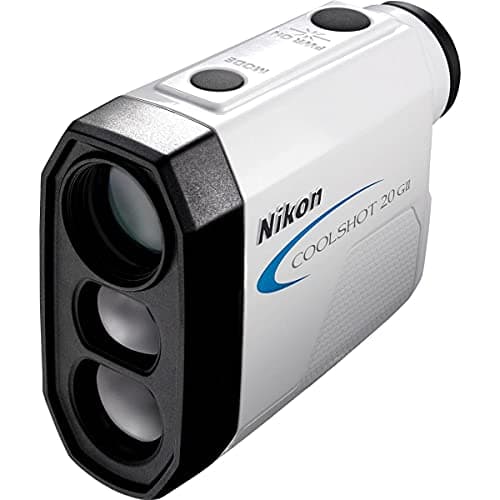
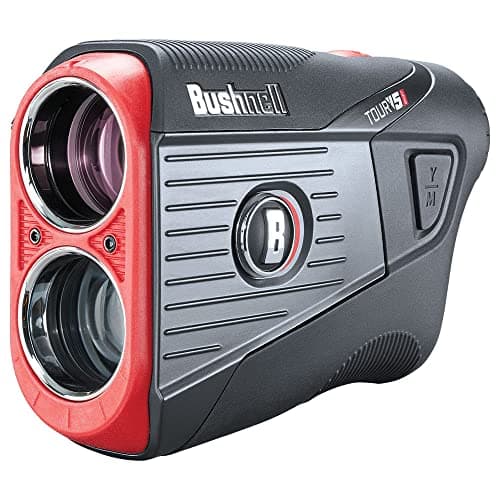
This is the premium-versus-budget laser question in its clearest form: two 6x rangefinders that both put an accurate number on the flag, at very different prices and with very different feature sets. The Bushnell Tour V5 Shiftis the premium all-rounder most serious players settle on — a visual-JOLT lock that flashes red the instant it grabs the pin, switchable slope on an external switch, and the BITE magnet that sticks it to a cart bar. The Nikon Coolshot 20 GIIis the tiny, no-slope budget laser that’s always tournament-legal, with clean multilayer-coated optics and nothing to switch off. Both read to the flag; the question is how much the premium extras are worth to you. Check the live prices above, because the gap between them is the whole debate.
What both share
Start with the common ground, because it’s the part that matters most. Both are laser rangefinders, which means both measure the exact distance to whatever you aim at — the flag, a bunker lip, a tree you need to carry — rather than reading to a mapped green the way a GPS does. Both use 6x magnification, which is plenty for the distances you actually play, and both are honest about their optics: Bushnell’s premium glass and Nikon’s multilayer-coated lenses each give a clean, bright view. And because both are lasers, neither carries a course database or a subscription — you point and it reads, the same on any course in the world, with no yearly fee. On the core job of putting an accurate number on the flag, these two are closer than the price gap suggests. The differences are all about confirmation, convenience, and slope.
Choose the Tour V5 Shift if…
You want the premium laser experience — a lock you trust instantly, elevation help when it’s legal, and the small conveniences you use every hole — and you’re willing to pay for it. The Tour V5’s calling card is the visual JOLT: when it locks the flag, a red ring flashes in the display so you know you grabbed the pin and not the tree behind it, which is the single feature that most reduces the “did I get it?” re-shoot. Its slope toggles off with the external Shift switch, so the same unit gives you a “plays like” number in casual play and drops into a legal, distance-only mode for competition. And the integrated BITE magnet parks it on the cart bar between shots. For a committed golfer who plays a mix of casual and competitive rounds, that’s the feature set that earns its keep — and our full Tour V5 Shift review covers it on its own.
Choose the Nikon Coolshot 20 GII if…
You want a simple, accurate, always-legal laser for the least money and you don’t need slope. Because the Nikon has no elevation feature at all, it’s always tournament-legal — nothing to switch off, nothing to forget on the first tee, no risk of an accidental breach — which is genuine peace of mind a switchable-slope laser can’t quite match. It’s also one of the smallest and lightest lasers around at a listed 4.6 oz, genuinely pocketable, and its multilayer-coated 6x optics with First Target Priority give a clean read that favors the flag over the trees behind it. You give up the JOLT confirmation, the magnet and any elevation help — but you get an honest, always-legal number to the flag at a budget price.
How they actually differ
Four things separate them, and none is the basic accuracy. The first is lock confirmation: the Tour V5’s visual JOLT flashes a red ring the instant it locks, so you trust the number and move on, where the Nikon relies on First Target Priority to favor the near target but gives you no flash or pulse to confirm — you eyeball the read yourself. The second is mounting: the Tour V5’s BITE magnet sticks it to a cart bar between shots, and the Nikon has no magnet, so it lives in a pocket. The third is slope: the Tour V5 has switchable slope for elevation help in casual rounds, and the Nikon has none at all. The fourth is price and glass: the Tour V5 is a premium instrument priced well above the budget Nikon, with the polish that implies; the Nikon is a compact, weather-resistant (Nikon lists IPX4) budget laser that spends its money on being small, clean and always legal rather than on extras. In short, the Tour V5 buys confirmation, convenience and slope; the Nikon buys simplicity, pocketability and zero rules risk.
Slope, and staying legal
The slope difference is also the rules difference, so it’s worth being precise. Under Rule 4.3, using a slope or elevation feature in a counting round is a breach — so a slope laser is legal in competition only with the feature switched off. The Tour V5 Shift handles that cleanly: its external Shift switch flips slope off in a second for a legal, distance-only mode, so you get elevation help in casual play and a legal unit when it counts, all in one laser. The Nikon sidesteps the question entirely by having no slope to begin with — it’s always legal, with nothing to switch and nothing to forget. So if you play competition and want the least to think about, the Nikon’s subtraction is a feature; if you play a mix and want both modes in one trustworthy instrument, the Tour V5’s switch is exactly what you’re paying a little extra for. The full rule is in are rangefinders legal.
Skip the decision entirely if…
You want slope help but at a value price with an easy off-switch — because neither of these is quite that. The Tour V5 has the clean switch but a premium price; the Nikon has the budget price but no slope at all. If that’s your want, the answer is a value slope laser with a proper external toggle — a Blue Tees Series 3 or a TecTecTec, ranked in the best slope rangefindersroundup — which gives you switchable, tournament-legal slope for far less than the Bushnell. Skip the whole laser question, too, if what you actually want is a wrist-glance and the whole green at once rather than a pinpoint number to the pin — that’s a GPS watch’s job, not a laser’s. And if you’re simply not sure where the Tour V5 and the Nikon sit against the rest of the field, the full best rangefinders roundup ranks them both.
The honest verdict
Buy the Tour V5 Shift if you want the premium experience and you’ll use it — the confident JOLT lock, the switchable slope, the cart-bar magnet — and you play enough of a mix of casual and competitive golf to want one instrument that does both. Buy the Nikon Coolshot 20 GII if you want a simple, accurate, always-legal laser at a budget price and slope isn’t something you’ll miss. Both put the right number on the flag; the Tour V5 does it with more confirmation and more convenience, the Nikon does it with less fuss and less money. Be honest about whether the premium features are ones you’ll actually use hole after hole — if they are, the Bushnell is worth it; if they aren’t, the Nikon gives you the number that counts for far less.