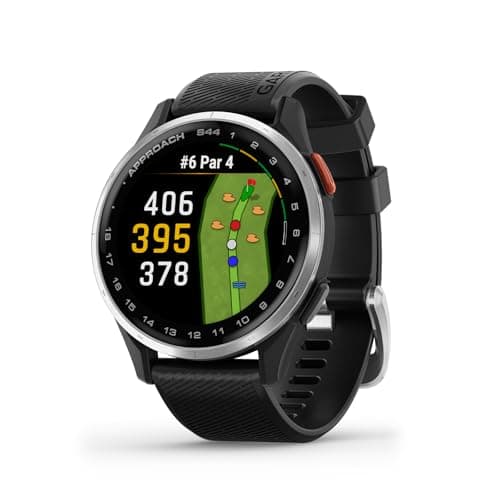
The Garmin Approach S44 is the GPS watch for the golfer who wants distances and a watch worth wearing off the course. Where the budget Approach S12gives you the same yardages on a plain monochrome screen, the S44 puts them on a bright AMOLED color touchscreen with full-color course maps, adds smart notifications and basic activity tracking, and — crucially — still carries its 43,000+ course database with no subscription. It’s the nicer instrument; the honest question is whether the screen and the smart features are worth the step up in price and the step down in battery.
Who it’s for
It’s for the golfer who’ll wear the watch beyond the round — to work, to the gym, all day — and wants the course maps to look as good as a modern smartwatch. The AMOLED screen is genuinely easier to read in bright sun than a monochrome display, the full-color hole graphics make doglegs and hazards obvious at a glance, and the touchscreen makes moving the pin or panning the map effortless. If you already own a fitness watch you love, or you truly only look at a yardage and nothing else, the extra spend is harder to justify — the S12 gives you the same on-course distances for less. This is an upgrade you buy for the screen and the daily wear, not for more accurate numbers.
What the color touchscreen and no-subscription maps get you
Two things make the S44 feel a tier above a budget GPS. First, the display: the AMOLED color touchscreen turns a list of numbers into a readable map, which helps most on an unfamiliar course where seeing the shape of the hole matters. Second, the S44 doesn’t punish you for the nice screen with a recurring bill — like the rest of Garmin’s Approach line, the course data is free to keep updated with no membership. The subscription trap that haunts launch monitors simply isn’t a Garmin-watch problem, and the whole no-fee field is ranked in our best GPS watches roundup.
The honest limits
The AMOLED screen is the S44’s best feature and also its clearest trade: a bright color display draws more power, so battery life is noticeably shorterthan the S12, which can run up to a listed 30 hours in GPS mode. You’ll charge the S44 more often. It also costs meaningfully more for what is, on the course, the sameGPS yardage — you are paying for the screen and the smart features, not for better distances. And the fundamental GPS limit still applies: it reads to the mapped green, not the flag, so it can’t give you the pinpoint number a laser puts on the actual pin. We base this on Garmin’s published specifications and aggregated owner feedback — we don’t run a test lab.
The verdict
If you want a GPS watch you’ll wear all day and you’ll use the color maps and smart features, the S44 is the easy pick and a genuinely lovely thing to use. If you only care about yardages and long battery, save the money and buy the S12 — the distances are identical. And if the number you actually want is to the flag, buy a laser instead. Decide which of those three golfers you are, and the S44 either is or isn’t your watch.
S44 vs S12: is the upgrade worth it?
This is the decision most S44 shoppers are really making, so be honest with yourself about it. The two watches give the same on-course distancesfrom the same no-subscription database — front, middle and back to the green — so you are not buying accuracy. You are buying the AMOLED color touchscreen, the full-color maps and the everyday smart features, and paying for them in dollars and in battery life. If you’ll wear the watch daily and enjoy the screen, that’s a fair trade and the S44 is a pleasure. If the watch comes off after the round and you only ever glance at a number, the S12 is the smarter money — we lay the two side by side in Garmin S12 vs S44.
GPS or a laser — or both?
Whichever Garmin you pick, remember what a GPS watch is and isn’t. It’s the fastest, lowest-fuss way to get distances — a wrist-glance, the whole green’s numbers at once, nothing to aim — which is why so many golfers wear one for pace of play. What it can’t do is put an exact number on a tucked pin; for that you need a laser from the rangefinder roundup. Plenty of good players carry both: the watch for pace, hazards and the number to the middle, the laser for the precise approach. Our rangefinder vs GPS guidewalks the whole decision if you’re still choosing.