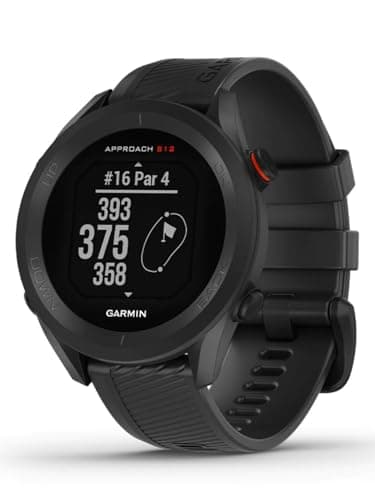
The Garmin Approach S12 is the budget GPS watch we point most golfers toward first, and the reason is refreshingly simple: it does the one job a golf GPS exists for — give you front, middle and back yardages at a glance — without a subscription and without a fussy screen to babysit. Garmin lists 42,000+ preloaded courses and you buy the watch once; there’s no yearly course-data fee, which is the trap that quietly turns some distance devices into a recurring bill. For a lot of players that’s the whole pitch, and it’s a good one.
Who it’s for
It’s for the golfer who wants distances on the wrist, hates faff, and doesn’t want to pay a fee forever. A glance gives you the numbers to the green with nothing to aim — which is faster and easier than a laser for pace of play, especially if your hands aren’t steady. It’s also a strong first distance device for a beginner or a casual player who wants help without spending laser money. It is not for someone who needs an exact yardage to the pin, or who wants color hole maps and smartwatch features — those point you elsewhere.
What the no-subscription database gets you
This is the S12’s quiet strength. Garmin’s 42,000+ course database is preloaded and free to keep updated — no membership, no unlock. On the course you get front/center/back numbers to the green and basic hazard distances, which is genuinely most of what a recreational golfer uses. Pair that with one of the longest battery lives in the range — Garmin quotes up to 30 hours in GPS mode — and you have a watch you charge rarely and never pay to keep working. If the subscription-free approach is what you’re after, the whole best GPS watches roundup ranks that field.
The honest limits
Two trades keep the price and battery where they are. First, it’s a basic monochrome display with button navigation — no color maps, no touchscreen, no smartwatch notifications. It shows numbers cleanly and little else, which is exactly what keeps it cheap and long-lasting, but if you want the bright color maps and everyday features, the AMOLED Approach S44 is the upgrade. Second, and more fundamental: like every GPS, it reads to the mapped green, not to the flag. It can’t give you the pinpoint number a laser puts on the actual pin.
GPS or laser?
That green-not-flag point is the real decision, and it’s worth being honest about. If you want an exact distance to the stick, buy a laser — the S12 will never do that. If you want speed, a wrist-glance, the whole green’s numbers at once and no aiming, the S12 is the better tool, and cheaper than most lasers. Plenty of good players carry both. Our rangefinder vs GPS guide walks the choice in full; if you land on GPS, the S12 is the value answer.
The verdict
For a subscription-free, glance-and-go yardage watch on a budget, the S12 is the easy recommendation: the course data is free forever, the battery lasts, and it does the core job without fuss. Pay up for the S44 only if you genuinely want the color touchscreen and smart features, and buy a laser instead if pinpoint distance to the flag is what you’re really after. Know which of those you are, and the S12 either is or isn’t your watch. We base this on Garmin’s published specifications and aggregated owner feedback — we don’t run a test lab.
GPS watch, handheld or phone app?
Before you settle on the S12, it’s worth knowing the three ways to get GPS distances, because they suit different golfers. A GPS watchlike the S12 is the fastest — a glance at the wrist, nothing to hold or pull out — which is why it’s the most popular format. A handheld such as the Bushnell Phantom 2 trades the wrist-glance for a bigger, more legible screen, which some players (especially older eyes) prefer, and it clips to a bag or cart. A phone app is free-ish but eats your battery and pulls your phone out on every hole. For a walker who wants distances with zero fuss and no fee, the watch wins — and the S12 is the value version of it.
Getting the most from a budget GPS watch
Two habits make a budget GPS pay off. First, trust the middle number: GPS reads to the front, center and back of the green, and for most amateurs playing to the center is the smart, score-lowering default — chasing a front-pin number you can’t carry is how you find the bunker. Second, charge it the night before a round, not the morning of; the S12’s long battery means you’ll rarely think about it, but a full charge guarantees a full day. And if you ever want the pinpoint number to a tucked pin, remember the honest limit — the S12 reads to the mapped green, so pair it with a laser from the rangefinder roundup the day precision matters more than speed.