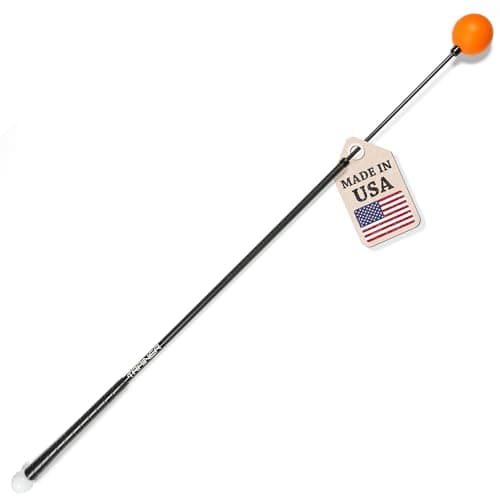
The Orange Whip is the most beautifully made tempo trainer you can buy, and one of the best warm-up tools in the game — but it is a feel trainer, and it is worth being honest about what that means before you spend premium money on one. Swing it and you feel a balanced, in-sequence motion; you do not get a single word of feedback about your clubface, your path, or where the club bottomed out. That is the whole review in two sentences. Everything below is the detail behind it.
What it is
The Orange Whip is a counterweighted, flexible-shafted swing trainer: a heavy orange ball on the end of a whippy shaft, with a counterweight built into the grip. The design is the clever part. As you swing it, the flexible shaft loads on the way back and unloads through the hitting area, and the counterweight in the handle balances the heavy head so the whole thing wants to move in sequence — lower body first, then torso, then arms, with the head releasing last. Rush the transition or throw the club from the top with your hands and the whip fights you: it lags, it feels out of sync, and you feel exactly that. Sequence it properly and it feels effortless and smooth. That sensation is what it is built to teach, and per the manufacturer’s listing it is pitched as a tempo, balance and sequencing tool — which is an honest description of what it does.
Where it genuinely helps
Two things, and it does both well. First, warm-up. A dozen smooth swings with the Orange Whip before a round stretches the golf-specific muscles and grooves an unhurried rhythm far better than a couple of stiff practice swings with a club, which is exactly why it has been a fixture on tour range tees for years. If loosening up on the first tee were the only thing you ever used it for, it would still earn its keep. Second, tempo and transition. If your swing gets quick — if you snatch it back and lunge from the top, one of the most common amateur faults — swinging the whip daily builds the feel of a patient, in-sequence motion that starts from the ground up. The heavy head and flexible shaft will not let you be violent with it without feeling wrong, so the feedback about rhythm is genuinely useful. Do it consistently and a jerky transition can smooth out, and a smoother transition helps strike and consistency across the board. Used for what it is, it is one of the better feel tools made.
Where it falls short (and the honest gimmick risk)
Here is the part the marketing skips. The Orange Whip gives you feedback on rhythm and sequence, and on nothing else. It cannot tell you the face was open at impact, it cannot show you an out-to-in path, and it says nothing about where your club bottoms out. So if your real problem is a slice, a hook, or a fat strike — which is most golfers’ real problem — the Orange Whip does not address the cause. It can make you smoother, and a smoother swing occasionally masks a fault, but masking is not fixing. The gimmick risk is not that the tool is bad — it is genuinely good at its job — but that it gets bought as a “swing fixer” when it is a rhythm and warm-up trainer. The other honest mark against it is price: it costs several times what a weighted alternative like the SKLZ Gold Flex does, and the Gold Flex loads and unloads in much the same way. You are paying a real premium for the counterweight, the build and the balance — not for any extra feedback, because there isn’t any.
Is the premium worth it over the cheaper option?
Sometimes. The counterweight genuinely gives the Orange Whip a smoother, better-tuned load than the Gold Flex, it is built to last, and if a tempo tool is something you will pick up before every round for years, the nicer tool is easier to justify — you use it enough to feel the difference. But be honest with yourself about that “for years” part, because a lot of training aids get used twice. If you are not certain you will keep swinging it, the cheaper stick gives you most of the benefit and leaves money for a feedback aid that actually diagnoses a fault. We put the two side by side in the Orange Whip vs Gold Flex comparison if you want the head-to-head.
How it fits our feedback-vs-feel test
This hub ranks aids on one line: do they give real feedback, or only a feel? The Orange Whip sits firmly on the feel side, and it is about the best tool on that side of the line. It scores well for us on build and durability, and honestly on effectiveness for its narrow job, but modestly on feedback quality and value, because it gives no read on your fault and costs a premium. That is not a criticism of the tool — it is a description of it. Bought as a warm-up and tempo trainer, it is excellent. Bought as a swing fixer, it will quietly disappoint, because there is nothing about a slice or a fat shot that it can see.
How to actually use it
Getting value out of it is simple: little and often beats long and occasional. Start each session with a few slow, deliberate swings to feel the head lag and the shaft load, then build to smooth, full-length swings, letting the weight release the head last. Count a tempo in your head — a longer backswing than you think, an unhurried transition — and try to make every swing feel identical. Swinging it both left-handed and right-handed a few times is a genuinely good stretch and keeps you balanced. The two rules that matter: do it most days, because rhythm is a habit you build by repetition, not a thing you buy; and do not try to hit balls with it — it is a swing trainer, not a club, and using it to strike anything defeats the point and risks the shaft. Five minutes before a round, and a few minutes on non-golf days, is plenty to feel a difference in your tempo.
The build, and how long it lasts
Build quality is where the Orange Whip most clearly justifies its price. It is, plainly, beautifully made: the shaft flex is consistent, the counterweighted handle feels solid rather than hollow, and the orange head is properly attached rather than glued on as an afterthought. In our scoring it earns one of the highest durability marks in the category, and that matches its reputation — these tools tend to survive years of daily swinging rather than splitting or going soft after a season. That longevity matters more than it sounds, because a tempo trainer only works if you keep using it, and a tool that feels good in the hand and holds up is one you are more likely to pick up every day. It is also, for what it is worth, pleasant to own: the fit and finish are a cut above the typical training-aid molding, which is part of why it turns up on tour range tees and in gift guides. None of that changes what it teaches — but if you are paying a premium, getting a genuinely premium object in return is the least you should expect, and here you do.
Who should buy it
Buy the Orange Whip if you want the best-feeling tempo trainer made and you will actually use it — a player whose miss is a quick, out-of-sequence, all-arms swing, or anyone who wants a genuinely excellent warm-up tool and does not mind paying for build quality. If you swing it every day, the rhythm it grooves is real, and the feel transfers to the course. It is also a fine gift-quality object: it looks and feels like a premium tool, and it lasts.
Who should skip it
Skip it if your scores are being wrecked by a specific ball-flight fault — a slice, a hook, a chunk. The Orange Whip will not touch the open face behind a slice or the low point behind a fat shot; for those you want a feedback aidthat shows you the fault, like the Divot Board or The Hanger. Skip it too if you are on a budget: the Gold Flex delivers most of the tempo benefit for a fraction of the money. And if you just want to groove rhythm for free, a slow, deliberate swing with a headcover tucked under your lead arm, or a heavier club swung smoothly, gives you a rough version of the same feel at no cost — the whip is a nicer, more consistent way to do it, not the only way.