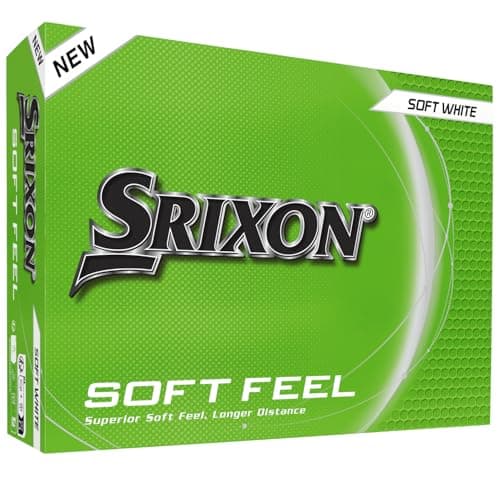
If someone asked us for one value ball to buy without overthinking it, the Srixon Soft Feel is the answer. It is soft, straight, durable and consistently one of the best price-per-dozen in the category — the value ball we’d actually put in our own bag. Nothing about it is exciting, and that is precisely the point: a value ball’s job is to do the unglamorous things well and cost little enough to lose without a second thought, and the Soft Feel does exactly that. This review is about where it wins, the one thing it can’t do, and who should buy it over both the softer value balls and the tour balls above it.
What the Soft Feel actually is
Srixon builds the Soft Feel as a two-piece ball with an ionomer cover over a low-compression core. The compression sits a rung above the very softest value balls — higher than a Callaway Supersoft or Wilson Duo Soft — which is deliberate: it gives the Soft Feel a slightly firmer, more responsive feel while still being easy for a moderate swing to compress. Cover material and relative compression here are manufacturer and widely-published facts, not numbers we measured — we don’t run a lab, and we say so on how we rank. The short version: a low-compression, ionomer-covered value ball tuned for a good middle ground between soft feel and feedback.
It sits in the value tier and competes head-on with the Supersoft, the Titleist TruFeel and the TaylorMade SpeedSoft. Like all of them it is on the ionomer side of the urethane-versus-ionomerdivide that separates value balls from tour balls — a distinction that matters more than any dimple pattern or layer count.
Where it shines
The first strength is the balance of feel. The Soft Feel is soft off the face — soft enough to please a player coming from a firmer ball — but it is a touch firmer and more responsive than the very softest value balls, so it doesn’t feel mushy off the putter. For players who find a Supersoft or Duo Soft too soft, that extra bit of feedback is the reason the Soft Feel is often the more satisfying ball to play. It is a genuine middle ground, and a lot of golfers land on it after trying the softer options.
The second strength is the same low-compression distance logic that makes any soft value ball a smart buy for a moderate swing: it flattens efficiently at impact and gives back the yards a firm tour ball leaves on the tee for a slower swing. The third, and the reason it tops our value thinking, is price. The Soft Feel is reliably one of the cheapest per dozen of the genuinely good value balls, and combined with a durable ionomer cover that survives cart paths and thin strikes, that makes its cost-to-play about as low as a quality new ball gets.
Where it falls short (honestly)
The main limitation is the one every value ball shares: greenside spin. The ionomer cover gives you limited full-spin greenside control, so wedge shots release more than they check. For a moderate or high handicapper that is the correct trade — you gain distance, straightness and durability and give up spin you weren’t generating anyway — but for a single-digit player who spins wedges on purpose, the missing bite is a real shortfall. This is not a scoring ball for a sharp short game; it is a value ball, and it plays like one greenside.
The second “limitation” is really just its character: nothing about the Soft Feel is exciting. It doesn’t launch dramatically higher, spin dramatically more, or feel dramatically different from its rivals. In a value ball that is a feature, not a bug — consistency and low cost are the whole job — but if you’re shopping for a wow factor, you won’t find it here, and you shouldn’t expect to.
Who should buy it
Buy the Soft Feel if you want the safest, smartest value-ball pick and you don’t want to overthink it. It suits a moderate swing that wants distance and straightness, a player who finds the softest value balls a little mushy and wants more feedback, and anyone who cares about getting the most golf ball per dollar. It is a superb everyday ball for a mid-to-high handicapper, a strong pick for a senior game, and a sensible constant to groove a swing around. If you buy one dozen of one value ball this season, this is the one we’d point you to.
Who should skip it
Skip it if you genuinely spin your wedges and play to a single-digit handicap — you’ll feel the missing greenside bite, and you should step up to the urethane-covered Srixon Q-Star Tour or a Pro V1. Skip it too if you want the very softest possible feel: the Callaway Supersoft and Wilson Duo Soft are softer, and if maximum softness is your priority they’re the better match. And if you fight a bad slice specifically, a dedicated low-spin ball like the Bridgestone e6 is aimed squarely at that fault. For everyone else, the Soft Feel is hard to beat.
The bottom line
The Srixon Soft Feel is the value ball we recommend most, and the reasons are unglamorous on purpose: it feels good without being mushy, it flies straight, it lasts, and it costs less than most of its rivals. Its ceiling is the ionomer cover’s greenside spin, which matters only to the sharp short game that should be playing urethane anyway. For the moderate or improving golfer it is aimed at, the Soft Feel isn’t a compromise — it is simply the right ball, and the money you save over a tour ball is real.