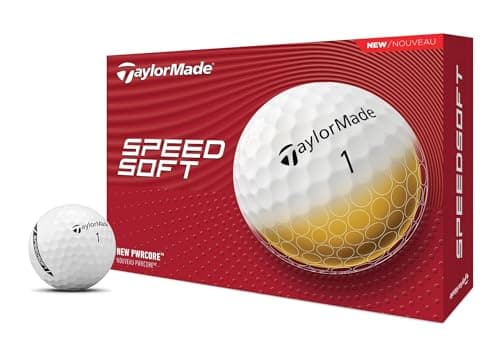
The TaylorMade SpeedSoft is the softest ball TaylorMade makes, and it is unusually direct about it: a published 35 compression, the first ball the company has built below a 50. It replaced the three-piece Soft Response in the lineup, and the swap tells you what TaylorMade decided mattered in the value tier — feel and price, not layer count. If you swing at a moderate speed and a firm ball feels like hitting a rock, this is a ball worth knowing about; if your scoring leans on wedge spin, it is not.
What it is
A two-piece, ionomer-covered value ball built around what TaylorMade calls the PWRCORE: a large, low-compression core designed to be easy to squash without leaking ball speed. TaylorMade’s own claim is that the SpeedSoft tests to the USGA’s maximum initial-velocity limit, and it wraps the core in a firm ionomer cover with a low-drag, extended-flight dimple pattern. Every figure in that paragraph is the manufacturer’s published wording or a widely-reported construction fact — we did not measure compression, speed or spin, we don’t have a lab, and how we rank says so plainly.
Where it shines
Softness is the headline and it is real. A 35 compression is low even by value-ball standards, and the practical effect for a slow-to-moderate swing is that the ball actually deforms on the strike instead of resisting it — which is where a slower player’s distance comes from, and why a soft ball outdrives a tour ball for the golfer it is built for. It also feels soft everywhere you notice feel: off the putter, off a wedge, off the middle of a mid-iron. If you have been playing a firm distance ball because it was cheap and you have quietly disliked the click, this is the fix.
The second strength is price discipline. TaylorMade sells the SpeedSoft in the same bracket as the Callaway Supersoft and the Srixon Soft Feel, so the soft-value decision stays a price-and-preference decision rather than a premium one. That matters more than it sounds: these balls are close enough in performance that the honest tiebreak has always been the shelf price the week you buy, and the SpeedSoft does nothing to break that rule.
Where it falls short (honestly)
The ionomer cover imposes the usual ceiling: wedge shots release rather than check. That is the correct trade for the golfer this ball targets — you gain durability, straightness and a low price — but it does mean the SpeedSoft is not a scoring ball for a sharp short game, however soft it feels off the face. Soft feel and greenside spin are not the same property, and the marketing around soft balls blurs them constantly.
The second thing to be clear-eyed about is the construction change. The Soft Response was a three-piece; the SpeedSoft is a two-piece. A simpler build is not automatically worse — at this price the extra layer was never transformative — but if you specifically valued the Soft Response for being a three-piece at value money, understand that the replacement is not that. You are buying feel and price here.
Who should buy it
Buy the SpeedSoft if you swing at a moderate or slow speed and you want the softest feel you can get without leaving the value aisle. It suits a beginner, a high handicapper and a senior game well, and it is a sensible default for anyone who loses a few balls a round and refuses to lose expensive ones. Buy it, too, if you were a Soft Response player looking for the nearest current equivalent — it is TaylorMade’s answer in that slot, and the Soft Response page explains exactly how the two differ.
Who should skip it
Skip it if the Supersoft or the Soft Feel is cheaper the day you shop — these three are close enough that price should decide, and the Supersoft vs Soft Feel comparison covers the other two in full. Skip it if you swing hard: a fast player will over-compress a 35 and lose both control and the ball’s reason to exist. And skip it if you genuinely spin your wedges, which points at a urethane ball like the Srixon Q-Star Tour rather than any ionomer ball at any softness.
The bottom line
The SpeedSoft is an honest value ball with one clear, well-published differentiator: it is the softest thing TaylorMade sells. That is worth something to the moderate swing it is built for and nothing at all to a good short game, and the ball is refreshingly upfront about which of those it is chasing. Bought as the cheapest soft ball on the shelf, it is a genuinely good buy. Bought at a premium over a Supersoft or a Soft Feel, it is the wrong one — which is exactly what we said about the ball it replaced.