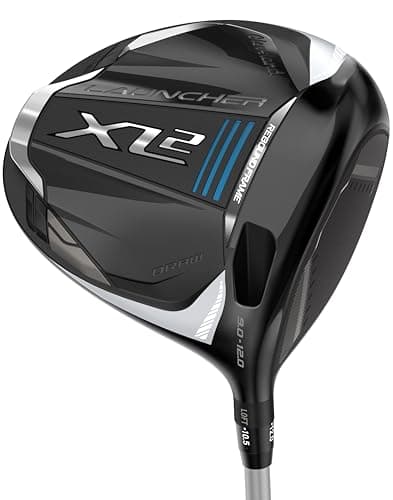
The Cleveland Launcher XL 2 is a current-generation, major-brand game-improvement driver built to do one thing supremely well: keep your bad drives in play. Cleveland’s pitch is their highest-ever driver MOI in an oversized “XL” head, and that claim is the whole story — a bigger, more stable head resists twisting on the heel-and-toe strikes an improving swing actually makes, so the ball holds its line and keeps more of its speed. This listing is the 10.5°, Regular-flex graphite build, and it is the driver that already tops our best golf drivers for beginners roundup. Here is the honest, full-length case for it — including where it is the wrong club.
What it is
It is a 460cc, adjustable game-improvement driver from Cleveland’s Launcher XL family. The headline is size and stability: Cleveland builds the “XL” head larger than a standard driver and weights it low and deep, which they say produces the highest MOI — resistance to twisting on off-center hits — of any driver they have made. Behind the face sits what Cleveland calls a MainFrame XL variable-thickness face, an AI-designed pattern of different thicknesses meant to protect ball speed across the whole hitting area rather than only the center. This particular listing is sold in 10.5° loft with a Regular-flex graphite shaft, and the hosel is adjustable — Cleveland quotes twelve loft settings — so you can raise or lower the loft and tweak the face angle as your swing settles. Every one of those numbers is Cleveland’s own published spec, not something we measured; we do not have a lab, and the way we actually score clubs is set out in how we rank.
Where it shines
Forgiveness on off-center strikes is where this driver earns its place, and it is the single most useful quality a developing golfer can buy in a driver. A new or improving swing does not find the middle of a 460cc face every time, and the difference between a good driver and a great one, for that player, is what happens on the strikes that miss the sweet spot. A high-MOI head twists less on those hits, so the face stays closer to square, the ball starts nearer your intended line, and it keeps more of its ball speed. That is exactly what Cleveland engineered the XL head to do, and it is why a big, stable driver flatters a mishit the way a smaller, “faster” head never will.
It launches easily, too. The low-and-deep weighting that raises MOI also drops the center of gravity, which helps the ball climb without a fast, aggressive move — and for a moderate swing, height is where carry distance actually comes from. In the 10.5° setting most players will get a genuinely easy, high launch, and if you need more you can add loft at the hosel rather than buying a different head. The MainFrame XL face is Cleveland’s answer to the thin-strike problem: their stated aim is to hold ball speed across more of the face, so the toe and heel drives lose less distance than they would off a flat, uniform face.
The last thing it does well is the least glamorous and the most practical: it is a real, current major-brand club. That means an adjustable hosel you can actually use as your game changes, fitting options at retail, and resale value when you trade up — none of which a no-name budget driver can offer. If you are buying one driver to grow into for a few seasons, being able to re-loft it and sell it on later is worth real money, and it is a big part of why we rank it ahead of the cheaper heads for a player who is in the game to stay.
Where it falls short
Be honest about the trade a game-improvement driver makes: it is built for stability, not shot-shaping. All the weighting that keeps the face from twisting on a mishit is the same weighting that stops a skilled player bending the ball left and right on command. If you already flight your driver well and like to work it, the XL 2 will feel like a lot of head that wants to go straight no matter what you tell it — that is a feature for most golfers and a limitation for a few. A more compact players’ or players-distance driver gives that golfer back the workability this one deliberately removes.
It is also one of the pricier ways to solve a beginner’s problem. The forgiveness is real, but a budget offset driver — the kind we rank right alongside it — will get a brand-new golfer airborne and pointed roughly straight for a fraction of the outlay. If money is tight, or you are genuinely not sure the game will stick, the gap between this and a value driver is better spent on lessons or on the short game, where the strokes actually hide. Our guide to how much to spend on golf clubs lays that arithmetic out plainly.
One more honest caveat about this exact listing: it is the 10.5°, Regular-flex build. That is the right spec for a lot of golfers, but a genuinely fast swinger who wants a lower launch and a stiffer profile is looking at the wrong number on the shelf even though the head is a good one. The adjustable hosel closes some of that gap, but flex it cannot change — so match the loft and flex to your speed, or buy the listing that already does. None of these are faults, exactly; they are the honest edges of a driver trying to be maximally forgiving, and forgiveness always costs a little workability and a little money.
Who should buy it
Beginners and improving golfers who want one driver to grow into. If your miss off the tee is a slice or a weak, low fade, if you do not consistently center the face, or if you simply want the most stable, easy-to-launch head you can buy from a brand with resale value, this is the pick — and the adjustable hosel means you keep tuning it as your swing develops rather than replacing it. It is also smart for a moderate-speed swing that struggles to get the ball in the air, because the high launch is baked into the head design rather than borrowed from a hot shaft. It is the winner of our beginner driver roundup for exactly these reasons.
Who should skip it
Two golfers should look elsewhere. The first is the accomplished ball-striker who flights and shapes the driver on purpose — you will want a more compact, workable head and will find the XL 2 too much club. The second is the brand-new golfer on a tight budget, or anyone not yet sure they will keep playing: a value offset driver from our driver roundupgets you airborne for far less, and the money you save is better spent where the scoring actually is. Everyone in between — which is most golfers reading this — is squarely who Cleveland built it for.