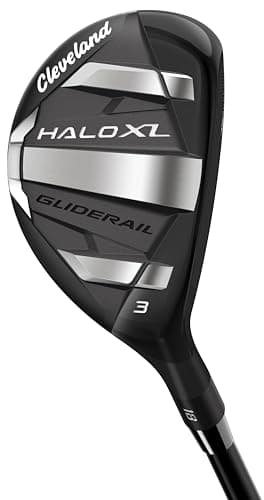
The Cleveland Launcher Halo XL is the hybrid we point most golfers toward, and it wins our roundup for the simplest reason there is: it does the one job a hybrid exists to do better than almost anything else. A hybrid is there to replace the long irons hardly anyone hits well, and this big, high-launching game-improvement head makes that shot playable. This listing is the 21° build — a 4-hybrid, which for most golfers steps in for the 4 iron, the club that tends to leave the bag first. Here is the full, honest case for it, including the player who should buy something else.
What it is
It is a game-improvement hybrid from Cleveland’s Launcher Halo XL family, and this listing is the 21° loft with a Regular-flex graphite shaft. At 21° it sits in the most-bought hybrid slot — a 4-hybrid, which roughly replaces a 4 iron, though as always it is the loft that matters more than the number stamped on the sole. Cleveland builds it around three published ideas. First, a three-rail “Gliderail” sole, which they say keeps the face straighter through impact and helps the club glide over the turf instead of digging in. Second, a stepped crown that lowers the center of gravity to launch the ball high and easy. Third, what Cleveland cites as their highest-ever hybrid MOI — the head’s resistance to twisting — for forgiveness on off-center strikes. Every one of those is Cleveland’s own published claim, not a spec we measured; the way we actually score clubs is set out in how we rank.
For context, this is the head that tops our hybrid roundup, and it earns that spot by being the most complete forgiveness-and-launch package for the golfer a hybrid is actually for. Cleveland aims the Launcher Halo XL squarely at the mid-to-high handicapper who wants the hardest clubs in the bag to become the easiest, and every one of its published features — the Gliderail sole, the stepped crown, the high MOI — points at that single goal rather than at tour-level control. It is not a niche or a compromise head; it is a game-improvement hybrid doing exactly what the category exists to do, which is why it is the one we point most golfers toward first.
Where it shines
Launch is the headline, and it is the whole point of the club. A 4 iron is hard to hit because it has too little loft and too little help to get the ball up for most swings; the Launcher Halo XL fixes exactly that. The stepped crown drops the center of gravity low and deep, so the ball climbs easily on a high, soft-landing trajectory — the kind of flight that actually holds a green, which a long iron struggles to do. For a moderate or slower swing especially, that easy height is where the distance and the stopping power come from, and it is the single most useful thing this club offers.
It is worth being concrete about who feels that most. If your long irons come off low and “hot”, chase along the ground and will not stop on a green, the fix is height, and this head is built to deliver it without a faster swing. The same is true off the tee on a tight hole, or from a flyer lie in the rough: the easy launch means you can hit it hard and still get a controllable, high-landing flight rather than a low screamer. For the golfer whose miss is a thin, running long iron, that alone is worth the price of admission.
Forgiveness is the second strength, and Cleveland leans on two features for it. The highest-ever-hybrid-MOI claim means the head is built to resist twisting on strikes off the heel or toe, so your mishits hold their line and keep more of their speed — the same logic that makes a big, stable driver flatter a mishit, applied to a hybrid. And the three-rail Gliderail sole is designed to keep the face square through impact and stop the club digging, which is what makes it so playable from an imperfect lie. Together they turn the hardest club in the bag into one of the easiest.
The third thing it does well is handle a bad lie. Where a long iron needs a clean strike off good turf to work at all, the Gliderail sole lets this hybrid glide through the rough, off a tight lie, or off the tee on a tight hole. Add in that it is a real, current major-brand club with fitting options, a range of lofts and resale value, and you have a hybrid you can buy once and trust for years — which is a big part of why it tops our best golf hybrids roundup.
Where it fits: hybrid, long iron or fairway wood
A 21° hybrid like this sits in a useful spot between a fairway wood and a long iron, and for most amateurs it beats both in the 4-iron slot. Against the 4 iron it replaces, it launches higher, lands softer and forgives an off-center strike, so it actually holds a green where the iron runs through it — that is the whole trade, and it is a good one for anyone who does not strike long irons cleanly. Against a fairway wood, it is shorter, heavier and easier to control, so it comes out of the rough and off a tight lie far more reliably, at the cost of a little distance. Keep a lofted fairway wood if you want maximum carry from the fairway and the tee — the fairway woods roundup ranks those, and shows how the same GlideRail sole works in Cleveland’s fairway heads — keep a long iron only if you are a strong ball-striker who wants a lower, more workable flight, and let a 21° hybrid like this Launcher Halo XL cover the ground in between — which for most bags is exactly the 4-iron distance nobody hits well.
Where it falls short
The honest trade a game-improvement hybrid makes is workability. This is a big, forgiving head built to launch high and fly straight, and that is the opposite of a club you can flight down, hold against the wind, or shape on command. A better ball-striker who wants to work a hybrid will find it goes where it wants — up and straight — more than where they tell it. For most golfers reaching for a hybrid that is a feature, not a fault; for a skilled player it is a real limitation, and a more compact players’ hybrid gives that workability back.
It is also one of the pricier hybrids you can buy. The forgiveness and the launch are real, but a value-brand hybrid gets you a playable club for a fraction of the outlay, and the physics of a big, low-CG head have not changed much in years — so a prior-generation or budget hybrid launches nearly as high. If money is tight, the gap between this and a value head is better spent elsewhere in the bag. Our roundup ranks those cheaper options alongside it.
One last practical caveat about this exact listing: it is the 21° loft. That is the right number for the golfer replacing a 4 iron, but a hybrid is sold across a range, and you should buy the loft that fills your gap, not the one in the photo. If it is your 5 iron you avoid, you want more loft; if you already carry a lofted fairway wood, you may want a stronger hybrid to slot beneath it. Keep your lofts three to four degrees apart so your distances step down evenly.
Who should buy it
The golfer this hybrid is built for is the mid-to-high handicapper who cannot reliably launch or land a long iron — which is most amateurs. If your 3, 4 or 5 iron flies low, runs out and will not hold a green, replacing it with this head is one of the clearest upgrades in golf. It also suits a slower swing that needs easy height, a player building a hybrid-iron combo set, and anyone who wants one forgiving, major-brand club to trust from the fairway, the rough and the tee. It is our winning all-round hybrid for exactly these players. If you have quietly stopped reaching for a long iron because you cannot trust it, this is the club that gets that distance back in your hands with none of the dread.
Who should skip it
Two golfers should look elsewhere. The accomplished ball-striker who flights and shapes long irons on purpose will want a more compact, lower-spin players’ hybrid and will find this one too much head. And the golfer on a tight budget can get a perfectly playable hybrid for far less — the value picks in our hybrid roundup launch nearly as high for a fraction of the price. If you are weighing a hybrid against fixing the whole top of your iron set, the forgiving sets in best golf irons for beginners— often bought as a hybrid-iron combo — are the other half of that decision. But for the great majority reaching for a hybrid to escape their long irons, this is the head to beat.