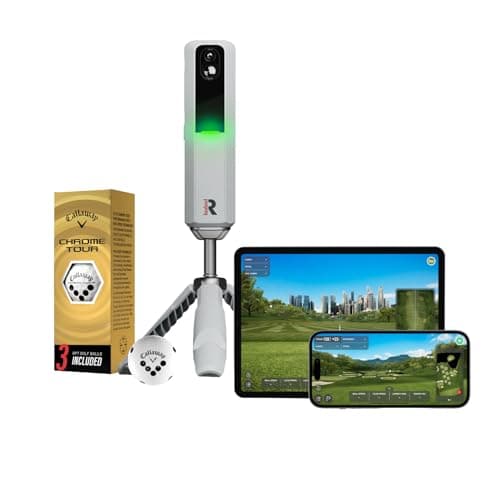
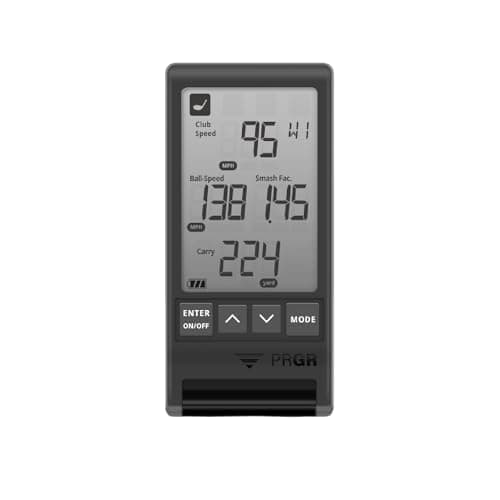
This is the widest gap in the whole category, and that is exactly why it is worth laying out. On one side is the PRGR HS 130-A, a pocket doppler that does one thing — ball speed, club speed, smash factor and estimated distance, shown on the unit itself with no app and no subscription. On the other is the Rapsodo MLM2PRO, a camera-plus-radar unit that measures spin optically, records video of every swing, drives a home simulator, and gates its best data behind a paid membership. One is a purpose-built speed trainer that fits in a pocket; the other is a near-full launch monitor and simulator front-end. They are not really rivals so much as answers to two different questions, and the honest job of this comparison is to tell you which question you are actually asking.
The widest gap in the category
Everything about these two is different, starting with what they even try to measure. The PRGR is deliberately narrow: point it down the line, swing, and the on-unit screen shows your speed numbers and an estimated distance instantly — no phone, no account, no login, nothing locked away. The Rapsodo is deliberately broad: a camera reads the ball to measure spin, a radar backs it up, video captures the strike, and the app turns all of it into a practice and simulator platform. So the PRGR gives you a few trustworthy speed figures with zero friction and zero running cost, while the Rapsodo gives you a rich, measured, video-backed data set with real setup discipline and a recurring fee. The price gap between them is as wide as the feature gap, which is why the live prices above should frame the whole decision.
Choose the PRGR HS 130-A if…
Your goal is speed and smash factor, and you want it with no strings whatsoever. For speed training — building ball speed, checking smash, tracking your gains — the PRGR does the job for a fraction of the Rapsodo’s price, with nothing to subscribe to and nothing to set up beyond switching it on. It is small and cheap enough to live in your bag and check your speed anywhere. The honest limits are severe by design: it reads speed metrics only — no launch angle, no spin, no simulator, no shot video, and no data history beyond the last few shots. It is a speed trainer, not a full monitor. If speed is the job, it is the right tool; if you wanted the whole launch picture, it will disappoint you, and that is on the buyer, not the unit.
Choose the Rapsodo MLM2PRO if…
You want the full picture — measured spin, launch data, shot video and the option to play simulated courses at home — and you accept paying for it. The camera measuring spin optically is the headline: it is a genuinely more trustworthy number than any radar’s estimate, and the video replay is how a lot of golfers finally connect a fault to a figure. It is the tool for the improving golfer who has outgrown “that felt good” and wants to see and measure the swing, not just clock its speed. The catch, which we will not bury: its full data set and simulator sit behind a paid membership, so budget the box plus a yearly fee that compounds, and give the camera decent light and careful alignment. It is far more capable than the PRGR, and far more expensive to buy and to keep.
Speed-only radar versus camera-plus-radar
Under the hood, this is also a sensing-technology contrast. The PRGR is a pure doppler radar that reports a narrow set of speed-derived figures; its distance number is estimated, and it does not attempt spin or launch at all. The Rapsodo is photometric — a camera paired with radar — so it measures spin from the ball’s markings rather than modeling it, and captures the shot on video. That is the difference between a device that honestly tells you how fast you swung and one that tells you, with measured spin and video, why the ball did what it did. Neither is a five-figure professional unit and we do not run a test lab; this is drawn from the manufacturers’ published specs and how each captures a shot. But the gap in what they can even report is real and it is large.
The cost gap runs both ways
It is tempting to call the PRGR the cheap one and stop there, but the honest picture has two layers. Up front, yes — the PRGR is a small fraction of the Rapsodo’s price. Over time, the gap widens further, because the Rapsodo’s full experience is tied to a membership that recurs every year you keep it, while the PRGR never sends a renewal notice. So the Rapsodo is more expensive to buy and more expensive to own. That does not make it a worse buy — you are getting vastly more monitor for the money — but it does mean the comparison is not one number against another; it is a one-time speed tool against a hardware-plus-subscription platform. Our cost-of-ownership breakdown runs the multi-year math so you can see the true distance between them.
The honest deciding factor
It comes down to what you are buying the thing to do. If you want speed and smash factor with no app, no fee and no fuss, the PRGR is the right tool and the Rapsodo is overkill you will not switch on. If you want measured spin, video and a home simulator and you will pay to keep them, the Rapsodo is in a different league and the PRGR will leave you wanting. Do not buy the platform to watch a speed number, and do not buy the speed tool expecting the platform.