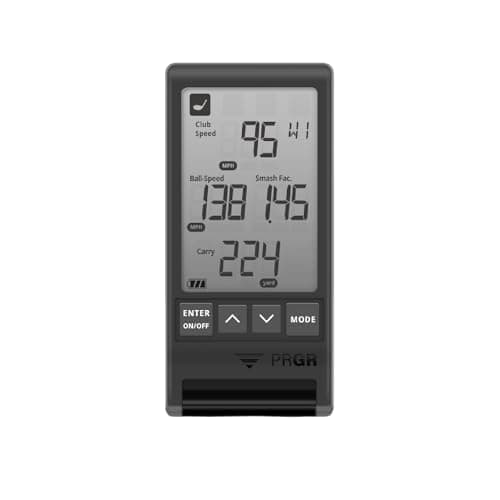
The PRGR HS 130-A is the antidote to the launch-monitor arms race. It’s a pocket-sized doppler radar that shows ball speed, club speed, smash factor and estimated distance on its own little LCD screen — no phone, no app account, no subscription, ever. It weighs about four-and-a-half ounces, runs on AAA batteries, and stores your recent shots on the unit itself. For a specific kind of golfer, that narrow focus is exactly the appeal: it does the speed job instantly and costs nothing to keep.
Who it’s for
It’s for the golfer who wants to train and track speed— and nothing else. If you’re working on clubhead speed, want to check ball speed and smash factor at the range, or want to confirm a speed-trainingprotocol is actually adding miles per hour, the PRGR gives you the number the instant you swing. It even reads clubhead speed without a ball, which makes it a genuinely useful overspeed-training companion. It’s also the honest pick for anyone who simply refuses to deal with an app, an account or a yearly fee.
The no-subscription, no-app advantage
This is the whole point of the PRGR, and it’s a real one. Where the R10 and the MLM2PRO gate their best features behind an app tier or a membership, the PRGR gates nothing: buy it once, use it forever, read your numbers off the device. There’s no pairing, no charging a proprietary battery, no renewal email. For a speed-focused practicer that zero-running-cost, zero-friction design beats a richer monitor you have to set up every time — the tool you actually pull out of the bag is the one that helps.
The honest limits
The PRGR is deliberately narrow, and you have to buy it knowing that. It reads speed metrics only— ball speed, club speed, smash and an estimated distance. There is no launch angle, no spin, no shot video and no simulator, and its shot history is a short on-device log rather than a synced database. It is a doppler radar, so its distance figure is estimated rather than measured. If you want carry-mapping, spin numbers or to play courses at home, this is the wrong tool by design — a Garmin R10 or a camera unit like the Rapsodo MLM2PROis what you want instead. We base this on PRGR’s published specifications and how doppler radar captures a shot; we don’t run a testing lab.
The verdict
As a speed trainer, the PRGR is superb: cheap, pocketable, instant, and free to run forever. As a full launch monitor, it isn’t one, and pretending otherwise sets you up to be disappointed. Buy it if speed and smash factor are what you care about; step up to a data-rich radar or camera unit if you want the full launch picture.
PRGR vs a full launch monitor: match the tool to the job
The mistake buyers make is comparing the PRGR to a Garmin R10 or a Rapsodo on features — it loses that fight on paper, because it’s not trying to have it. The right comparison is on job. If the job is “how fast am I swinging, and is my strike efficient,” the PRGR does it for less money, with less faff, than any full monitor. If the job is “what are my carry distances, my spin, my launch, and can I play a course at home,” the PRGR can’t, and you should buy from the under-$1,000 roundup instead. A lot of golfers actually end up owning both: a full monitor for practice sessions and the PRGR living in the bag for a quick speed check anywhere.
What it costs to own
This is where the PRGR quietly wins. Its true cost of ownership is the sticker price and a set of AAA batteries — that’s the whole bill. There’s no subscription, no in-app purchase and no consumable ball sticker like a Mevo needs. Over three years, a subscription-based monitor can add a few hundred dollars in recurring fees on top of the hardware; the PRGR adds essentially nothing. If you only want speed data, that math is the strongest argument for it — see how the fees compound in our cost-of-ownership breakdown, and the no-subscription roundup for the wider field of fee-free units.