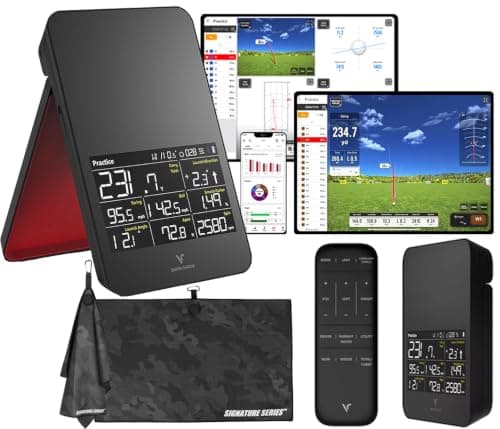
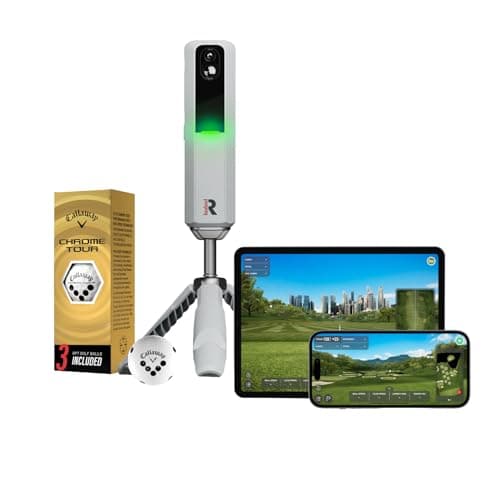
These two solve the same job — real launch numbers under a four-figure ceiling — from opposite design philosophies. The Rapsodo MLM2PRO is a camera-plus-radar unit that measures ball spin from the markings on the ball and records video of every swing, then leans on that hardware to drive a home simulator. The Voice Caddie SC4 Pro is a standalone doppler radar with its own built-in display: no phone, no app account and no subscription to read your numbers. One is the richer, more educational tool; the other is the tidier, cheaper-to-keep one. The right pick comes down to two questions — do you want spin measured and your swing on video, and are you willing to pay a yearly fee to keep the best of one of them?
How each one reads your shot
Start with the sensing, because it drives everything else. The SC4 Pro is a pure doppler radar. It watches the ball travel and works the flight backward into ball speed, club speed, launch and carry, which is why it is happy outdoors and portable enough to move between a range bay and an indoor net. The trade with any radar is that some figures — spin above all — are modeled from ball flight rather than measured directly, so you treat spin as guidance, not gospel. The MLM2PRO is a photometric unit that pairs a camera with radar. The camera reads the ball itself, so it can measure spin optically from the ball’s markings and capture a video replay of the strike. That is a genuinely different class of data on the one metric that separates good practice from guesswork. The cost of the camera is discipline: it wants decent light and careful, consistent alignment, where the radar just wants a few clear yards of ball flight.
Choose the Rapsodo MLM2PRO if…
You want spin measuredrather than estimated, and you want to see your own swing next to the numbers. Measured spin is the reason to buy this unit over almost anything else at the price: for dialing in wedge distances, understanding why a driver balloons or knuckles, or fitting yourself, an optically measured figure is worth more than a radar’s model. The shot video matters more than the spec line suggests, too — watching your actual move alongside the data is how a lot of golfers finally connect a fault to a figure. And if playing simulated courses at home is part of the plan, the MLM2PRO is built as a front-end for exactly that. The catch, which we will not soft-pedal, is the membership: its full data set and simulator features are tied to a paid tier, so budget for the recurring fee on top of the box.
Choose the Voice Caddie SC4 Pro if…
You want honest numbers on a screen you can read at a glance, with nothing to log into and nothing to renew. The SC4 Pro’s appeal is that it is self-contained: the display is on the unit, so you are not tethered to a phone app to see your data, and it is sold as a monitor-and-simulator bundle rather than a box that unlocks its best features only after you subscribe. For a range-practice improver who mainly wants trustworthy carry and speed feedback — and who values one less account and one less annual charge — it is the lower-friction, lower-running-cost choice. The honest limits are the flip side of that simplicity: it is less widely reviewed than the Rapsodo, so there is a smaller body of owner feedback to lean on, and as a radar it models some figures rather than measuring them. There is no camera here, so there is no measured spin and no shot video.
The software cost is the real gap
This is where the two genuinely diverge, and it is the part most head-to-heads skip. With the Rapsodo, the price on the box is not the price of the experience — the complete data set and the simulator sit behind a paid membership, so the true cost of ownership is the hardware once plusa fee that compounds every year you keep it. Over three seasons that recurring charge can add up to a meaningful fraction of the unit itself. Membership tiers and prices change, so treat any figure you read as ‘verify current on rapsodo.com’ rather than settled. The SC4 Pro carries no such fee to read your numbers: you buy it, you use it, and the standalone simulator function is part of the package rather than a rented add-on. If you are subscription-averse on principle, that difference alone may decide it — and our cost-of-ownership breakdown puts the multi-year math next to the hardware for both.
Measured versus modeled — the data honesty
Neither of these is a five-figure professional launch monitor, and we do not run a testing lab, so read every claim here as drawn from the manufacturers’ published specifications and from how each device physically captures a shot. On ball speed, club speed, launch and carry, the two are closer than the marketing implies — both read those reliably enough to practice and self-fit against. The real, defensible difference is spin: the Rapsodo measures it with a camera, the Voice Caddie estimates it with radar, and if that single number is central to how you want to practice, it settles the argument. If it is not — if you mainly want to know your real distances and work on smash factor — then you are paying the Rapsodo premium, and its subscription, for a metric you will glance at twice.
Portability and everyday use
Both are genuinely portable, but they carry differently. The SC4 Pro is a grab-the-unit-and-go monitor because everything it needs is on the device — no phone to pair, no app to open, no login to time out mid-session. The MLM2PRO travels just as small, but its everyday use assumes a phone or tablet nearby and a moment to align, and its best data assumes you are logged into a current membership. Neither is a burden, but if you value the shortest possible path from bag to first number, the standalone screen wins the day-to-day; if you value the depth waiting at the end of that slightly longer setup, the camera earns it back.
Which fits a home setup better
If the endgame is a garage or spare-room setup, remember that a “simulator” is never one purchase — you still need a net to catch the ball and a mat to hit off before either of these earns the word. The MLM2PRO is the stronger simulator front-end of the two: the measured spin and video feed a more complete picture, and the software is built around home course play, provided you are paying for the tier that unlocks it. The SC4 Pro comes with its simulator function bundled and standalone, which is friendlier to a player who wants to hit into a net and see a number without a laptop in the loop, but it is a lighter simulator experience than the camera-driven Rapsodo. Either way, price the whole station — monitor, net, mat and any subscription — rather than the monitor alone, because the box is only ever the first of three or four purchases.
The honest deciding factors
Three things decide this. First, spin and video: if measured spin and a swing replay are worth a recurring fee, the Rapsodo is the richer, more educational tool, full stop. Second, running cost: if you refuse a subscription or simply want the lowest total cost over the years you will own it, the standalone SC4 Pro keeps winning every season you do not pay Rapsodo. Third, workflow: the Rapsodo wants light, alignment and a phone or tablet to shine, while the Voice Caddie wants nothing but the unit and a few yards of ball flight. Check the live prices above, decide which of those three matters most to you, and the choice makes itself. If measured spin is not the hill you are buying on, do not pay for the camera and the membership to watch a smash-factor number.