Skip to content
Divot&Draw

The Distance · Rangefinders & GPS

The Best Golf Rangefinders for Shaky Hands

Only three golf lasers on sale publish optical stabilization, and that single spec decides most of this page. Seven picks ranked on what genuinely helps an unsteady hand get a number — including the two that ask you to stop aiming altogether.

By Stephen V.Updated How we rank
#ad

We earn a commission when you buy through our Amazon links, at no extra cost to you. It never changes our rankings — and we'll tell you when the cheaper ball or club is the better buy. How this works.

If your hands shake — from essential tremor, from medication, from age, from cold, or just from being out of breath on the 18th tee — a golf laser can be genuinely infuriating. At 6x magnification every small movement of your hand becomes a large movement of the picture, the beam wanders off the flag, and you get the yardage to a tree forty yards behind the green. The best rangefinder for shaky hands is the Nikon COOLSHOT PROII STABILIZED, and the reason is not a judgment call: it is one of only three golf lasers on sale that publish genuine optical image stabilization, and Nikon is the only one that quantifies the effect — viewfinder vibration from hand movement reduced to one fifth or less.

That single published spec does most of the work on this page, so let us be straight about what the rest of the category offers. Almost every rangefinder sold advertises “flag lock”, “pin seeker”, or a vibration buzz. Those are confirmation features: they tell you whether you hit the flag. They do not make hitting the flag easier. Stabilization is the only feature in this category that changes the difficulty of the aiming task itself, and three products a golfer can buy today state it: Nikon’s COOLSHOT PRO line, the Garmin Approach Z30, and the far cheaper TecTecTec ULT-S Pro, which carries the word in its own product name. Everything else on this page helps for a different, more mechanical reason, and we say which.

How we ranked these (the criteria, in order)

Price sets expectations here; it does not buy a place in the order. We ranked on five things, weighted in this sequence:

  • Published optical stabilization. Does the manufacturer state, in its own specifications, that the device reduces image shake? Three do. That outranks everything else, because it is the only feature addressing the actual problem.
  • Feedback you can feel, not just see. A vibration on lock means you do not have to hold a steady picture and read a number at the same time. For an unsteady hand that is two tasks reduced to one.
  • Body mass and mounting.Weight physically damps small involuntary movement — the same principle that makes a heavy camera rig steadier than a phone. A magnetic mount matters for a different reason: it removes the fumbling of retrieving and stowing the device, which for arthritic hands is often the harder half.
  • Display legibility. Shaky hands and aging eyes travel together. A red OLED readout is easier to resolve against a dark tree line than the black LCD most units use, and a bigger display beats a crisper one.
  • An honest exit. If a laser is going to defeat you, a good page says so and points at GPS instead. Two of the six picks here are GPS units for exactly that reason.

We do not run a lab and we do not claim to have measured any of this. Every figure below is the manufacturer’s own published number, fetched and dated in the sources at the foot of the page. Where a number is not published — Precision Pro does not publish a water rating for the NX10 — we say that too, rather than filling in a guess. Our how we rank page explains the scoring in full.

Why 6x magnification is the problem, not the solution

This is the piece of physics worth understanding before you spend anything, because the spec sheet reads like higher magnification is better and for a shaky hand it is often the opposite.

Magnification multiplies angular movement as well as angular size. At 6x, a one-degree wobble of your hand moves the image six degrees across the viewfinder. The field of view narrows at the same time — Nikon publishes 7.5° of actual field of view on the PROII — so the flag you are trying to hold is inside a smaller window that is moving faster. That is why a tremor that is barely visible when you point a finger makes a 6x laser feel impossible.

Three things genuinely counteract it. Optical stabilization cancels the movement before it reaches your eye, which is why it is ranked first. Mass resists the movement at source: the 12 oz Precision Pro NX10 is physically steadier in the hand than a 6.3 oz unit of identical optics, and that is not marketing, it is inertia. Bracingcosts nothing at all — two hands, elbows into your ribs, or the device resting on the cart roof bar — and it is the single most effective free improvement available to anyone reading this page.

The picks, and who each one is for

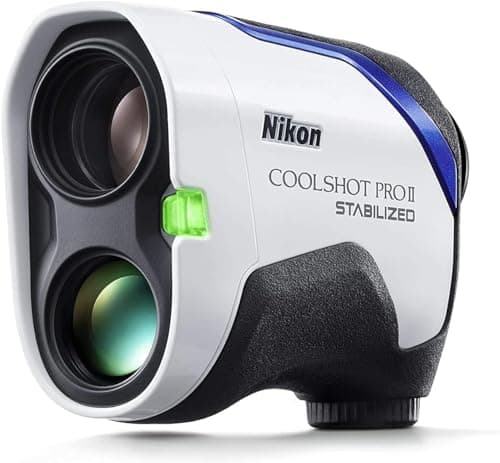
1. Nikon COOLSHOT PROII STABILIZED — the answer, if a tremor is the problem.Nikon’s STABILIZED function is the only mid-priced implementation of the thing this page is about, and the published claim is specific enough to trust: viewfinder vibration from hand movement cut to one fifth or less. Add the red internal OLED display, which is the easier readout to resolve in low contrast, and ID slope that switches off with an external compliance light so the same unit covers a medal round. What you give up: a magnetic mount, which it does not have, and roughly double the price of a basic laser. It is also light at a published 6.3 oz, so the stabilization is carrying more of the load than it would in a heavier body.

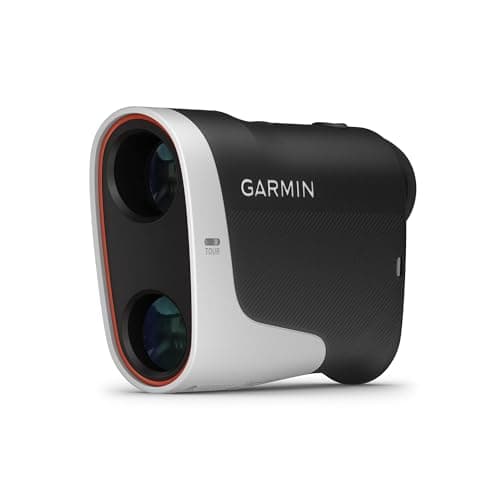
2. Garmin Approach Z30 — stabilization plus a second screen.Garmin publishes image-stabilized 6x glass with vibration feedback on lock, so it belongs in the same conversation as the Nikon. What earns it second place rather than fifth is Range Relay: the measured distance is pushed to a paired Garmin watch, handheld, or the Garmin Golf app. Read that as an accessibility feature and it is the best one on this page — the number survives you taking the device away from your eye, so you never have to re-acquire a flag just to re-read a yardage you already got. PlaysLike slope turns off with a three-second mode-button hold and a green tournament light. It is the most expensive unit here, and Range Relay is much less compelling if you do not already own a Garmin watch.

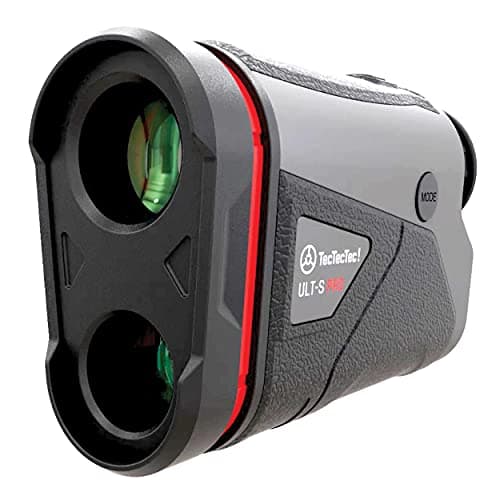
3. TecTecTec ULT-S Pro — stabilization at half the price.The budget surprise of this page, and the pick most readers will actually buy. TecTecTec publishes it as OIS — Optical Image Stabilization — which it describes as keeping the image in place and steady and removing “factors such as a shaky hand or wind”, with the field of view effectively slowing down so the target is easier to capture. It lands at roughly half the Nikon PROII and a third of the Garmin, adds Target Lock vibration on lock and a red TOLED display with four luminosity settings, and slope toggles with a pull-out faceplate so it drops into a tournament-legal mode without a menu. The honest caveats are real: TecTecTec publishes no quantified shake-reduction figure the way Nikon does, so you are trusting a feature claim rather than a measured one; the glass and elements compensation do not match a top-tier Bushnell; and it runs a CR123 cell rather than the rechargeable some rivals now include. Start here, and move up to the Nikon only if it is not enough.

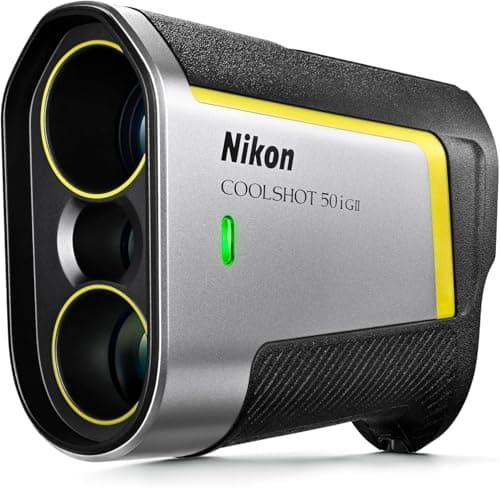
4. Nikon COOLSHOT 50i GII — confirmation without the stabilization premium.Nikon’s 2025 mid-range laser. No STABILIZED function — the model name is the tell, and we are not going to pretend otherwise — but Dual LOCKED ON QUAKE is the best confirmation system in this group: Nikon publishes that when overlapping subjects are measured, the nearest is shown with a red LOCKED ON sign in the viewfinder and a simultaneous brief vibration. Two signals, one of which you can feel. It also adds the magnetic mount the PROII lacks. Buy this if your problem is uncertainty about whether you hit the flag; do not buy it if your problem is holding the flag at all.

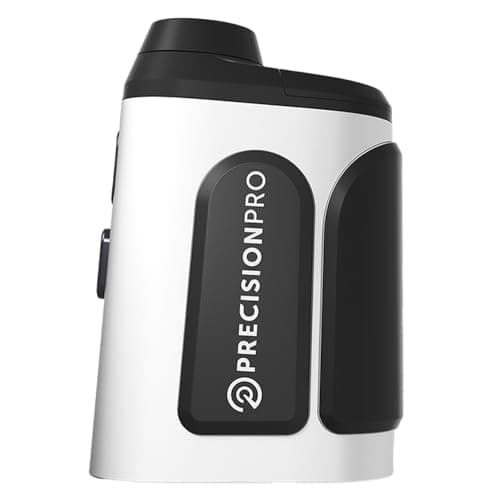
5. Precision Pro NX10 Slope — steadied by physics, not optics. A published 12 oz makes this the heaviest device on the page, and for a mild shake that mass genuinely helps. Precision Pro’s own description of the magnet — one that grabs the cart bar and does not let go, even over the bumps between 8 and 9 — points at the other half of the problem: a device that lives in reach is a device you do not have to fish out of a pocket with stiff fingers. Slope is tournament legal at the flick of a switch, and the 3-year full-coverage warranty plus a 90-day satisfaction guarantee with free returns is real insurance when you are buying on ergonomics you cannot assess until it arrives. No optical stabilization at all, and no published water rating.

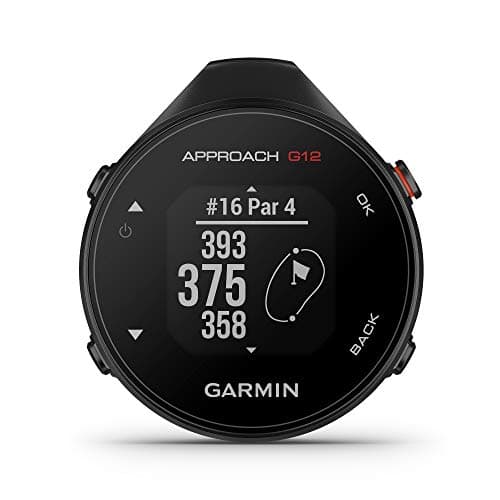
6. Garmin Approach G12 — stop aiming entirely. This is the honest pick, and for some readers it is the rightpick rather than a consolation. A clip-on GPS requires no aiming, no steadiness and no eye at an eyepiece: it clips to a belt, a pocket or a bag, and you glance at front, center and back distances. Garmin lists 42,000-plus preloaded courses with no subscription and free course updates, on a rechargeable battery Garmin quotes at up to 30 hours in GPS mode — several rounds between charges, and no small cell to seat with stiff fingers. Two honest caveats: GPS reads to the green, not to the flag, so it is less precise than any laser above; and the screen is small, so if legibility rather than steadiness is your main problem, a watch or a large-display handheld reads better.

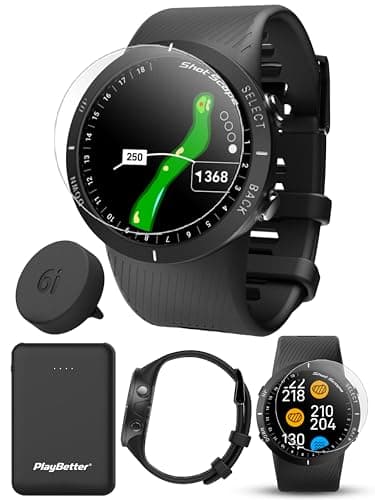
7. Shot Scope V5 — hands-free, on your wrist.The most accessible format of all: distances on a watch face, no device to hold, nothing to retrieve, nothing to drop. Front, middle and back yardages plus hazards and layups on 36,000-plus courses, and automatic shot tracking with a free-for-life stats dashboard — no subscription for any of it. The honest cons: you have to screw small tracking tags into your grips to get the tracking, which is itself a fiddly job for arthritic fingers, and like every GPS it reads to the green rather than the pin.

Laser or GPS: the decision this page is really about

Most readers arrive here wanting a better laser. Some of you should be buying a GPS, and the test is simple: how often do you currently fail to get a reading at all?

If it takes you two or three attempts but you get there, a laser is still the right tool — you are losing time, not information, and stabilization or mass fixes it. If you routinely give up, or you have stopped carrying the device because it is embarrassing to hold up play, that is not a problem a better laser solves. A GPS unit removes the aiming task from golf entirely. You lose the precision of a laser locked onto the actual flag, which on a deep green is a real club, and you gain a yardage you can get every single time in two seconds. Our rangefinder vs GPS guide works through the wider trade-off, and the best golf GPS watches roundup ranks the wrist-worn field properly.

Free things that help more than you expect

Before you spend, four techniques that cost nothing and are worth more than one tier of price:

  • Use two hands and brace your elbows. Pull both elbows into your ribs and hold the device with both hands. This is the standard fix riflery and photography arrived at independently, and it removes more shake than any feature you can buy.
  • Rest it on something. The cart roof bar, a bag strap, the top of a fence post. Contact with any rigid object transforms the picture.
  • Range the flag when you arrive, not when you are out of breath. Tremor amplifies with exertion and with cold. Take the number as you walk up, while your hands are still steady.
  • Range a bigger target and do the math. Bunker lip, front edge, the tree line behind. Big targets are far easier to hold, and front-edge plus your own estimate of pin position is often all the precision the shot deserves anyway.

One rules note before you buy slope

Every laser on this page has a slope mode, and every one of them can switch it off. That matters because under Rule 4.3 of the Rules of Golf, getting distance information with a device is allowed but getting elevation-changeinformation is not — so in competition, slope must be disabled. Both Nikons signal compliance with an external Actual Distance Indicator LED; the Garmin shows a green light on top of the unit; the Precision Pro uses a physical switch. If you only ever play casual golf, slope is a genuinely useful feature and you should use it. Our are rangefinders legal page covers the rule properly, and what slope actually does explains the math it is doing.

The short answer

Quick picks

#ProductBest forScorePrice
01
Nikon Nikon COOLSHOT PROII STABILIZED
Nikon COOLSHOT PROII STABILIZED

The one rangefinder built for a hand that will not hold still: Nikon publishes the STABILIZED function as cutting viewfinder shake to one fifth or less, and nothing else near this price claims it at all.

Shaky hands, full stop
8.2
$296.95Amazon
02
Garmin Garmin Approach Z30
Garmin Approach Z30

Image-stabilized 6x glass plus Range Relay: it buzzes when it locks the flag, then throws the number onto your Garmin watch or phone so you never have to re-aim just to re-read it.

Stabilization plus a second screen
8.2
$446.48Amazon
03
TecTecTec TecTecTec ULT-S Pro
TecTecTec ULT-S Pro

The value laser with the premium trick that matters most for shaky hands — optical image stabilization — plus switchable slope.

Steadier lock for unsteady hands
7.8
$149.99Amazon
04
Nikon Nikon COOLSHOT 50i GII
Nikon COOLSHOT 50i GII

Nikon's 2025 mid-range laser: no stabilization, but Dual LOCKED ON QUAKE both buzzes and flashes when it has the flag, so you are told you succeeded instead of having to hold the picture and squint.

Lock confirmation without the stabilization premium
7.8
$246.95Amazon
05
Precision Pro Precision Pro NX10 Slope
Precision Pro NX10 Slope

The value pick, and the heavy one: a published 12 oz of body mass damps a mild shake all by itself, and a strong magnet means you never have to dig it out of a pocket.

A mild shake on a budget
7.8
$249.99Amazon
06
Garmin Garmin Approach G12
Garmin Approach G12

GPS distances without a watch on your wrist — a tiny clip-on that reads front/center/back and lasts up to 30 hours on a charge.

GPS for people who won’t wear a watch
7.2
$134.99Amazon
07
Shot Scope Shot Scope V5
Shot Scope V5

The GPS watch that also tracks every shot and hands you the stats — automatic performance tracking, no subscription, ever.

GPS plus free shot tracking
8.0
$259.99Amazon

#ad · Live prices from the Amazon Product API, as of October 9, 2026. Where we have no verified live price, we show none — we would rather leave a gap than print a number that has rotted.

In detail

The picks, in full

01
Nikon Nikon COOLSHOT PROII STABILIZED

Shaky hands, full stop

Nikon COOLSHOT PROII STABILIZED

STABILIZED optical shake reduction (Nikon)6x magnification, 21 mm objective8-1,200 yd range; red OLED displayID slope, switchable with ADI light
8.2/10

The one rangefinder built for a hand that will not hold still: Nikon publishes the STABILIZED function as cutting viewfinder shake to one fifth or less, and nothing else near this price claims it at all.

Accuracy
9
Speed/UX
9
Features
7
Ergonomics
9
Value
7

Pros

  • Nikon's published claim is specific rather than marketing fluff: the STABILIZED function reduces viewfinder image vibration caused by hand movement to one fifth or less, which is the whole reason this page exists — a steadier picture means the beam stays on the flag long enough to return a reading
  • A red internal OLED readout instead of the usual black LCD, which is the easier of the two to read against a dark tree line — the other half of the aiming problem for older eyes
  • ID (Incline/Decline) slope can be switched off, and an external Actual Distance Indicator LED shows playing partners and officials that it is off, so one device covers casual rounds and competition

Cons

  • Stabilization costs money: this is a mid-price laser in a category where sub-$150 units exist, and the premium buys steadiness rather than extra range or features
  • At a published 6.3 oz it is light, which cuts both ways — body mass damps tremor on its own, so the stabilization here is doing more work than it would in a heavier unit

Skip this if…

…your hands are steady. Stabilization is the only reason to pay this much for a 6x laser with no magnetic mount and no app — a steady-handed golfer gets the same yardage from a unit costing half as much.

$296.95View on Amazon

$449.9534% off

Price as of October 9, 2026. Prices change — Amazon's is the one that counts.

#ad · we may earn a commission from this link to Nikon COOLSHOT PROII STABILIZED

02
Garmin Garmin Approach Z30

Stabilization plus a second screen

Garmin Approach Z30

Image-stabilized 6x glass (Garmin)400 yd to flag, 1,300 yd reflectiveRange Relay to watch / Garmin Golf appTransparent OLED; CR2, up to 1 yr
8.2/10

Image-stabilized 6x glass plus Range Relay: it buzzes when it locks the flag, then throws the number onto your Garmin watch or phone so you never have to re-aim just to re-read it.

Accuracy
9
Speed/UX
9
Features
9
Ergonomics
8
Value
6

Pros

  • Garmin publishes image stabilization plus vibration feedback on lock, which is exactly the pair a shaky grip needs: the picture settles enough to aim, and the buzz tells you it worked without you having to hold that picture steady while you read
  • Range Relay pushes the measured distance to a paired Garmin watch, handheld or the Garmin Golf app — so the reading survives the moment you take the laser away from your eye, which is the most quietly useful accessibility feature on this page
  • PlaysLike slope adjustment, disabled by a three-second hold of the mode button with a green tournament light on top of the unit, so the same device is legal when you need it to be

Cons

  • The most expensive unit on this page, and a chunk of that price is the Garmin ecosystem — Range Relay is far less useful if you do not own a Garmin watch or use the Garmin Golf app
  • At a published 7.4 oz it is the heaviest laser here, which is a plus against tremor but a minus if a weak or arthritic grip is the real problem

Skip this if…

…you want the cheapest route to a steadier picture. Nikon's PROII STABILIZED does the stabilization job for meaningfully less; the Z30's extra money buys connectivity, not more stability.

$446.48View on Amazon

$489.999% off

Price as of October 9, 2026. Prices change — Amazon's is the one that counts.

#ad · we may earn a commission from this link to Garmin Approach Z30

03
TecTecTec TecTecTec ULT-S Pro

Steadier lock for unsteady hands

TecTecTec ULT-S Pro

Laser6x magnificationImage stabilizationSlope (switchable)
7.8/10

The value laser with the premium trick that matters most for shaky hands — optical image stabilization — plus switchable slope.

Accuracy
8
Speed/UX
8
Features
7
Ergonomics
8
Value
8

Pros

  • Optical image stabilization steadies the view, which is the single biggest help for anyone who struggles to hold a laser still on the flag
  • Slope toggles via a pull-out faceplate, so it drops into a tournament-legal mode
  • 6x magnification and a listed fast read — mid-tier performance without a top-tier price

Cons

  • Stabilization aside, it doesn’t match a Pro X3+ on glass, display brightness or elements compensation
  • Uses a CR123 battery rather than the rechargeable cell some rivals now include

Skip this if…

…you already hold a rangefinder rock-steady. Stabilization is the whole reason to pay over a plain VPRO500 or Blue Tees; if a jittery view isn’t your problem, you’re paying for a fix you don’t need.

$149.99View on Amazon

Price as of October 9, 2026. Prices change — Amazon's is the one that counts.

#ad · we may earn a commission from this link to TecTecTec ULT-S Pro

04
Nikon Nikon COOLSHOT 50i GII

Lock confirmation without the stabilization premium

Nikon COOLSHOT 50i GII

6x magnification, 22 mm objective6-1,200 yd range; magnetic mountDual LOCKED ON QUAKE (vibration + sign)ID slope, switchable with ADI light
7.8/10

Nikon's 2025 mid-range laser: no stabilization, but Dual LOCKED ON QUAKE both buzzes and flashes when it has the flag, so you are told you succeeded instead of having to hold the picture and squint.

Accuracy
8
Speed/UX
8
Features
7
Ergonomics
8
Value
8

Pros

  • Dual LOCKED ON QUAKE is the feature to understand here: Nikon says that when overlapping subjects are measured, the nearest is displayed with a red LOCKED ON sign in the viewfinder and a simultaneous brief vibration — two separate confirmations that you hit the flag and not the trees behind it
  • A magnetic mount, which the PROII does not have — it parks on the cart bar instead of rattling round a pocket, and that genuinely matters when gripping and ungripping is the hard part of your round
  • Nikon's 2025 model, rainproof, rated to work from -10°C to +50°C, and ID slope switches off with the same external ADI compliance light as the PROII

Cons

  • No STABILIZED function — Nikon only puts that in the PRO line and the model name is the tell, so if a tremor is your actual problem this is the wrong Nikon
  • A published 4.5 inches long makes it the bulkier of the two Nikons, and the readout is in-viewfinder only, so there is no way to re-read a number without re-aiming

Skip this if…

…a tremor is stopping you getting a reading at all. Confirmation feedback tells you whether you succeeded; it does not help you succeed. Pay up for the PROII STABILIZED or move to GPS.

$246.95View on Amazon

$299.9518% off

Price as of October 9, 2026. Prices change — Amazon's is the one that counts.

#ad · we may earn a commission from this link to Nikon COOLSHOT 50i GII

05
Precision Pro Precision Pro NX10 Slope

A mild shake on a budget

Precision Pro NX10 Slope

6x magnification, 24 mm objective999 yd max, 400 yd flag lockMagnetic cart mount; 12 ozSlope switch; 3-year warranty
7.8/10

The value pick, and the heavy one: a published 12 oz of body mass damps a mild shake all by itself, and a strong magnet means you never have to dig it out of a pocket.

Accuracy
8
Speed/UX
7
Features
7
Ergonomics
8
Value
9

Pros

  • Weight is an underrated tremor tool and this is the heaviest unit here at a published 12 oz — mass resists small involuntary movement in a way no electronics can, which is the same reason camera operators shoot handheld on heavy rigs
  • Precision Pro describes the magnet as one that grabs the cart bar and does not let go, even over the bumps between 8 and 9, so the device lives in reach instead of needing a pocket fished for every shot
  • Slope is tournament legal at the flick of a switch, and the brand bundles a 3-year full-coverage warranty with a 90-day satisfaction guarantee and free returns — cheap insurance on a device you may need to send back if the ergonomics do not suit you

Cons

  • No optical stabilization of any kind — the steadiness here is physics and nothing else, so a genuine tremor will still defeat it
  • Precision Pro does not publish a water-resistance rating for this model on its own product page, so treat it as shower-proof rather than rainproof and keep a towel over it

Skip this if…

…your hands shake enough that you currently fail to get a reading at all. This is the right buy for it-takes-me-three-tries, not for I-cannot-hold-it-on-the-flag — that reader wants the stabilized Nikon or a GPS unit.

$249.99View on Amazon

Price as of October 9, 2026. Prices change — Amazon's is the one that counts.

#ad · we may earn a commission from this link to Precision Pro NX10 Slope

06
Garmin Garmin Approach G12

GPS for people who won’t wear a watch

Garmin Approach G12

Clip-on GPS42,000+ coursesNo subscriptionUp to 30 hr battery
7.2/10

GPS distances without a watch on your wrist — a tiny clip-on that reads front/center/back and lasts up to 30 hours on a charge.

Accuracy
7
Speed/UX
7
Features
6
Ergonomics
8
Value
8

Pros

  • Clips to a belt, pocket or bag for players who don’t want a watch or a device to hold
  • Garmin lists 42,000+ preloaded courses with no subscription and free course updates via the app
  • Long rechargeable battery — Garmin quotes up to 30 hours in GPS mode, several rounds between charges

Cons

  • Small screen shows the numbers and little else — no full-color hole graphics
  • Like any GPS, it reads to the green, not a laser-exact number to the flag

Skip this if…

…you want hole maps and green graphics, or an exact distance to the pin. This is a stripped-back numbers-only clip-on; a mapping handheld like the Phantom 2 or a laser suits those needs better.

$134.99View on Amazon

$149.9910% off

Price as of October 9, 2026. Prices change — Amazon's is the one that counts.

#ad · we may earn a commission from this link to Garmin Approach G12

07
Shot Scope Shot Scope V5

GPS plus free shot tracking

Shot Scope V5

GPS watchAutomatic shot trackingNo subscription36,000+ courses
8.0/10

The GPS watch that also tracks every shot and hands you the stats — automatic performance tracking, no subscription, ever.

Accuracy
7
Speed/UX
8
Features
9
Ergonomics
8
Value
8

Pros

  • Automatic shot tracking via included tags records every shot, then feeds strokes-gained and handicap-benchmark stats to the app — with no subscription for any of it
  • Front/middle/back distances plus hazards and layups on Shot Scope’s 36,000+ preloaded courses
  • The whole performance dashboard is free for life, which is where launch-monitor and app rivals usually start charging

Cons

  • You have to screw the little tracking tags into your grips to get the automatic tracking
  • GPS distances read to the green, not the flag, like every GPS unit here

Skip this if…

…you just want yardages and will never look at a stats dashboard. The shot tracking is the whole point of paying for this over a plain GPS watch — skip it and a simpler Garmin does the distance job for less faff.

$259.99View on Amazon

Price as of October 9, 2026. Prices change — Amazon's is the one that counts.

#ad · we may earn a commission from this link to Shot Scope V5

What the stabilization premium actually costs

The useful way to think about this category is that there are three price tiers and the thing separating them is not range or accuracy — every unit here is accurate to about a yard and ranges far further than any golfer needs.

The entry tierbuys you a working laser: 6x glass, flag lock, a buzz, slope you can switch off. The site’s budget rangefinder roundup covers that field, and for a steady-handed golfer it is honestly all you need. With one exception — the TecTecTec ULT-S Pro, which appears in both roundups and is reviewed on its own in our TecTecTec ULT-S Pro review — nothing in that tier addresses shake at all.

The mid tier— where the TecTecTec ULT-S Pro, the Nikon 50i GII and the Precision Pro NX10 sit — buys you better feedback, better glass and, in the NX10’s case, useful mass and a strong magnet. The ULT-S Pro is the outlier here because it puts stabilization into this tier at all, which is why it is the value sweet spot of the page.

The stabilized top tier— the Nikon PROII and the Garmin Z30 — buys a better-documented version of that same feature, plus the glass and the display to go with it. Expect to pay roughly double the ULT-S Pro for the Nikon and more again for the Garmin. If a tremor is genuinely stopping you getting readings and the cheap stabilized unit has not solved it, that premium is the best money on this page; if your hands are steady, it is money spent on a feature you will never notice.

The honest cost comparison nobody runs:a GPS watch often costs less than a stabilized laser and removes the problem rather than mitigating it. If you are deciding between the Nikon PROII and a GPS watch, you are not deciding between two prices — you are deciding whether precision to the flag is worth the aiming task to you. That is a real question with no universal answer, and anyone who tells you the laser is simply better has not thought about your hands.

On batteries, since it comes up.Every laser here runs a replaceable lithium cell rather than a rechargeable one — a CR2 on the Garmin and the Precision Pro, a CR123 on the TecTecTec. Garmin publishes up to a year of battery life; Precision Pro quotes roughly 50 rounds. Changing one means opening a small compartment and seating a small cylinder, which is worth a thought if dexterity rather than tremor is your issue. Both GPS picks charge on a cable and never ask that of you.
How we ranked this

We don't run a testing lab — and we say so

We compiled published manufacturer specifications, official standards and aggregated owner reviews, computed the running costs the big test-labs leave out, and scored each pick against a published rubric. The scores are judgments from documented research — they are not lab measurements we took, because we don't have a lab and we're not going to pretend we do. You can check every number we publish.

Questions

Frequently asked

What is the best golf rangefinder for shaky hands?
The Nikon COOLSHOT PROII STABILIZED. It is one of only three golf lasers that publish genuine optical image stabilization, and Nikon is the only maker that quantifies the effect: viewfinder vibration caused by hand movement reduced to one fifth or less. The Garmin Approach Z30 is the premium alternative and adds Range Relay, so the yardage appears on your watch or phone. The cheapest route to stabilization is the TecTecTec ULT-S Pro, which costs roughly half the Nikon and is where we would start. If a laser defeats you entirely, a GPS unit removes the aiming task altogether.
Do golf rangefinders have image stabilization?
Almost none do. Three publish it: Nikon's COOLSHOT PRO models (STABILIZED is part of the model name), the Garmin Approach Z30, which Garmin describes as having image-stabilized 6x glass, and the much cheaper TecTecTec ULT-S Pro, whose own product name reads "with Stabilization, Slope & Vibration". Everything else in the category advertises flag lock or a vibration buzz instead — those confirm that you hit the flag, they do not help you hold the device on it. If stabilization is what you need, the model name or the published spec list is the only reliable way to find it.
Does a heavier rangefinder help with shaky hands?
Yes, modestly, and it is a real effect rather than a marketing one. Mass resists small involuntary movement — the same reason a heavy camera rig is steadier handheld than a phone. The Precision Pro NX10 is the heaviest unit on this page at a published 12 oz, against 6.3 oz for the Nikon PROII, and that difference is noticeable in the hand. Weight will not beat optical stabilization for a genuine tremor, but for a mild shake it is a cheap way to buy some of the same benefit.
Should I buy a GPS instead of a rangefinder if my hands shake?
Use this test: if it takes you two or three tries to get a reading but you get there, a laser is still the right tool and stabilization or extra weight will fix it. If you routinely fail, or you have stopped carrying the device because holding up play is embarrassing, buy a GPS. You give up precision — GPS reads to the green, not the flag, which on a deep green is a real club — and you gain a number you can get every time, in two seconds, with no aiming at all. Our rangefinder vs GPS guide covers the full trade.
Does higher magnification make a rangefinder harder to hold steady?
Yes. Magnification multiplies the movement of the image as well as its size, so at 6x a small wobble of your hand becomes a large movement in the viewfinder, inside a narrower field of view. That is why a tremor you barely notice when pointing at something makes a golf laser feel impossible. It is also why stabilization matters more than magnification: 6x is the standard across this whole page, so the differentiator is what each device does about the shake, not how much it magnifies.
Can I use slope mode in a competition?
No. Under Rule 4.3 of the Rules of Golf, taking distance information with a device is allowed but taking elevation-change information is not, so slope must be switched off in competition. Every laser on this page can do that, and each signals it differently: both Nikons light an external Actual Distance Indicator LED, the Garmin Z30 shows a green tournament-mode light on top of the unit after a three-second button hold, and the Precision Pro NX10 uses a physical switch. For casual golf, leave slope on — it is genuinely useful.

Keep reading

Receipts

Sources

We do not run a testing lab, and we do not pretend to. Every spec number here comes from a manufacturer's published sheet or an official standard, cited above. Where we could not verify something, we say so on the page rather than quietly leaving it out. Read our full method.