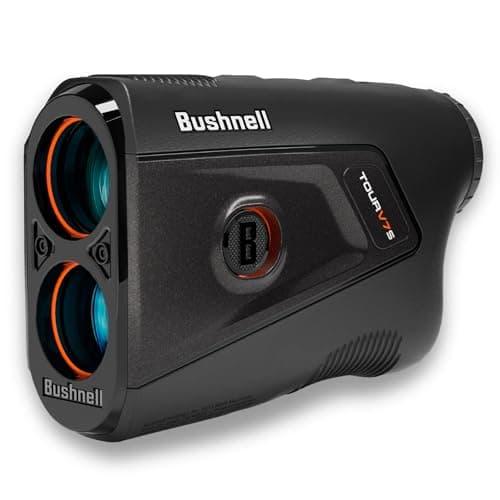
The Bushnell Tour V7 Shift is the current version of the laser that most serious club golfers end up owning, and it is the one we rank first in our rangefinders roundup. It earns that position without a single headline feature: what you are buying is a lock you trust, a slope switch you can flip on the tee, a magnet that keeps the unit on the cart bar, and a display that is legible in flat light. Bushnell publishes it at 6x magnification, a 5–1,300 yard ranging range with “accurate flag detection from 5 to 500 yards”, plus or minus one yard of accuracy, and 9 ounces on the scale. At a published $399.99 it is also one of the easiest lasers on the market to talk yourself out of, and this review spends as much time on that as on the specification.
What it is
The Tour V7 Shift sits in the middle of Bushnell’s laser line: above the value field, below the Pro X3+ flagship. The “Shift” in the name is the slope switch, an external control that turns the elevation-compensation feature off so the same unit becomes a legal, distance-only device in competition. The headline change over the outgoing Tour V5 Shift is the display: Bushnell publishes a red/green OLED on the V7, where the V5 used an LCD with a visual-JOLT ring. OLED is the practical upgrade here rather than a cosmetic one, because an emissive display stays legible against a dark treeline and in flat overcast light, which is exactly where an LCD reticle disappears.
Everything else is the Bushnell recipe, unchanged because it works. PinSeeker with Visual JOLT confirms the moment the unit grabs the flag rather than the trees behind it. The BITE magnet is built into the housing, so the laser lives on the cart bar instead of in a pocket. It is IPX6 water resistant, runs on a single replaceable 3-volt CR2 lithium cell (one included), measures 3.1 by 1.6 by 4.5 inches, and carries a two-year limited warranty.
The specification, as Bushnell publishes it
| Specification | Published figure |
|---|
| Magnification / objective | 6x / 24 mm |
| Ranging range | 5–1,300 yards |
| Flag detection | 5–500 yards |
| Accuracy | +/- 1 yard |
| Display | Red/green OLED |
| Field of view / eye relief | 330 ft at 1,000 yards / 16 mm |
| Slope | Yes, with external Slope Switch |
| Mount | BITE magnetic mount |
| Water resistance | IPX6 |
| Battery | 3-volt CR2 lithium, replaceable (one included) |
| Size / weight | 3.1 x 1.6 x 4.5 in / 9 oz |
| Warranty / published price | Two-year limited / $399.99 |
Two of those numbers deserve reading carefully. The 1,300-yard ranging range is a reflective-target figure and has nothing to do with golf; what matters is the 500-yard flag detection, and even that is three times further than any approach shot you will hit. And the 16 mm eye relief is the spec nobody shops on and glasses wearers should: it is what decides whether you can see the whole display without taking your glasses off.
Where it is genuinely good
The lock is the reason to buy a Bushnell, and it is as much a user-interface achievement as an optical one. Plenty of lasers return an accurate number; fewer tell you with confidence that the number belongs to the flag. PinSeeker with Visual JOLT flashes and pulses the instant it locks the pin, and the practical effect is that you stop re-shooting. Over eighteen holes that is a pace-of-play feature as much as an accuracy one.
The OLED display is the real upgrade over the previous generation, and it is the kind of improvement you only notice in bad conditions. A dual-color emissive display can be read against a dark background in flat light, where a black LCD reticle on a shaded green goes invisible. Bushnell also orders the display so the slope-adjusted figure reads first, which sounds trivial until you are standing over an uphill approach.
Then the two small things that decide whether a laser gets used. The BITE magnet means it sits on the cart bar within reach instead of being dug out of a pocket, and IPX6 means a wet round is not an event. Neither is exciting. Both are why the unit is in your hand when you need the number.
Where it falls short
The honest criticisms are about value and position, not performance. First, the price. A switch-equipped value laser gives you the same one-yard yardage to the same flag for a fraction of the money, and if your current lock speed is already fine, the Tour V7 is the nicer instrument rather than a more accurate one. Our budget rangefinder ranking exists precisely because that is the right call for a lot of golfers.
Second, it is a 6x unit with no temperature or altitude compensation. Bushnell reserves both the 7x glass and the Elements compensation feature for the Pro X3+. If you want every yard accounted for at elevation or in real heat, the V7 is deliberately not that device. And third — a point the marketing never makes — a laser does not read the green. It gives you a distance to the flag, not front and back numbers, so a tucked pin on a thirty-yard green is still a judgment call. That is a GPS job.
Slope, and staying legal
The Slope Switch is what a competitive golfer is actually paying for. Under Rule 4.3 of the Rules of Golf you may obtain distance information, but using a device to gauge elevation change in a counting round is a breach. The external switch makes compliance a one-second job on the first tee, and it leaves the unit in an unambiguous, distance-only state — which is a real advantage over a value laser whose slope hides inside a mode cycle. Always check your committee’s local rule as well, because some events ban devices outright. The full picture is in are rangefinders legal, and what is slope on a rangefinder explains what the feature is doing to the number.
Who should buy it
Buy the Tour V7 Shift if you play a mix of casual and competition golf and you want one instrument that handles both cleanly for years. The combination that justifies the price is specific: a confirmed lock you stop second-guessing, a slope feature you can switch off legally without a menu, a magnet you use on every hole, and a display that works in the light you actually play in. If you wear glasses, the 16 mm eye relief is a further argument. And if your current laser is an older no-slope unit you have stopped trusting, this is the upgrade that ends the conversation.
Who should skip it
Two buyers, clearly. Skip it if a value laser already locks the flag fast enough for the way you play — a slope-capable budget unit gives you the same number, and the difference is better spent on a lesson or on the club your bag is missing. Skip it in the other direction if you specifically want 7x optics or Elements temperature and altitude compensation, which is Pro X3+ territory. And if what you really want is the whole green at a glance rather than a pinpoint number, buy a watch instead: best golf GPS watches ranks that field, including the no-subscription options.
The verdict
The Tour V7 Shift is the best all-round laser Bushnell sells and the one we would buy with our own money if the budget allowed, because the OLED display and the legality switch are genuine improvements rather than specification padding. It is also, straightforwardly, more rangefinder than many golfers need. Our buying advice has not changed because this unit exists: if a value laser does the job for you, buy the value laser and bank the difference. If you want the one you will still be using in ten years, this is it. Everything above comes from Bushnell’s published specifications and aggregated owner feedback assessed against our rubric— we do not run a test lab and we are not going to pretend otherwise.
Tour V7 Shift vs Tour V5 Shift: is the upgrade worth it?
If you already own a Tour V5 Shift, no. The two share the lock behavior, the switchable slope and the BITE magnet — the three things that define the Tour line. The V7’s argument is the red/green OLED display in place of the V5’s LCD, which is a real readability gain in flat light and against dark backgrounds, and not worth replacing a working laser for. If you are buying your first premium laser and both are available, buy the V7 at a similar price and the V5 at a clearly lower one; the outgoing unit is still an excellent device, which is why its review stays on this site.
The running-cost question nobody asks
A laser has no subscription, and that is a bigger deal than it looks next to GPS devices whose better features sit behind an annual fee. The Tour V7’s only running cost is a CR2 lithium cell, which is a consumable you will buy rarely. There is also no course database to go stale: a laser measures what you point it at, so it works identically on a brand-new course and on one that has been re-routed. That is the quiet case for a laser over GPS for a golfer who travels to play, and it is covered properly in rangefinder vs GPS.
What a laser cannot do for you
Three honest limits, because a $400 device invites inflated expectations. It cannot read a green: you get the pin, not the front and back, so a long green with a tucked flag still needs judgment. It cannot steady your hands — if a handheld unit wobbles for you, that is a real fit problem and our rangefinders for shaky hands page addresses it directly. And it cannot club you: knowing the number only helps if you know your own carry distances, which is a range-session problem rather than a purchase.
Buying it without overpaying
Bushnell publishes $399.99, and the live price above is what it is actually selling for right now — check it rather than the MSRP, because premium lasers discount in the fourth quarter more than almost any other golf category. Two specific things to watch for. Patriot Pack and other bundle editions are the same unit with a different finish and a case, so compare them on the live figure rather than assuming the bundle is a saving. And if you are buying this as a gift, it is in our best golf giftsranking for a reason: it needs no size, no fitting and no knowledge of the recipient’s swing.