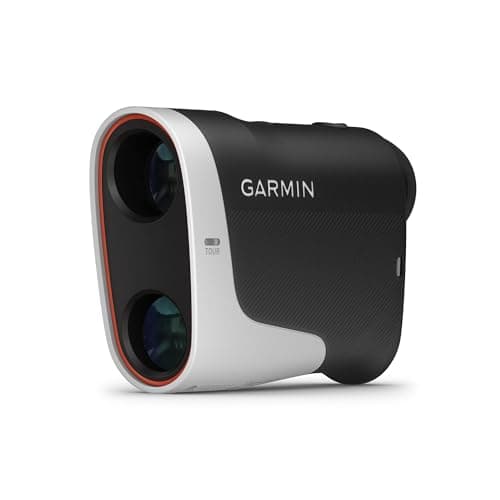
The Garmin Approach Z30 is the laser we rank second in best rangefinders for shaky hands, and it is the only rangefinder on this site that is really two products in one box: a stabilized laser, and a Garmin accessory. Which of those you are buying decides whether it is excellent value or expensive, and the answer has almost nothing to do with the optics.
Garmin publishes image stabilization in its own words — “Image stabilization makes it easier to find and range the flag. And when you lock in on it, vibrational feedback will let you know.” That pairing is the strongest part of the product and the reason it earns a place on this site at all. Range Relay, the feature Garmin leads its marketing with, is the part that needs a much more careful recommendation.
The published specification
Every figure below is from Garmin’s own US product page specification table, read on 2026-11-06. These are manufacturer claims, not our measurements — we do not run a lab and how we rank says so.
| Spec | Published figure |
|---|
| Magnification | 6x |
| Image stabilization | Yes (Garmin’s own product copy) |
| Laser range to flag | 400 yards / 366 meters |
| Laser range to reflective surface | 7–1,300 yards / 6–1,189 meters |
| Accuracy | Within 1 yard |
| Flag finder | Visual confirmation and vibrational feedback |
| Display | Transparent OLED, red |
| Slope | PlaysLike Distance; tournament legal with setting |
| Tournament mode | External indicator light |
| Connectivity | Bluetooth; Range Relay; Find My Garmin |
| Battery | Replaceable CR2, up to 1 year |
| Water rating | IPX7 |
| Laser class | Class 1 |
| Size / weight | 4.4 x 3.2 x 1.5 in (112 x 80 x 39 mm) / 7.4 oz (210 g) |
| In the box | Carry case with carabiner, hand strap, wipe cloth, CR2 battery, docs |
Two of those numbers get misread constantly. The 1,300-yard figure is the range to a large reflective target, which has nothing to do with golf; the number that matters is 400 yards to a flag, and that is already further than any approach shot you will ever play. And the up-to-one-year battery life is real but specific: it is a replaceable CR2 lithium cell, not a rechargeable pack, so there is no charging cable and no battery that degrades with cycles — just a coin cell you swap roughly once a season.
Stabilization is the feature worth paying for
At 6x magnification, every small tremor in your hands becomes a large movement of the picture. That is a problem long before you have a medical reason for it: cold hands, being out of breath after a hill, or simply holding a 7-ounce device at arm’s length will do it. The usual result is the beam drifting off the flag and locking onto a tree forty yards behind the green.
Almost every rangefinder sold advertises a flag-lock or pin-seeker feature with a buzz or a flash. Those are confirmationfeatures — they tell you whether you hit the flag. They do not make hitting it easier. Stabilization is the only feature in this category that reduces the difficulty of the aiming task itself, and very few golf lasers publish it. The Z30 does, and it pairs it with vibrational feedback on lock, which is the genuinely clever combination: the picture settles enough to aim, and then the buzz tells you it worked without you having to keep that picture steady while you read the number.
If an unsteady hand is your actual problem, that pairing is the whole case for this unit, and the rest of this review is secondary. Our shaky-hands roundup ranks the handful of lasers that publish stabilization against each other, including the cheaper ones.
Range Relay: brilliant for some golfers, irrelevant for most
Range Relay sends the measured distance from the laser to a paired Garmin smartwatch, handheld or the Garmin Golf app, where it can be drawn as an arc on a course map. Paired with a compatible device it will also show pin-relative front and back of green yardages, and Garmin says PlaysLike Distance factors in air density in that configuration.
Here is the honest read. If you already wear a Garmin golf watch, this is excellent and hard to go back from: the number survives the moment you take the laser away from your eye, you can glance at your wrist over the ball instead of re-shooting, and the laser becomes a precision input to a device you were already looking at. If you do not own a Garmin watch, you are paying a premium for a feature you cannot use, and the unit in front of you is a stabilized 6x laser at a price set by connectivity you will never switch on.
That is the single most important sentence in this review, because it is where most of the money goes. A laser is a laser: it measures what you point it at, there is no course database to license and no subscription of any kind. The Z30’s price premium over a very good value laser is almost entirely ecosystem, not accuracy. Our rangefinder vs GPS guide works through the broader version of that decision, and best budget rangefinders is where to look if lock speed is already fine for you.
Slope, tournament mode and the rules
PlaysLike Distance adjusts the yardage for elevation, and Rule 4.3 is clear that while you may obtain distance information, using a device to gauge elevation change is a breach in a counting round. So slope has to be switched off for competition, and the Z30 handles that better than most: Garmin publishes it as tournament legal with a setting, with an external indicator light so playing partners can see the device is only providing data within the rules.
That external light is a small thing that removes a real irritation. On units where slope is a menu toggle with no outward sign, you are trusting your own memory and asking your opponents to trust it too. Check your event’s local rule as well, since some competitions ban devices outright — are rangefinders legal covers the detail, and what is slope on a rangefinder explains what the adjustment is actually doing to the number.
The honest cons
It is expensive for what the optics are. Six-times magnification is standard in this category, not a premium figure. You are paying for stabilization plus Garmin connectivity, and if you only want one of those two there are cheaper routes to it.
At 7.4 oz it is heavy for a golf laser.Weight is a mild help against tremor, because a heavier body damps small movements. It is a hindrance if the real problem is a weak or arthritic grip, where holding a 210 g device steady at arm’s length is itself the difficulty. Those two cases look similar and want opposite answers.
The value case collapses outside the Garmin ecosystem. Said once more because it is the thing people get wrong: this is a very good laser and an excellent Garmin accessory, and the price is set by the second description.
Our verdict
Buy the Approach Z30 if you already wear a Garmin golf watch, or if a shaky hand is making lasers genuinely frustrating and you want the version of the fix that also talks to your phone. In the first case it is one of the most satisfying accessory purchases in golf. In the second it does the job, though a stabilized laser without the connectivity does the same job for less.
Buy something else if you have steady hands and no Garmin watch. You would be paying for two features you do not need and getting standard 6x optics for the money — the main rangefinder roundup has better value at every price below this one.