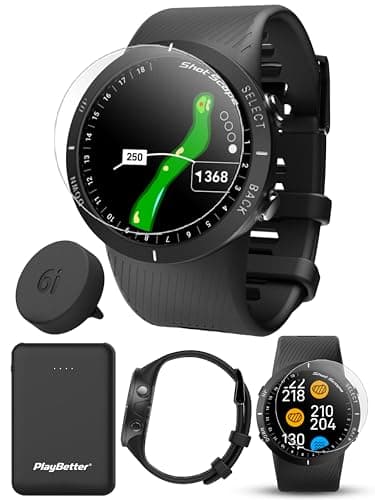
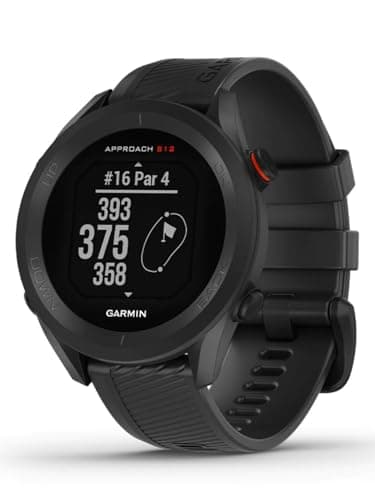
Here’s the honest headline: both of these are subscription-free GPS watches that give you front, middle and back distances to the green with a wrist-glance — and neither reads to the flag the way a laser does. The Garmin Approach S12 keeps it deliberately simple: yardages, a long battery, and nothing to babysit. The Shot Scope V5does the same distances and then adds the thing Garmin’s budget watch doesn’t — automatic shot tracking that feeds strokes-gained and handicap-benchmark stats to a dashboard that’s free for life. So the decision isn’t really about distance, where they’re close; it’s about whether you’ll actually use the stats. Check the live prices above, then read on.
What both share
The common ground is most of the watch. Both are GPS watches, so both read your position and show front, center and back distances to the mapped green plus basic hazard and layup numbers — the fast, whole-green view a laser can’t match. Crucially, both carry their course data with no subscription: Garmin lists 42,000+ preloaded courses, Shot Scope lists 36,000+, and neither charges a yearly fee to keep the maps working. That matters, because the yearly-cost creep is the one trap in GPS, and both of these sidestep it entirely — Shot Scope goes further and makes its whole performance dashboard free for life, where app-based rivals usually start charging. And both share the fundamental GPS limit: they read to the mapped green, not the flag, so for a pinpoint number to a tucked pin you’d still want a laser. On distance and on the no-fee promise, these two are level. The gap is what the Shot Scope does after the round.
Choose the Approach S12 if…
You want the yardages and nothing else to think about. The S12 is the simplest possible subscription-free GPS watch: a glance gives you the number to the green, its monochrome display drives one of the longest battery lives in the range — Garmin quotes up to 30 hours in GPS mode — and there are no tags to fit, no dashboard to check, no setup beyond charging it. For a golfer who just wants distances, hates faff, and would never open a stats app, that simplicity is the feature, and the S12 delivers it for less money than a stat-tracking watch. It’s also the lighter mental load: you charge it rarely and it gets out of the way. Our full Garmin S12 review covers it on its own.
Choose the Shot Scope V5 if…
You want to actually improve, and you’ll look at the numbers. The V5’s standout is automatic shot tracking: you screw the included tags into your grips, tap the watch, and it records every shot, then feeds strokes-gained analysis and handicap-benchmark stats to the app — all with no subscription, ever. That turns the watch from a distance tool into a practice tool: over a few rounds you learn which clubs and which parts of your game are actually costing you strokes, which is the kind of feedback that lowers a handicap. You still get the front/middle/back distances and hazards on the course; the tracking is the upgrade. It costs a bit more than the S12 and asks you to fit the tags, but for a stat-minded player that’s a small price. Our full Shot Scope V5 review covers it in detail.
How they actually differ
Two things separate them, and distance isn’t really one of them. The first and biggest is shot tracking and stats: the Shot Scope records every shot via its grip tags and hands you a free-for-life performance dashboard — strokes gained, club distances, tendencies — where the S12 simply shows the yardage and moves on. If you want to know why you’re shooting what you shoot, only one of these tells you. The second is battery and simplicity: the S12’s stripped-back monochrome screen buys up to a listed 30 hours in GPS mode and zero setup, while the Shot Scope trades a little of that simplicity for the tracking hardware and app. Neither has the color touchscreen of a pricier watch — both are numbers-first — so the choice is genuinely about whether you want a distance watch or a distance-plus-coaching watch, not about which shows the better map.
Will you actually use the stats?
This is the honest question the whole comparison turns on, so be truthful with yourself. The Shot Scope’s tracking is genuinely excellent and genuinely free — but it only pays off if you fit the tags, remember to use them, and open the dashboard afterward. A player who loves data and practices with intent will get real, handicap-lowering value from it. A player who just wants a number on the wrist and will never look at a strokes-gained chart is paying for a feature they’ll leave switched off — and for them the S12 is not a compromise, it’s the smarter, cheaper, longer-lasting buy. There’s no wrong answer; there’s only which golfer you honestly are. If the stats sound like something you’d use, the V5; if they sound like homework, the S12.
Skip the decision entirely if…
You want an exact number to the pin — because neither of these gives you that. Both read to the mapped green, not the flag, so if pinpoint approach yardages are the point, the money is better spent on a laser from the best rangefinders roundupthan on either watch. Skip it, too, if you want a bright color touchscreen and everyday-smartwatch features — neither of these plain watches offers that, and the AMOLED Garmin Approach S44 is the upgrade that does. And if price is the only thing that matters and you don’t need the stats, the whole subscription-free budget field — watches, clip-ons and handhelds — is ranked in our best budget golf GPS roundup.
The honest verdict
Buy the Shot Scope V5 if you’ll use the shot tracking — it’s the same on-course distances as the S12 plus a free-for-life stats engine that can genuinely lower your scores, and that’s a lot of value for a small step up in price. Buy the Garmin Approach S12 if you just want yardages, the longest battery and zero fuss — it does the core GPS job beautifully for less, with nothing to fit and nothing to check. Both are honest, subscription-free watches; the Shot Scope adds a coaching layer, the Garmin strips everything back to the number. Decide whether you’re a player who’ll study the data or one who just wants the distance, and the right watch picks itself.