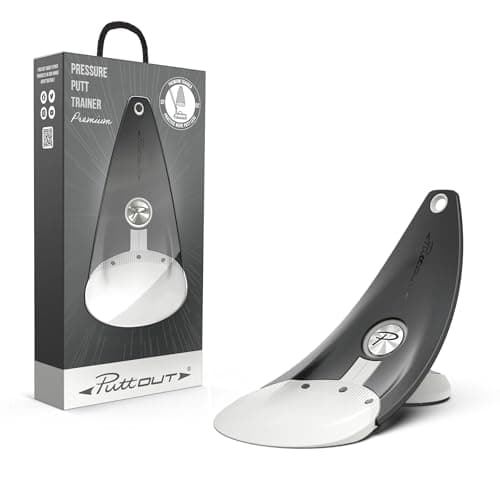
The PuttOut Pressure Putt Trainer is, for once, a gadget that fully earns its place. It is a small parabolic ramp you set where a hole would be: sink the putt on the right line and at the right pace and the ramp catches the ball and returns it the exact distance it would have rolled pastthe cup had you missed. Hit it too hard and the ball flies off the top; too soft and it rolls back short. In other words, it turns every practice putt into instant, honest feedback on the two things that decide short putting — start line and pace. That is why it sits on our list of aids that actually work.
What it is
The PuttOut is a curved plastic ramp with a small round target dish at its base, sized to simulate the leading edge of the hole. The parabola is the whole trick. When you hole a putt into it, the ball climbs the ramp, slows, and rolls back to you; the distance it returns is calibrated to represent how far past the hole the putt would have run at that speed. A putt struck at the ideal “dead-weight” pace — roughly the speed that would leave the ball tumbling in or finishing a foot past — returns a specific short distance. A putt hammered at it launches off the top of the ramp and away, exactly as a too-firm putt would lip out and race past in real life. And the small target dish means the ball only stays if your start line was true, so you are training aim and speed in the same stroke. It folds flat, weighs almost nothing, and works on the practice green or the carpet at home, which is where most putting practice actually happens.
Where it genuinely helps
Pace and start line, which between them are most of putting inside ten feet. The feedback is the reason it works. On a normal practice green you can roll twenty putts, miss half, and never be sure whether it was line or speed — the hole swallows a good putt and a lucky one identically. The PuttOut refuses to let you fool yourself: a putt that returns the right distance was struck at the right pace on the right line, and one that flies off or rolls back short was not, and you know which within a second. That tight, unambiguous loop is exactly what builds a skill, and it is why a cheap plastic ramp out-teaches a lot of electronic gadgets. It is also excellent for pressure practice — setting a target return distance and trying to hit it ten times in a row builds the kind of focused, consequence-carrying reps that make short putts hold up on the course. Cheap, tiny, portable, and genuinely effective: a rare combination on the training-aid rack.
Where it falls short
Be clear about the boundary. The PuttOut is a short-to-mid-range tool, and it does nothing for the part of putting that actually costs most amateurs their strokes: lag putting from distance. The three-putt that ruins a hole almost always starts with a poor first putt from thirty feet, and no small ramp on the carpet trains the speed control you need from range. It also cannot help you read a green — slope, grain and break are still all on you. And the target dish is genuinely small, so it rewards a near-perfect strike; early on that can feel punishing, and a beginner can leave a session feeling worse than they arrived. That is not a flaw so much as a scope limit, but it is worth knowing before you expect it to fix everything about your putting. It fixes a specific, important slice of it, extremely well.
What it does that a free drill can’t — and what it can’t
A lot of short-putt practice can be done for nothing. A chalk line or a pair of tees as a gate trains start line for free, and a putting mirrorsharpens your eye-line and setup more directly than the PuttOut does. What none of those free or cheap options gives you is the PuttOut’s pacefeedback — the return-distance mechanism that tells you, on every single putt, whether your speed was right. That is the one thing it does that a chalk line cannot, and it is the reason to own one. For distance control on longer putts, though, you are back to the old free drills: putt to a tee and try to stop the ball within a club-length, or ladder putts to the fringe. Pair the PuttOut for the short stuff with a pace drill for the long stuff and you have covered putting for almost nothing.
How it fits our feedback-vs-feel test
The whole ethos of this hub is separating aids that give real, immediate feedback from gadgets that only sell a feel, and the PuttOut is a textbook example of the good kind. It does not ask you to trust an abstract sensation; it hands you evidence on every putt and lets the ball’s behavior tell you the truth. That is why it scores highly for us on feedback quality and value, and why it is one of the few putting aids we recommend without a caveat about gimmickry. The only caveat is scope, not honesty.
How to actually practice with it
Do more than roll aimless putts at it. Start close — three or four feet — and learn what the ideal return distance looks like for a putt struck at true holing pace, then keep that same target return as you move back to six, eight and ten feet. The skill you are grooving is a consistent, slightly-firm-but-not-hard pace on line, and the return distance is your scorecard for it. Turn it into a game: try to earn the correct return ten times in a row, and start over on any miss, so the last putt carries a little pressure — that is what makes short putts hold up when they matter. For the putts the PuttOut cannot help with, add a free pace drill on a real green — lag putts from thirty feet and try to stop each within a club-length — and a chalk line or a mirror for start line and eye-line. The PuttOut trains the short ones; the drills cover the rest.
Build, size and portability
Part of the PuttOut’s appeal is how little there is to it. It is a single molded piece of plastic — no batteries, no app, nothing to charge or calibrate — and that simplicity is a strength: there is almost nothing to break. In our scoring it holds a solid durability mark, and the practical upshot is that it lives happily in a bag or a desk drawer and comes out whenever you have two minutes on a hard floor. It folds flat for travel, weighs next to nothing, and sets up on any carpet, which is the honest reason a tool like this actually gets used: the best putting aid is the one that is already out on the floor when you walk past it. Companion pieces — a longer mat, a ball-gathering gate — are sold alongside it, but the core trainer needs none of them; a ball and a flat surface is the whole kit. For a device this cheap and this portable to give feedback this good is genuinely unusual on the training-aid shelf.
Who should buy it
Anyone who misses too many putts inside ten feet, which is nearly everyone. It is especially good for a player who is unsure whether their short-putt misses are a line problem or a speed problem, because it separates the two cleanly. It is also an ideal first putting aid for a beginner, since roughly 40% of shots happen on the green and this returns more improvement per dollar than almost any full-swing gadget. Cheap enough to be an easy yes.
Who should skip it
Skip it if your putting problem is distance control on long putts — the PuttOut cannot teach the pace that prevents three-putts from range, and buying it expecting that will disappoint you; a chalk line, a mirror, or simple ladder drills will serve you better there. And if you already hole your short putts reliably and your misses come from misreading greens, this trains a skill you have already got. For everyone else who leaves too many short ones out on the low side, it is about as honest and effective as a putting aid gets.