Skip to content
Divot&Draw

The Practice · Training Aids

The Best Golf Putting Mats

A putting mat can fix your start line and your stroke. It cannot teach you pace, and most of them quietly teach you the wrong pace. Six mats ranked on what they genuinely train.

By Stephen V.Updated How we rank
#ad

We earn a commission when you buy through our Amazon links, at no extra cost to you. It never changes our rankings — and we'll tell you when the cheaper ball or club is the better buy. How this works.

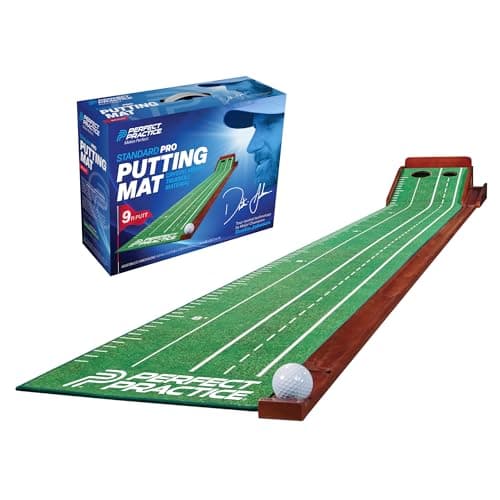
The best golf putting mat is the Perfect Practice Standard— a nine-and-a-half-foot velvet surface with two cups, one regulation size and one deliberately reduced. Perfect Practice publishes that pair at 2.56 and 3.35 inches on its Extra Long listing, against a regulation hole’s four and a quarter. That gap is the whole argument for spending real money on a mat: hole a putt into a cup barely wider than the ball and a genuine six-footer on grass starts to look like a bucket. If that is more mat than you want, the SKLZ Accelerator Prois the value pick and the one we hand most people, because it has the feature that decides whether a mat gets used at all — a ball return.

Before any of that, the honest part. A putting mat is a directiontrainer. It can groove a repeatable stroke, square up your start line and put a few hundred reps into your hands over a winter. What it cannot do is teach you pace, because no mat in this price range rolls at the speed of the greens you play — and a slow mat actively teaches you to hit putts too hard. Every ranking decision below follows from that split.

What a putting mat fixes, and what it quietly breaks

Putting has two independent variables: where the ball starts and how fast it is going. Miss on start line and you miss on the low side; miss on pace and you three-putt. They are trained completely differently, and a mat is only good at one of them.

Start line is a mat’s home ground. A flat, uniform indoor surface removes break, grain, slope and wind, so the only thing left to blame for a missed putt is you. Add a printed line, a narrow cup or a physical gate and the mat will tell you, honestly and immediately, that the ball left the face two degrees right. That is feedback you cannot get on a real green, where a putt that started badly and broke back in looks exactly like a good one.

Pace is where mats mislead. Short-pile synthetic turf is slow. Roll putts on a cheap mat all winter and your hands learn to deliver more speed than an actual green needs, which is why the first round of spring so often features two putts eight feet past the hole. There are only two honest responses: buy a genuinely fast surface (the velvet on the Perfect Practice is the closest thing here), or accept that you are practicing direction and do your pace work with a ladder drill on a real green. Anyone selling you a mat as a complete putting solution is selling you half a tool.

This is also the reason a mat and a feedback aid are not the same purchase. Our training aid roundupranks the aids; this page ranks the surfaces they sit on. The two best-known putting aids on this site — the PuttOut Pressure Putt Trainer and the GoSports alignment mirror — both need somewhere to live, and a mat is it.

How we ranked these (the criteria)

  • Does it give feedback, or just a target? Ranked first and weighted hardest. A narrow cup, a physical gate or a printed alignment line tells you something about the stroke you just made. A hole in a piece of turf tells you only whether the ball went in, which you already knew.
  • Whether it has a ball return. This is the most underrated feature in the category and the single best predictor of whether a mat is still in use in March. Walking nine feet after every putt turns a fifty-putt session into a chore; a return turns it into something you do during a phone call.
  • Surface speed, honestly described.We score what the maker publishes and say plainly when they publish nothing. Velvet-type surfaces roll meaningfully faster than short-pile turf. We have not measured any of them — we do not own a Stimpmeter and we are not going to pretend otherwise.
  • Usable length and width. Length sets the longest putt you can practice; width decides whether you can only roll one straight putt or work the cup from several angles. Most mats in this category are narrow on purpose, and a few are too narrow.
  • Whether it lies flat and stays put. A mat that keeps a shipping crease in it or creeps across the carpet as you putt is worse than no mat, because every putt has a defect in it you cannot see. Rubber backing and a crease-resistant roll are scored.
  • What it costs, honestly. Price sets expectations rather than buying a place in the order. The cheapest mat here is a legitimate recommendation for the right buyer, and the most expensive one is not the value pick.

Scores are judgments from published manufacturer specifications, listing details and aggregated owner feedback against our rubric— not lab measurements. We have not rolled a thousand putts on these mats in a controlled room; we do not run a lab, and we say so on every page that ranks anything.

The specs, side by side

Every figure below is the listing’s or maker’s own published specification. Blank cells are blank because nothing is published, which is itself worth knowing before you buy:

PickSize (published)CupsBall returnBuilt-in feedback
Perfect Practice Standard9ft 6in2 — regulation + reducedYes, automaticNarrow cup + true-roll alignment
SKLZ Accelerator ProNot published1Yes, plus a behind-hole collectorGuides at 3, 5 and 7 feet
CHAMPKEY Premium with gatesNot published3NoThree physical putting gates
Putt-A-Bout Grassroots Par Three9ft x 3ft3NoNone — target only
PuttOut Medium Mat7.9ft x 1.6ft0 — surface onlyNoAlignment and distance markings
Callaway Odyssey 8ft8ft1NoNone

The narrow cup is the one feature worth paying for

A regulation hole is four and a quarter inches across and at least four inches deep, which is a touch over two and a half golf balls wide. That is generous — generous enough that a putt starting slightly off line still falls in from the edge. Which is fine on the course and useless in practice, because a putt that goes in from the lip and a putt that goes in dead center both read as “made.”

Shrink the target and the feedback sharpens immediately. Perfect Practice publishes its two cups at 2.56 and 3.35 inches — the small one roughly one and a half ball widths. A putt holed into that has to have started on line and arrived with sensible pace. Miss by the margin a real hole would have forgiven, and the ball stays out. Over a few hundred reps that is a genuinely different training stimulus from a standard cup, and it is the reason the two-hole mats sit above the single-cup ones in this ranking regardless of price.

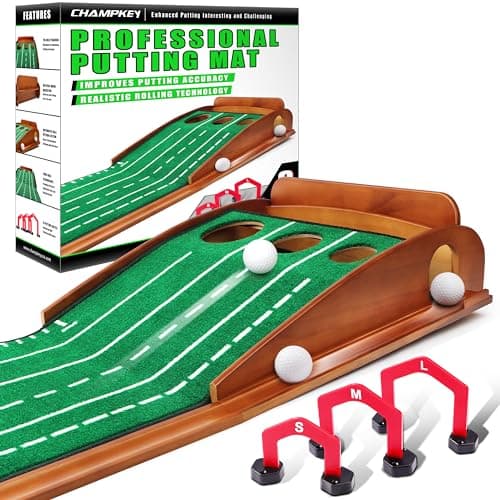
A gate does the same job from the other direction. The CHAMPKEY ships with three, and a gate set just wider than the ball a foot in front of it is the single most honest putting drill there is: the ball either goes through clean or it clips plastic, and no amount of wishful thinking changes which. If you putt well enough that a sub-three-inch cup is demoralizing rather than instructive, gates are the better tool, because you choose how hard to make them.

The ball return matters more than the surface

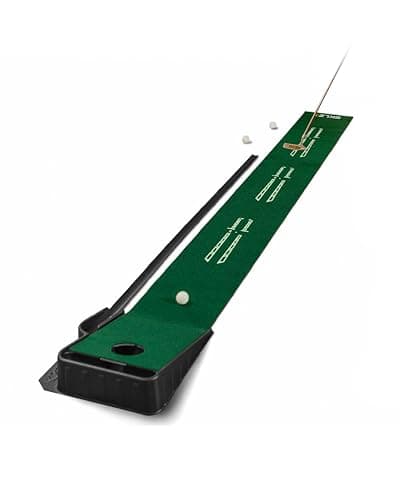
Here is the unglamorous truth of home putting practice: the mats that get used are the ones where putting is continuous. The SKLZ Accelerator Pro has a return ramp and a collector behind the hole, so a holed putt comes back to you and a missed putt is caught rather than running under the sofa. You can stand in one place and hit sixty putts. The Callaway, the CHAMPKEY and the Putt-A-Bout all require you to walk the length of the mat after every ball, or to drop five balls down and retrieve them in batches — which works, but is the difference between a habit and a chore.

That is why the SKLZ sits second here despite a basic surface and a single standard cup. For most golfers, the mat that gets a hundred putts a week beats the better mat that gets twenty. The Perfect Practice only outranks it because it has a return and the narrow cup and the fastest surface of the six.

Where a mat fits in a home practice setup

A putting mat is the cheapest and most space-efficient part of practicing indoors, and the only one that needs no ceiling height, no net and no insurance conversation. Thirty square feet of hallway and four feet of ceiling is enough. Compare that with a full-swing setup, where you need room to swing a driver and a net that stops it: our home setup cost breakdown works through what that actually runs, and how to practice golf at home covers the drills.

If you only ever buy one indoor practice item, buy a putting mat. Putting is somewhere around forty percent of the shots in a round for a mid-handicapper, it is the part of the game least dependent on physical ability, and it is the only part you can genuinely practice in a living room without compromise. A driver swung indoors is a compromise. A six-foot putt indoors is a six-foot putt.

The honest limits of every mat on this page

No mat here breaks. None of them has slope, so you will never practice a putt that moves. None of them rolls at the speed of a well-maintained summer green, the velvet surface included. None of them puts you under any pressure, which is the variable that actually makes short putts hard. And a mat cannot tell you that your eyes are over the ball or that your shoulders are open — for that you want a mirror, which is why the PuttOut versus GoSports mirror comparison exists. Buy a mat for reps and start line. Buy the aid separately for the stroke.
The short answer

Quick picks

#ProductBest forScorePrice
01
Perfect Practice Perfect Practice Standard 9ft 6in Putting Mat
Perfect Practice Standard 9ft 6in Putting Mat

The mat that actually trains something — a two-cup layout where the small hole is narrower than a regulation one, so holing out on it makes a real six-footer feel wide.

The best putting mat overall
8.0
$129.99Amazon
02
SKLZ SKLZ Accelerator Pro Indoor Putting Mat
SKLZ Accelerator Pro Indoor Putting Mat

The best value in the category — auto ball return and alignment guides at three, five and seven feet, for a fraction of what the premium mats ask.

The best value putting mat
7.6
$54.99Amazon
03
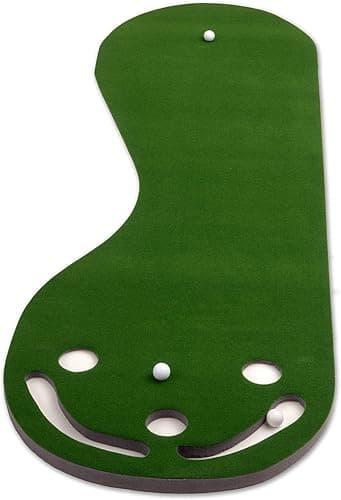
CHAMPKEY CHAMPKEY Premium Golf Putting Green with 3 Putting Gates
CHAMPKEY Premium Golf Putting Green with 3 Putting Gates

The mat that comes with the drill built in — three physical gates you have to roll the ball through, which is the one piece of putting feedback that cannot be fudged.

Fixing a start line
7.2
$79.99Amazon
04
Putt-A-Bout Putt-A-Bout Grassroots Par Three Putting Green
Putt-A-Bout Grassroots Par Three Putting Green

The cheapest useful putting surface here and the only one you can putt across rather than along — three cups on a nine-by-three green.

The best budget putting mat
6.8
$37.50Amazon
05
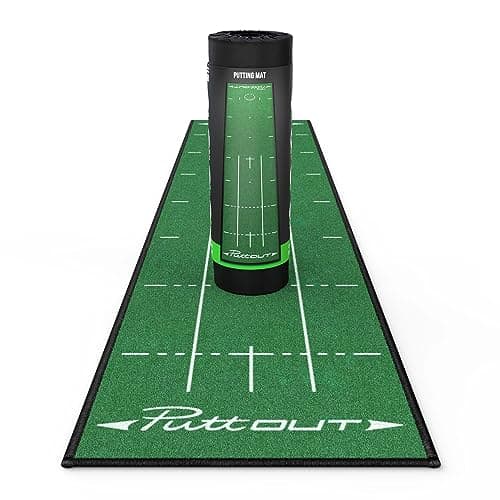
PuttOut PuttOut Medium Putting Mat
PuttOut Medium Putting Mat

The mat to buy if you already own a PuttOut trainer — a true-rolling surface with distance markings, built to sit under the pressure trainer rather than replace it.

Pairing with a PuttOut Pressure Putt Trainer
7.2
$79.99Amazon
06
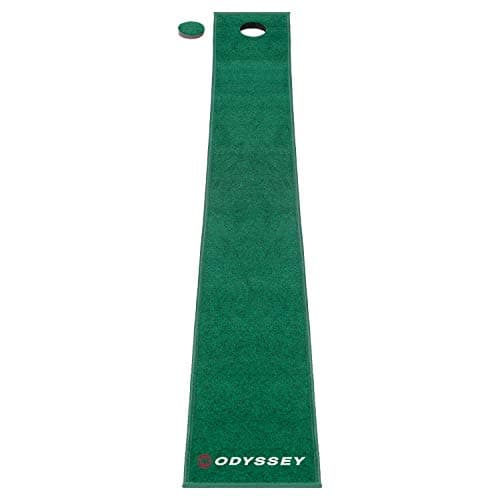
Callaway Callaway Odyssey 8ft Putting Mat
Callaway Odyssey 8ft Putting Mat

A plain, well-made 8-foot mat from a brand that makes putters for a living — nothing clever on it, and nothing to break.

A simple mat from a brand you know
6.6
$49.99Amazon

#ad · Live prices from the Amazon Product API, as of October 18, 2026. Where we have no verified live price, we show none — we would rather leave a gap than print a number that has rotted.

In detail

The picks, in full

01
Perfect Practice Perfect Practice Standard 9ft 6in Putting Mat

The best putting mat overall

Perfect Practice Standard 9ft 6in Putting Mat

9ft 6in length (listing)Two cups: regulation and reduced sizeCrystal velvet surface, true-roll alignmentAutomatic ball return
8.0/10

The mat that actually trains something — a two-cup layout where the small hole is narrower than a regulation one, so holing out on it makes a real six-footer feel wide.

Effectiveness
9
Feedback quality
9
Durability
8
Ease of use
8
Value
6

Pros

  • The two-hole design is the whole point: Perfect Practice pairs a regulation-size cup with a reduced one (its Extra Long listing publishes the pair at 2.56in and 3.35in), and a putt holed in the small cup is a putt that would have gone in with room to spare on grass
  • The crystal-velvet surface is the closest thing in this price band to a fast green — it is the one surface here that does not make every putt feel slow and uphill
  • Automatic ball return means you putt continuously instead of walking the length of the mat after every ball, which is the single biggest reason cheap mats stop getting used

Cons

  • It is the most expensive mat here by a wide margin, and the premium buys surface quality and the ball return rather than more holes or more width
  • At nine and a half feet you are practicing putts up to roughly eight feet — useful, since that is the scoring range, but it will not help your lag putting at all

Skip this if…

…you want a mat for the whole family to mess about on, or you want to practice long putts. This is a narrow, single-line training surface for grooving a stroke inside ten feet. If you want three holes and room to move around, the Putt-A-Bout Grassroots is a fraction of the money and a far better fit.

$129.99View on Amazon

Price as of October 18, 2026. Prices change — Amazon's is the one that counts.

#ad · we may earn a commission from this link to Perfect Practice Standard 9ft 6in Putting Mat

02
SKLZ SKLZ Accelerator Pro Indoor Putting Mat

The best value putting mat

SKLZ Accelerator Pro Indoor Putting Mat

Auto ball return with behind-the-hole collectorAlignment guides at 3, 5 and 7 feet (listing)Rubber-backed for multi-surface stabilitySingle hole
7.6/10

The best value in the category — auto ball return and alignment guides at three, five and seven feet, for a fraction of what the premium mats ask.

Effectiveness
7
Feedback quality
7
Durability
6
Ease of use
9
Value
9

Pros

  • The ball return and the behind-the-hole collector mean a putt that misses is still caught — you can hit fifty putts without standing up, which is the only way a home mat earns its storage space
  • Guides printed at 3, 5 and 7 feet give you three distinct distances on one mat, so you can build a ladder drill without a tape measure
  • It is the cheapest mat here with a working ball return, and the rubber backing keeps it flat on carpet or a hard floor

Cons

  • The surface is a basic short-pile turf, not a fast velvet — putts roll noticeably slower than any real green, so the pace you groove on it is not the pace you will face
  • The ramp that feeds the ball back is a plastic assembly and is the part owners most often report breaking; treat it as the wear item

Skip this if…

…you are specifically trying to calibrate pace for fast greens. A slow mat teaches you to hit putts harder than you should, which is the one bad habit a home mat can give you. Spend up to a velvet surface if pace is what you are working on.

$54.99View on Amazon

Price as of October 18, 2026. Prices change — Amazon's is the one that counts.

#ad · we may earn a commission from this link to SKLZ Accelerator Pro Indoor Putting Mat

03
CHAMPKEY CHAMPKEY Premium Golf Putting Green with 3 Putting Gates

Fixing a start line

CHAMPKEY Premium Golf Putting Green with 3 Putting Gates

Three holes (listing)Three putting gates includedRated for indoor and outdoor use (listing)No ball return
7.2/10

The mat that comes with the drill built in — three physical gates you have to roll the ball through, which is the one piece of putting feedback that cannot be fudged.

Effectiveness
8
Feedback quality
8
Durability
7
Ease of use
6
Value
7

Pros

  • Gates are objective in a way a printed line is not: the ball either passes through or it clips the gate, so a start line two degrees off gets caught instead of looking fine
  • Three holes at different distances let you practice a short pressure putt and two longer ones on the same mat without re-setting anything
  • The listing rates it for outdoor use as well, so it can live on a patio or a deck rather than taking up living-room floor

Cons

  • No ball return, so every miss is a walk to the far end — the thing that quietly kills most home putting practice
  • CHAMPKEY publishes very little about the surface itself (no pile height, no roll-speed claim), so the pace you get is unknown until it arrives

Skip this if…

…your putting problem is pace rather than direction. Gates fix a start line and tell you nothing about speed; if you three-putt from distance, you need a longer mat and a ladder drill, not gates.

$79.99View on Amazon

$119.9933% off

Price as of October 18, 2026. Prices change — Amazon's is the one that counts.

#ad · we may earn a commission from this link to CHAMPKEY Premium Golf Putting Green with 3 Putting Gates

04
Putt-A-Bout Putt-A-Bout Grassroots Par Three Putting Green

The best budget putting mat

Putt-A-Bout Grassroots Par Three Putting Green

9ft x 3ft (listing)Three cupsContoured, not flatNo ball return
6.8/10

The cheapest useful putting surface here and the only one you can putt across rather than along — three cups on a nine-by-three green.

Effectiveness
6
Feedback quality
4
Durability
6
Ease of use
9
Value
9

Pros

  • Three feet wide is nearly double every other mat here, which means you can putt at the cups from different angles instead of rolling the same straight putt over and over
  • Three cups at different distances build a genuine three-station drill straight out of the box, with nothing to assemble
  • It is the cheapest mat on this page by a clear margin and the one most likely to get used by more than one person in the house

Cons

  • The surface is a short synthetic turf with a slight contour — honest about being a backyard green rather than a tour-speed surface, but that means pace on it means nothing
  • No ball return and no alignment markings at all, so it gives you a target and nothing else

Skip this if…

…you are grooving a stroke rather than playing around. There is no alignment line, no gate and no narrow cup, so nothing on this green tells you whether your stroke was good — only whether the ball went in. For actual stroke work, the Perfect Practice or the CHAMPKEY earn their extra money.

$37.50View on Amazon

$49.9925% off

Price as of October 18, 2026. Prices change — Amazon's is the one that counts.

#ad · we may earn a commission from this link to Putt-A-Bout Grassroots Par Three Putting Green

05
PuttOut PuttOut Medium Putting Mat

Pairing with a PuttOut Pressure Putt Trainer

PuttOut Medium Putting Mat

7.9ft x 1.6ft (listing)Printed alignment and distance markingsRubber-backed, rolls flatDesigned around the PuttOut trainer
7.2/10

The mat to buy if you already own a PuttOut trainer — a true-rolling surface with distance markings, built to sit under the pressure trainer rather than replace it.

Effectiveness
7
Feedback quality
6
Durability
8
Ease of use
9
Value
6

Pros

  • It is designed as the surface for the PuttOut Pressure Putt Trainer, which is the aid we already rank first for putting feedback — the two together are a complete practice station rather than two things that half-fit
  • The printed distance markings let you work a repeatable ladder drill instead of hitting the same putt eighty times, which is how putting practice actually transfers
  • The rubber backing is heavy enough that it stays put on carpet and does not creep forward as you putt into it

Cons

  • There is no hole and no ball return in the box — this is a surface, and on its own it only gives you a line to roll along
  • At 1.6 feet wide it is the narrowest mat here, so a pull or a push runs straight off the edge

Skip this if…

…you do not own and do not want a PuttOut trainer. A bare mat with no cup gives you almost no feedback; buy a mat with a hole in it, or buy the trainer and this mat together.

$79.99View on Amazon

Price as of October 18, 2026. Prices change — Amazon's is the one that counts.

#ad · we may earn a commission from this link to PuttOut Medium Putting Mat

06
Callaway Callaway Odyssey 8ft Putting Mat

A simple mat from a brand you know

Callaway Odyssey 8ft Putting Mat

8ft length (listing)Single holeOdyssey-branded turf surfaceNo ball return, no gates
6.6/10

A plain, well-made 8-foot mat from a brand that makes putters for a living — nothing clever on it, and nothing to break.

Effectiveness
6
Feedback quality
5
Durability
8
Ease of use
8
Value
6

Pros

  • It does the basic job without a plastic mechanism anywhere on it, which is why it is the mat least likely to need replacing in two years
  • Eight feet is the right length for the putts that actually decide your score, and it rolls up small enough to live behind a door
  • Odyssey is the putter brand behind this site's best-mallet pick, and this is the cheapest way to buy into that shelf

Cons

  • You get one hole, no gates and no ball return — every single putt is followed by a walk, and the only feedback is whether the ball went in
  • Callaway publishes no surface or roll-speed detail for it at all, and it is priced above the SKLZ mat that does more

Skip this if…

…you want the mat to teach you something. This is a surface with a cup in it. The SKLZ Accelerator Pro costs less and adds a ball return and three marked distances; the CHAMPKEY adds gates. Buy this one for simplicity and the brand, not for training value.

$49.99View on Amazon

Price as of October 18, 2026. Prices change — Amazon's is the one that counts.

#ad · we may earn a commission from this link to Callaway Odyssey 8ft Putting Mat

What to buy, by what is actually wrong with your putting

Nobody needs six putting mats. Match the mat to the fault:

If your miss is…BuyWhy
Short putts lipping out left and rightPerfect Practice StandardThe reduced cup punishes a start line a regulation hole forgives, so the error shows up in practice instead of on the course.
You know what to work on, you just never do itSKLZ Accelerator ProThe ball return removes the friction. Reps happen or they do not, and this is the mat reps happen on.
You push or pull the ball off the faceCHAMPKEY with gatesA gate a foot in front of the ball is a pass-fail test of start line that no printed line can match.
You want the family to use it tooPutt-A-Bout GrassrootsThree feet wide and three cups, for the least money — a green to play on rather than a lane to drill in.
You already own a PuttOut trainerPuttOut Medium MatBuilt as the surface for it. Do not buy it on its own; it has no cup.

The cost math nobody does

Putting mats look expensive next to a sleeve of balls and cheap next to a club. The useful comparison is a lesson. A single putting lesson with a decent coach is in the same money as the mid-priced mats on this page, and it will tell you more about your stroke in an hour than a mat will in a year — but it gives you no reps. The mat gives you nothing but reps. The sequence that actually works is the lesson first, so you know what you are grooving, then the mat to groove it. Buying the mat and hoping it diagnoses you is the common and expensive mistake, and it is the same mistake we flag in do golf training aids work.

On price brackets: the cheap end of this category (a bare green with cups) is genuinely cheap — less than a dozen premium balls. The mid bracket adds a ball return or gates and roughly doubles it. The top bracket, the velvet two-hole mats, runs about three times the cheap end and is the only place you will find a surface that rolls anything like a real green. All three brackets are defensible; what is not defensible is paying the top bracket for a mat that then lives rolled up in a closet, which is why the ball return question comes before the surface question.

Three things to check before you order

  • Measure your floor first, and add three feet. A nine-foot mat needs about twelve feet of clear floor, because you have to stand behind it. This is the most common return reason in the category.
  • Check what it ships rolled around. Mats shipped folded arrive creased, and a crease is a permanent break in the roll. Rolled-in-a-tube shipping and a rubber backing are what you want.
  • Decide whether you want a cup at all.Two of the six mats here are surfaces rather than targets — fine if you own a trainer, useless if you do not.

How we ranked this

We don't run a testing lab — and we say so

We compiled published manufacturer specifications, official standards and aggregated owner reviews, computed the running costs the big test-labs leave out, and scored each pick against a published rubric. The scores are judgments from documented research — they are not lab measurements we took, because we don't have a lab and we're not going to pretend we do. You can check every number we publish.

Questions

Frequently asked

What is the best golf putting mat?
For most golfers who want the mat to actually train something, the Perfect Practice Standard: a velvet surface with an automatic ball return and a reduced-size cup alongside a regulation one, so holing out on it demands a genuinely good start line. If you want the best value, the SKLZ Accelerator Pro has the ball return and three marked distances for a fraction of the price. If you want the cheapest thing worth owning, the Putt-A-Bout Grassroots is a nine-by-three green with three cups.
Do putting mats actually improve your putting?
They improve your start line and your stroke repeatability, which is real and measurable on the course. They do not improve your pace control, because no mat at this price rolls at the speed of a maintained green — and a slow mat can actively make your distance control worse by teaching your hands to deliver too much speed. Use a mat for direction and reps, and do your pace work on a practice green before you tee off.
How long should a putting mat be?
Eight to ten feet covers the putts that decide your score. Inside ten feet is where a mid-handicapper gains or loses strokes, and a nine-foot mat lets you work from roughly three to eight feet. Longer mats exist and they are not a bad thing, but they need the floor space and they practice putts you will miss anyway. Measure your room and add about three feet for where you stand.
Is a putting mat better than a putting mirror?
They do different jobs, so the question is which fault you have. A mat trains where the ball goes; a mirror trains where your eyes and shoulders are before you move the putter. If your stroke is sound and you miss on line, buy a mat. If you cannot aim the putter or your setup drifts, buy a mirror first — our PuttOut vs GoSports mirror comparison covers that side. Plenty of people end up with both, and a mirror sits on a mat perfectly well.
Why do putting mats have a smaller hole than a real one?
To remove the forgiveness. A regulation hole is four and a quarter inches across — about two and a half balls wide — so a putt that started slightly off line still drops in from the edge, and in practice that is a problem: a lucky make and a good make look identical. A cup narrower than the ball-and-a-half mark only accepts a putt that genuinely started on line, so the feedback is honest. The side effect is that a real hole then looks enormous, which is a pleasant way to arrive on the first green.
Will a putting mat work on carpet?
Yes, and carpet is usually the better surface of the two — it damps the mat flat and stops it sliding. What matters is that the mat has a rubber or TPR backing so it grips rather than creeping forward as you putt into it, and that the floor underneath is genuinely level. A mat on a sloping or uneven floor adds an invisible break to every putt, which is the opposite of what you bought it for. Thick shag carpet is the one exception: it can make a thin mat feel spongy underfoot.

Keep reading

Receipts

Sources

We do not run a testing lab, and we do not pretend to. Every spec number here comes from a manufacturer's published sheet or an official standard, cited above. Where we could not verify something, we say so on the page rather than quietly leaving it out. Read our full method.