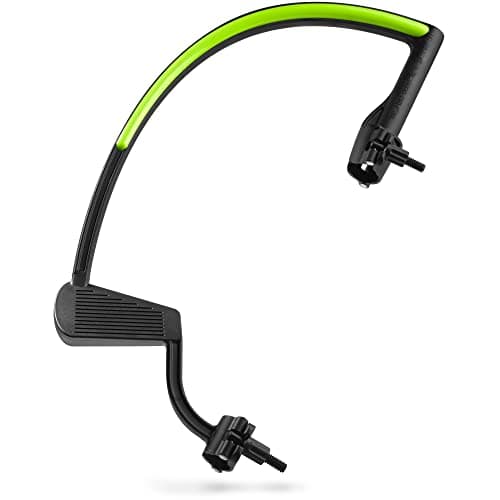
The Hanger is one of a small handful of training aids that give you real, physical feedback on the clubface — the fault behind most slices and a fair few hooks — rather than a feel you have to trust blindly. It clamps onto a club and sits against your lead forearm, and the instant the face drifts open (or your lead wrist cups) through the swing, a bar presses your arm and you feel it before the ball is gone. That tight, unarguable feedback loop is why it earns a place among the aids that actually work. This is the honest, full-length case for it — including the golfer it’s wrong for.
What it is
The Hanger is a clubface-and-wrist trainer made by Watson Golf. It clamps onto the shaft of almost any iron with a quick-release fitting and extends a bar that rests along your lead forearm at address. From there the mechanism is simple and clever: through the swing, a square clubface and a flat lead wrist keep the bar sitting quietly against your arm, while an open face — the lead wrist cupping, the face rotating open through the takeaway or impact — makes the bar press into your forearm, so you feel the error physically and instantly. The maker’s pitch, per the product listing, is clubface awareness and an on-plane takeaway, and that is a fair description of what it does: it trains the relationship between a flat lead wrist and a square face, which is the same thing from two angles. It comes off with the quick-release and moves between clubs, and it’s built to be used in slow rehearsals and half-swings as much as fuller ones. It is a rehearsal tool, not something you play shots with on the course.
Where it shines
The clubface is the biggest single cause of a slice, and it’s the fault most amateurs can neither see nor feel — they know the ball curved, but not that the face was open three degrees at impact. The Hanger’s great strength is that it makes that invisible fault physical. The bar presses your forearm the moment the face opens, so you get immediate, impossible-to-ignore feedback on something you’d otherwise have to guess at, and you can adjust and feel a square face on the very next rehearsal. For a slicer, that is close to the most direct feedback there is on the actual cause of the curve, not its symptom. It’s just as useful for the player whose lead wrist cups at the top or through impact — the breakdown that flips the face open and adds loft — because a flat lead wrist and a square face are the same position described two ways, and the bar trains both at once.
The other thing it does well is transfer, and that matters more than it sounds. Plenty of aids force you into a position: a rigid guide holds the club on a track, you make a nice-looking swing, and the feel vanishes the instant you take the gadget off. The Hanger works the other way — it builds awarenessof where the face is by pressing you when it’s wrong, so what you groove is a feel you own rather than a shape a rail imposed. That’s why it belongs with the feedback tools rather than the constraining ones, and why the skill it trains tends to survive being taken off. It also moves between clubs and works in slow-motion rehearsals, so you can drill a square face at home, at half speed, without a ball — which is exactly how a face-awareness feel gets built. Used that way, it is one of the few genuinely effective answers to a fault that most gadgets on the rack only pretend to address.
Where it falls short
Be honest about the limits. First, it takes a little setup and a little interpreting. Clamping it on correctly matters, and the feedback — a press on the forearm — takes a few swings to learn to read; it’s not as instantly obvious as a divot mark you can just look at. Second, and more important, it is a rehearsal tool. You build the feel of a square face in practice, then you have to trust it without the aid on the course, because you can’t play shots with it clamped on. That’s true of most good feel-training, but it’s worth stating plainly: the Hanger grooves an awareness, it doesn’t come to the first tee with you.
Third, and this is the big one, it is a specialist. The Hanger reads the clubface and the lead wrist, and nothing else. It says nothing about your low point, so it can’t diagnose a fat or thin strike; it says little about your path beyond the takeaway, so it isn’t a general swing-shape tool. If your miss isn’t a face or wrist problem — if you chunk it and thin it, or your trouble is contact rather than curve — the Hanger is a solution looking for a problem, and a Divot Boardthat shows your low point and path will teach you far more. It also assumes you already know your miss: if you can’t yet say whether you fight an open or a closed face, start by diagnosing that — a strike board shows path and low point plainly — and come back to the Hanger once you know the face is the culprit.
How it fits our feedback-versus-feel test
This hub ranks aids on one line: do they give real feedback, or only a feel? The Hanger sits firmly on the feedback side, which is the good side — it hands you an immediate, physical read on a genuine fault rather than a sensation you have to take on faith. That’s why it scores well for us on feedback quality and effectiveness, with the honest marks against it being the setup and the interpretation, which cost it a little on ease of use. It isn’t a do-everything tool, and it doesn’t pretend to be; it does one important job — training a square face and a flat lead wrist — about as well as any aid we’ve seen. For the golfer whose fault it targets, that focus is exactly the point.
How to actually use it
Getting value out of the Hanger is about slow, deliberate reps, not speed. Clamp it on correctly — the quick-release makes that quick once you’ve done it a couple of times — and start with slow rehearsal swings, feeling the bar sit quietly against your lead forearm when the face is square and press into it when the face opens. Work in half-swings before full ones, and pause at the top and again at impact to feel where the face and your lead wrist actually are. The point is to build a clear, repeatable sense of “square” that you can find without looking, so keep the swings unhurried and honest rather than trying to make full-speed passes with the aid on. Move it between your irons so the feel isn’t tied to a single club, and do a little most days rather than a lot once a week — a square face is a habit you groove through repetition, not a thing you buy in one session. Then, and this is the step people skip, hit some balls without it to prove the feel transferred. A few focused minutes of rehearsal followed by real shots is how the awareness the Hanger builds turns into a straighter ball on the course; endless full swings with it clamped on, by contrast, teach you very little.
Who should buy it
Buy the Hanger if your miss is the clubface: a slice from an open face is the headline case, and it’s the aid on this site most directly aimed at that fault. It’s equally good for the player whose lead wrist cups — at the top or through impact — and who wants to feel a flat lead wrist and a square, forward-leaning strike. If you already know the face is your problem and you want a tool that gives real, physical feedback rather than a shape you have to trust, this is it — it’s a cornerstone pick in our training aids to fix a sliceguide for exactly that reason. It’s reusable across your irons, works in slow rehearsals at home, and trains a feel that transfers.
Who should skip it
Skip the Hanger if your miss isn’t about the clubface or the lead wrist. If you chunk it and thin it, your problem is low point, and a Divot Boardor the free low-point drills teach that far better. If you don’t yet know whether you fight an open or a closed face, start by diagnosing your miss rather than buying a specialist for a fault you may not have — our honest guide to whether training aids workwalks through how to name the fault first. And if you want one tool to cover the whole swing, the Hanger is deliberately narrow — that focus is its strength for the right golfer and a poor fit for someone shopping for a cure-all.