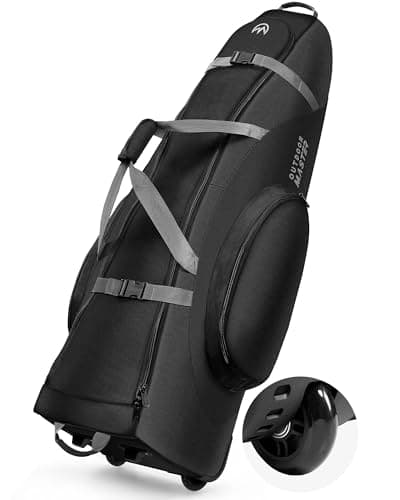
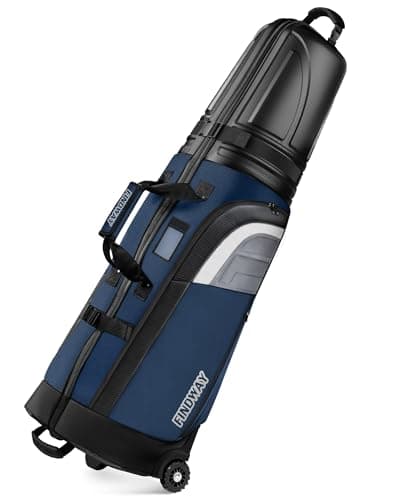
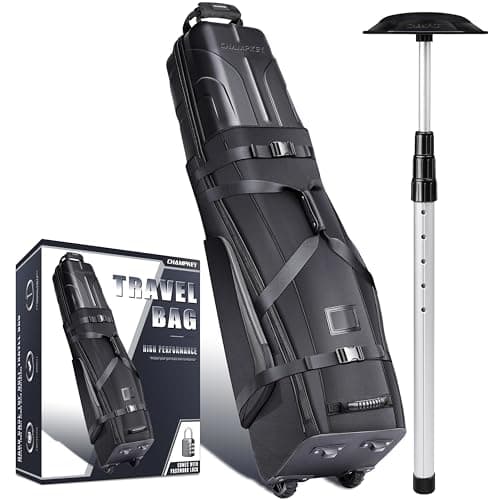
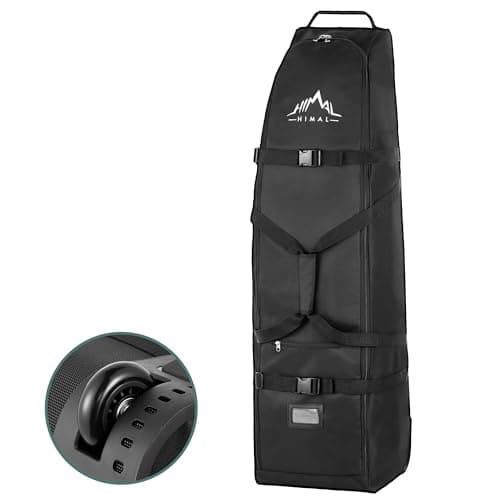
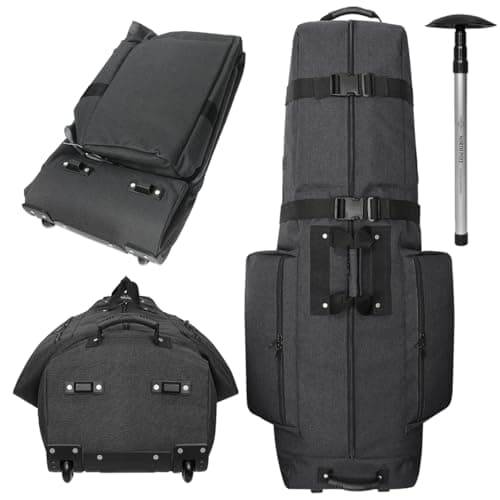
The best budget golf travel bag is the CaddyDaddy Constrictor— a soft-sided bag with a dense foam padded top and lockable zippers, which is the most protection per dollar anywhere in this price band, and it is the pick for an occasional flyer who does not want to spend premium money. Below it, the honest framing of this whole page: at the cheap end of this category you are buying a cover, not a case. A budget bag keeps your clubs together, keeps the dirt off, gives you something to wheel through a terminal and adds some padding. What it cannot do is stay the same shape when something heavy lands on it. Everything below is ranked with that in mind.
Padding and rigidity are different purchases
This is the distinction that decides whether a cheap travel bag was a good buy or a false economy, and listings blur it on purpose. Padding absorbs impact energy: it stops a knock leaving a mark and stops club heads chattering against each other. Rigidity resists deformation: it stops the bag being crushed when a loader stacks two hard suitcases on top of it. Padding is cheap. Rigidity is not, which is exactly why the budget end of this category is all padding.
That matters because of how golf clubs actually break in transit, which is almost never a scuff. It is the bag going down hard on its end and the whole mass of the set loading the longest, thinnest shafts you own — your driver and fairway woods. A padded soft bag handles ordinary handling perfectly well. Where it needs help is exactly that end-drop, and the help costs about five dollars, which we come back to below. If you want genuine rigidity, read the hard case travel bag roundupinstead — and our hard vs soft guide is the decision that sits behind both pages.
How we ranked these (the criteria)
- Protection where the clubs actually break. Padding over the club heads and down the shaft line outranks a thicker fabric everywhere else, because that is the load path in an end-drop.
- Whether it has wheels, and whether they survive. A loaded travel bag is heavy and you will drag it a long way. Wheels are not a luxury at any price; in-line skate wheels on a reinforced base are the realistic ask at this end.
- A lock you can actually use. Lockable zippers do not stop a determined thief, but they stop a zipper opening in transit and spilling a wedge onto a conveyor, which is the failure that actually happens.
- Fabric and stitching. Denier is the number listings lead with; the seams and the base are what fail. We weight published fabric specification alongside aggregated owner reports of where these bags tear.
- Storage when you are not flying. A soft bag folds flat. That is a real advantage over a rigid shell for anyone with a normal-sized closet, and it is scored.
Scores are judgments from published manufacturer specifications, listing details and aggregated owner feedback against our rubric— not lab measurements. We have not dropped, crushed or weighed any of these bags.
The specs, side by side
Built from each listing’s own published specification:
| Pick | Construction | Rigid part | Lock |
|---|
| CaddyDaddy Constrictor | Soft-sided, dense foam padded top | None — padding only | Lockable zippers |
| OutdoorMaster Padded | 900D Oxford, padded cushion layer (listing) | None — padding only | Not listed |
| findway ABS Hard Top | Soft body, ABS hard cap | Club heads only | Not listed |
| CHAMPKEY Hard Case | Soft body, hard case top, support pole included | Club heads only | Combination lock |
| Himal Soft-Sided | 600D polyester cover | None | Not listed |
Two of the five — the findway and the CHAMPKEY — are sold as “hard case” bags and are not. They are soft bags with a rigid cap over the club heads, which is a genuinely useful thing to own and not the same product as a molded shell. We label them as hybrids wherever they appear on this site.
The five-dollar accessory that outperforms the bag
Buy a support rod. A telescoping support rod extends above your longest club and takes the load in an end-drop so the impact runs through the rod rather than your driver shaft. It is the single highest-return item in this entire category, it costs a tiny fraction of any bag on this page, and the CHAMPKEY is the only pick here that includes one. If you buy any of the other four, buy a rod with it — a padded bag plus a rod protects against the failure that actually breaks clubs far better than an unsupported bag at twice the price.
Then pack it properly: head-cover your woods, and fill the void around the bag with soft clothing so nothing can shift inside. Our how to fly with golf clubs guide walks the full routine.
The weight trap at the budget end
A cheap bag has one real advantage over a shell that nobody mentions: it is light, and weight comes straight out of your checked allowance. US carriers generally treat a golf bag as a standard checked bag with the standard weight limit — American publishes 50 lb before an overweight fee and a 70 lb hard maximum, and Delta publishes 50 lb before an excess-weight charge. That limit covers the travel bag, the golf bag and everything inside both. A hard shell can be eighteen pounds empty; a soft cover is a fraction of that, and the difference is yours to pack. Weigh the loaded bag at home, because one overweight fee costs more than the gap between the first and last pick on this page. Current carrier fees are in our airline golf-club fee reference.
When a budget bag is the wrong buy
Three situations where we would tell you to spend more. If you fly with your clubs more than three or four times a year, the cheap bag will be replaced before a good one would have been. If you connect through multiple airports on a trip, each transfer is another chance for the bag to be stacked under something heavy, and that is a rigidity problem padding does not solve. And if the set in the bag is genuinely expensive, the arithmetic is obvious: the premium over a budget cover is a small fraction of one driver. For those cases, the ClubGlider vs Constrictor comparison and the hard case roundup are the right pages.