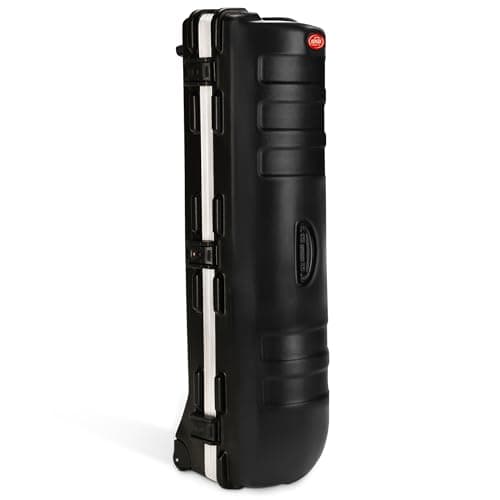
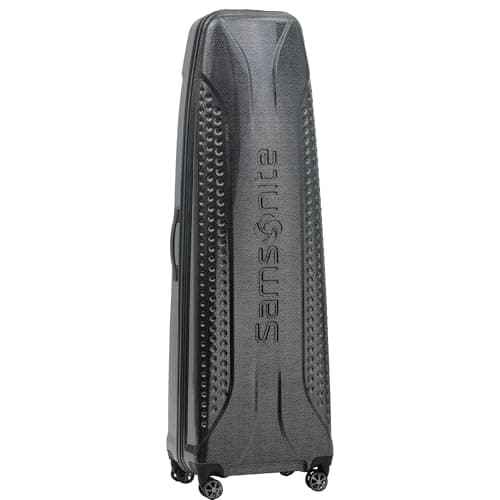
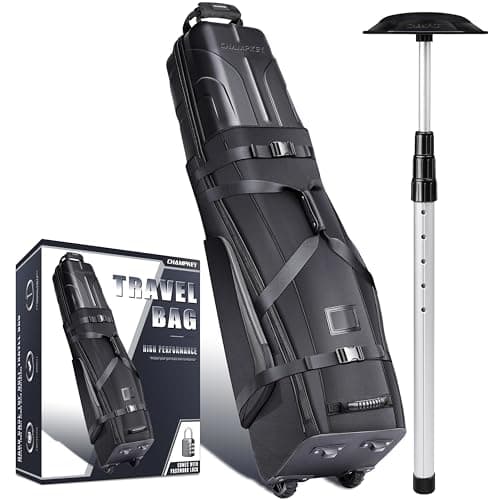
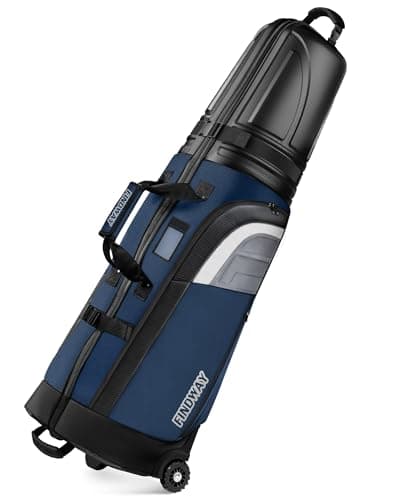
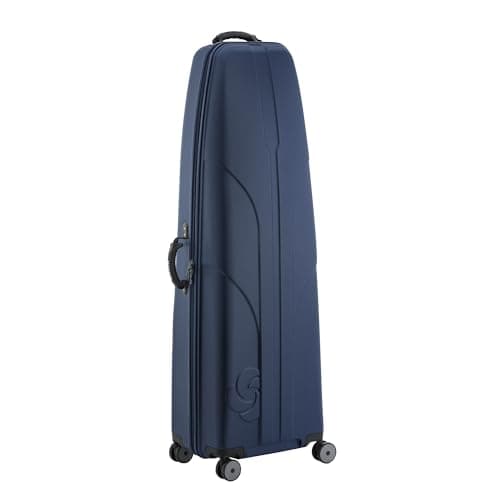
The best hard case golf travel bag for most golfers is the Samsonite Tour Classic Hardside— a rigid ABS shell on spinner wheels at a price that doesn’t require a tour schedule to justify. But the honest headline of this page is the one the category never leads with: a hard case is a specialistpurchase, not an upgrade everyone should make. It buys you real resistance to being crushed, dropped and stacked under someone’s suitcase. It costs you weight in a hold with a hard limit, money, and a rigid box that lives in your garage for fifty weeks a year. Below are five cases ranked by what they genuinely protect against — and an honest section on who should buy a padded soft bag instead.
One distinction decides this whole category, and most listings blur it deliberately. A full hard shell is rigid on every side: a molded ABS or polyethylene box your bag goes inside. A hard-top hybridis a soft fabric travel bag with a rigid cap over the club heads and nothing rigid anywhere else. Both get sold as “hard case”. They are not the same product, they don’t protect the same way, and they don’t cost the same. Picks one to three here are full shells; four and five are hybrids, clearly labeled as such. Our hard vs soft travel bag guide covers the wider choice, and the travel bag roundup ranks the soft field this page deliberately leaves out.
What a rigid shell actually protects against
It helps to be precise about the failure you’re buying insurance against, because padding and rigidity solve different problems. Padding absorbs impact energy: it stops a knock leaving a mark, and it stops club heads chattering against each other in transit. Rigidity resists deformation: it stops the bag being compressed when a loader stacks two hard suitcases on top of it, and it stops the whole load path from a corner-first drop running straight through your shafts.
That matters because the way golf clubs actually break in transit is almost never a scuff. It’s a bag going down hard on its end, and the entire mass of the set loading the longest, thinnest shafts in the bag — your driver and fairway woods. A soft bag with good padding survives ordinary handling perfectly well. What it can’t do is stay the same shape when something heavy lands on it. That’s the whole case for a rigid shell, and it’s a real one — it is also, honestly, a scenario most golfers taking one trip a year never meet. It is also the failure a twenty-dollar support rod addresses directly, which is why our guide to packing clubs for a flight puts the rod ahead of the case — and why it is worth reading what an airline actually owes you before you decide how much shell to buy.
How we ranked these (the criteria)
We ranked on five things, in this order — and price sets expectations rather than buying a place in the order:
- Rigidity, and where it actually is. A full molded shell outranks a hard cap over a fabric body, because a hard cap does nothing about a side crush. We state plainly which each pick is.
- How it moves loaded. A hard case full of clubs is heavy and awkward by definition, so wheels are not a luxury here. Multi-directional wheels you can push beat two in-line wheels you have to drag, especially at the end of a long terminal.
- Whether your bag actually fits.The most common way this purchase goes wrong isn’t protection, it’s dimensions — modern cart bags with wide molded top handles do not go into every case. Published interior dimensions matter more than the marketing.
- Security you can actually use.A TSA-accessible lock can be locked and still opened for inspection. A lock that can’t be is a lock that gets cut.
- What it costs you when you’re not flying.Empty weight comes straight out of your checked allowance, and a rigid shell doesn’t fold. Both are real costs and both get scored.
Scores are judgments from published manufacturer specifications, listing details and aggregated owner feedback against our rubric— not lab measurements. We haven’t dropped, crushed or weighed any of these; we don’t run a lab, and we say so.
The fit trap that catches modern cart bags
Before you buy any full shell, measure the widest point of your golf bag — usually the molded carry handle at the top, not the body. Hard cases are built to a fixed internal dimension and a bag that is an inch too wide simply does not go in. SKB publishes this caveat on its own product page: the Staff ATA won’t accommodate newer cart or stand bags whose molded top handles exceed twelve inches across, and it points those buyers at a larger model instead. Samsonite quotes its hardside cases as taking 10.5-inch top bags with clubs up to 48 inches.
Those two numbers — your bag’s widest point, and your longest club — are the only measurements that decide whether a case works for you, and they take two minutes with a tape measure. It’s the single most common return in this category and the easiest one to avoid. If your bag is a wide-handled modern cart bag, a hard-top hybrid with a fabric body is often the more practical answer than hunting for an oversized shell.
Skip this: buying a hard case for one trip a year
The pick nobody sells you is the one not to buy. If you fly with clubs once or twice a year, on direct flights, a full hard shell is usually the wrong purchase — and it’s the wrong purchase for reasons that have nothing to do with protection. It costs multiples of a good padded soft bag. It weighs enough empty to matter against a checked-bag limit. And it will not fold, so you are storing a five-foot rigid box for the fifty weeks a year you’re not using it.
For that golfer, a padded soft travel bag plus a cheap support rod does the job: the rod takes the end-load off your shafts, which is the failure that actually breaks clubs, and the bag folds into a cupboard afterwards. Our CaddyDaddy Constrictor review covers the value padded option, and Sun Mountain ClubGlider vs CaddyDaddy Constrictor weighs the frequent-flyer soft bag against it. Buy the shell when you fly often, connect often, or are checking clubs you’d be genuinely sick to lose — not because “hard” sounds safer than “soft”.
Match the case to the trip, not to the badge
The order below is our overall ranking, but as always the “best for” label on each pick matters more than its number. If you fly constantly and connect through busy hubs, the ATA-rated SKB is worth its weight and its price and our number one isn’t. If your trips are long-terminal marches, the Tour Pro’s bigger wheels earn their premium over the Tour Classic’s. If your golf bag is too wide for a shell, or your storage space is a hall cupboard, a hard-top hybrid is the honest answer and the two at the bottom of this list are cheaper than everything above them. Read across, not down.
If the prices on this page have talked you out of a shell entirely, that is a legitimate outcome: our best budget golf travel bags roundup covers the padded soft covers and hard-top hybrids at the cheap end, and is honest about what padding can and cannot do.
The weight math nobody mentions until check-in
Here is the cost of a hard case that never appears in the marketing. US carriers generally treat a golf bag as a standard checked bag, subject to the standard checked-bag weight limit — 50 lb for economy on the major domestic airlines. That limit applies to the whole package: the case, the golf bag inside it, and every club, shoe and sleeve of balls you packed around them.
Now put real numbers against it. SKB publishes the Staff ATA at 18 lb empty. A full set of clubs in a golf bag is commonly in the 25–35 lb range depending on the bag. You can see the problem before you’ve packed a pair of shoes: the heaviest shells on this page can put you within a few pounds of the limit before anything discretionary goes in. That is not a reason to avoid a hard case — it is a reason to weigh the packed case at home on a bathroom scale rather than discovering it at the counter, where the overweight fee frequently costs more than the difference between two of the cases on this page.
The lighter ABS shells and the hard-top hybrids give you more headroom here, which is a genuine advantage and part of why our number one pick isn’t the toughest case on the list. And check your specific carrier before you fly, because the oversize rules differ and change: our airline golf-club fee reference keeps a dated, cited table of how each major US carrier treats a golf bag.
How much should you spend on a hard case?
Think in three tiers rather than in brands. At the entry tier you are buying a hard-top hybrid: a rigid cap over the club heads on a fabric body, wheels, and usually a lock or a support pole thrown in. It costs about what a good padded soft bag costs, protects the most vulnerable part of the load, and stores far more easily than a shell. For an occasional flyer who wants more than padding, this is the sweet spot on this page.
The mid tieris the molded ABS shell — the Samsonite cases here. This is where you start paying for genuine all-round rigidity plus real wheels, and where most golfers who fly a few times a year should land. The step up inside this tier is almost entirely about how the case rolls, not how well it protects.
The top tieris the ATA-rated case: polyethylene, built to a published airline shipping-container standard, TSA locking latches, and in SKB’s case a lifetime warranty against defects. It costs roughly double the mid tier and weighs more. It is the right buy for road warriors, for anyone connecting through multiple airports on a trip, and for expensive sets — and it is overkill for a once-a-year direct flight to a resort. The premium is real, it is just aimed at a specific traveler.
Pack it properly, or the case can’t save you
A hard case is not a substitute for packing well, and this is the cheapest protection you can buy. Use a support rod that extends above your longest club so an end-drop loads the rod rather than your driver shaft. Head-cover your woods. Fill the void around the bag with soft clothing so the load can’t shift inside the shell — movement inside a rigid box is exactly what a hard case does not protect against, and it is the one failure mode a soft bag arguably handles better. Our how to fly with golf clubs guide walks through the full routine, and it applies just as much to a shell as to a soft bag.