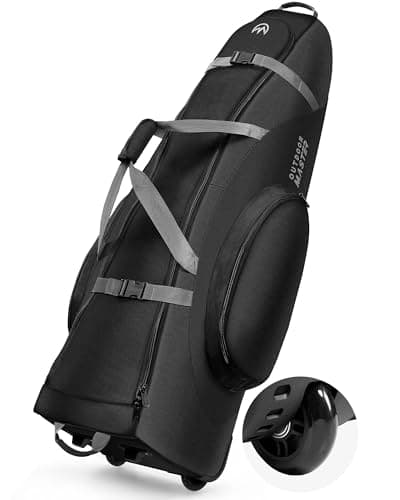
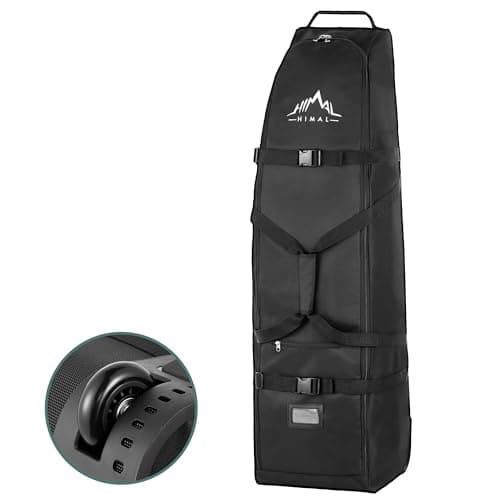
Both of these are budget, soft-sided wheeled travel bags for flying with your clubs, and both sit at the value end of the category — so this isn’t a premium-versus-value question, it’s a bare-cover-versus-padded-bag one. The Himal Soft-Sided Travel Bag is the cheaper of the two: a tough 600D polyester cover on wheels that folds away to almost nothing, best thought of as a dust-and-scuff cover rather than real crash protection. The OutdoorMaster Padded Golf Travel Bag steps up for a little more money with a cushioned 900D shell, giving your clubs more defense for not much more outlay. Neither is a hard case, and being honest about that is the whole point of this comparison.
Choose the Himal Soft-Sided if…
You want the cheapest possible way to check a bag on a rare trip, and you’ll add your own protection. The Himal is cheap, light, and folds down to nothing between uses, and its tough polyester shell keeps your clubs together and shrugs off scuffs — perfectly adequate for a once-a-year trip or a short drive to a course. What it isn’t is a protective case: with minimal padding, your club heads and shafts are largely on their own against rough baggage handling. Buy it if you fly with clubs seldom, you’re on a tight budget, and — this part isn’t optional — you’ll drop in a stiff-arm support rod and pack towels around the heads to make up for the padding it doesn’t have.
A note on the Athletico Ace
This comparison originally ran the Athletico Ace Wheeled Travel Bag as the padded budget option. Amazon no longer lists it — the listing returns “currently unavailable” and no Athletico travel bag is sold there any more — so rather than leave a buy link pointing at a dead page, we swapped the slot to the closest thing we could actually verify on sale: the OutdoorMaster padded bag below. If you own an Athletico Ace, nothing here says you should replace it; if you were about to buy one, this is the bag to buy instead.
Choose the OutdoorMaster Padded if…
You want some real padding without leaving the budget tier. OutdoorMaster wraps the whole case in what its listing calls a doubled cushion layer under a 900D Oxford shell — heavier fabric than the Himal’s 600D and, more to the point, actual padding between a baggage handler and your shafts. It rolls on in-line skate wheels with a rubber base, carries several grab handles and a shoulder strap, and its 51.2-inch body swallows a full set still sitting in a cart bag, with two internal fixing straps and a separate shoe compartment. For an occasional trip on a budget where you’d rather have padding than not, it’s the more protective of the two, and the small step up in price is the padding — nothing more complicated than that.
How they’re actually different
The gap between them is padding and shell weight — not handling, which is close. Both roll on wheels, both are cheap, and both fold away between trips. Where they part is protection: the OutdoorMaster’s cushioned 900D body genuinely guards your clubs more than the Himal’s bare 600D polyester cover, which is the entire reason to pay the small step up. Against that, the Himal is the cheaper of the two and packs down to even less. Neither is trying to be a premium bag; they’re both the sort of thing you buy for an occasional trip and store flat the rest of the year. Put simply:
| What matters | Himal Soft-Sided | OutdoorMaster Padded |
|---|
| Padding | Minimal — a bare cover | Doubled cushion layer (listing) |
| Protection | Low — heads and shafts largely exposed | Better — padding guards the clubs |
| Handling | Wheels; folds to almost nothing | In-line skate wheels, handles + shoulder strap |
| Shell | 600D polyester | 900D Oxford, waterproof (listing) |
| Best for | The cheapest occasional check | Budget flyers who want some padding |
What the small price gap actually buys
It’s worth being concrete about what you get for the modest step up to the OutdoorMaster, because the difference is narrow but real. Both bags share the same basic recipe: a soft-sided shell, a set of wheels and a fold-flat design for storage, and the Himal’s tough 600D polyester genuinely holds up to scuffs and keeps the clubs together on the journey. What the Himal doesn’t have is padding, and that is precisely the gap the OutdoorMaster closes. A cushion layer around the body sits between your club heads and shafts and the outside world, absorbing some of the knocks a bare cover passes straight through. It won’t turn a soft bag into a hard case — nothing short of a rigid shell does that — but on the margin, when a bag is tossed onto a belt or wedged under a heavier suitcase, that padding is the difference between a knock your clubs shrug off and one they don’t. For a few dollars more it’s cheap peace of mind — and the cheaper Himal plus a support rod is still a perfectly rational fallback if the budget is the deciding factor.
The protection honesty: neither is a hard case
Here’s the part no budget travel bag will tell you: both of these are soft-sided, and soft-sided offers less protection than a hard case, full stop. A rigid shell takes the load when a bag is dropped on its end or buried under heavier luggage; a soft bag — padded or not — flexes, and the force can reach your shafts. The OutdoorMaster’s padding narrows that gap; the Himal’s bare cover barely closes it at all. If you fly constantly, or your clubs are expensive, or you check bags on airlines with a rough reputation, a hard case is the more single-minded tool and neither of these is really enough — our hard vs soft golf travel bags guideweighs that trade in full. For an occasional trip with a sensible set, a padded soft bag with a support rod gets most travelers there intact; just don’t mistake either of these for a tank.
What flying with either actually costs
The good news is that neither bag will cost you extra to fly on most major carriers. On American, Delta and United, a golf bag is treated as one standard checked bag — you pay the normal checked-bag fee for your fare, subject to the usual weight limit, and several airlines waive the oversize fee a golf bag’s dimensions would otherwise trigger. The catch that actually catches golfers is weight: a packed travel bag climbs past the standard 50-pound limit faster than you’d think once you add shoes, balls and the towels you stuffed in for padding, and overweight fees are steep. Weigh the packed bag at home on a bathroom scale before you leave. The details differ by airline and change often, so check the current, dated figures in our airline golf-club fee reference before you fly.
The support rod matters more than either bag
Whichever of these you buy, do the one thing that protects clubs more than the bag itself does: add a cheap “stiff arm” support rod. It’s an adjustable pole that extends a few inches above your longest club, so when the bag is dropped on its end — the way most travel damage happens — the rod takes the impact and transfers it to the base, not to your driver shaft. In a bare cover like the Himal it’s close to essential; even in the padded OutdoorMaster it’s cheap insurance. Then put headcovers on the woods and putter and pack towels or a jacket around the heads to stop everything shifting. The full packing routine is in how to fly with golf clubs.
Skip the decision entirely if…
Skip both if you fly with clubs more than occasionally or your clubs are worth protecting properly — a budget cover is a gamble you’ll eventually lose, and you’re better off stepping up to a padded mid-tier bag or a hard case, both of which sit alongside these in the best golf travel bags roundup. And skip both if you’re not really flying at all: for a short drive to a nearby course, any travel bag is more than you need. This choice is specifically for the golfer who wants the cheapest workable way to check clubs on an occasional trip and is only deciding whether to pay a little more for padding.
The honest verdict
Buy the OutdoorMaster if you’d rather have padding than not — for a small step up in price it protects your clubs more than a bare cover, and that’s the sensible call for most occasional flyers. Buy the Himal if you want the absolute cheapest way to check a bag and you’ll commit to adding a support rod and towels to make up for the padding it lacks. Both are soft-sided budget bags, so be clear-eyed about what that means: neither matches a hard case for protection, and the support rod inside matters more than which of the two you pick. We base this on the manufacturers’ listing details and aggregated owner feedback; we don’t run a test lab.