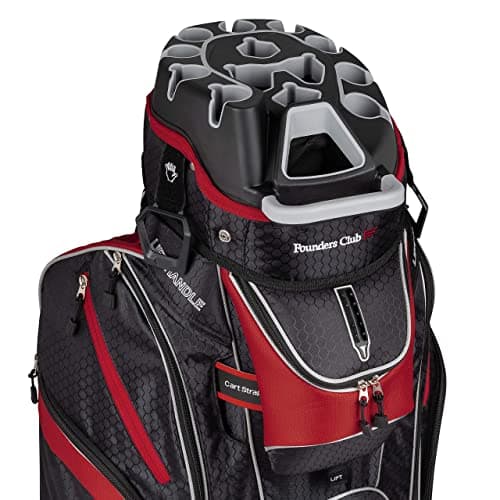
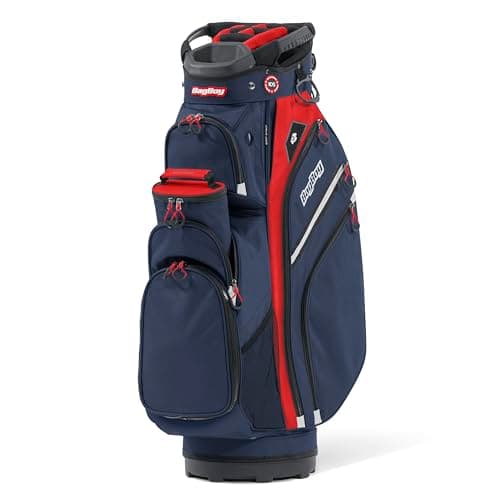
The best golf cart bag for most golfers is the Bag Boy Chiller Pro— a 14-way top with full-length individual dividers, a removable cooler the listing rates for six twelve-ounce cans, and a base that locks to a compatible cart instead of rotating under the strap. It is not the lightest bag here and it is not the cheapest. It is the one that gets the three things right that actually decide whether a cart bag is pleasant for four hours: your clubs do not tangle, your drink stays cold, and the bag does not twist.
A cart bag is a different product from a carry bag, built on a different premise: nobody is going to pick it up, so it can be heavy, wide and deep. That freedom is why cart bags hold so much — and it is also why the category is full of bags that are simply bigger rather than better. Below are six ranked on the four specs that genuinely change your round, with a live price on each and an honest note on who should not buy it. If you are not sure you are on the right page at all, our cart bag vs stand bag guide settles that first, and the main golf bag roundup ranks both types side by side.
The one spec that decides this category: full-length dividers
Every bag on this page has a 14-way top. That number tells you almost nothing. What matters is whether those fourteen slots are full-length dividers— tubes or fabric walls that run the whole depth of the bag — or a molded top cuff with an open body underneath.
With a plain 14-way cuff, your shafts fan out below the top and cross each other inside the bag. Pull a 7-iron out of a crossed cluster on a moving cart and you drag two other clubs halfway up with it; over a season the grips rub against each other and the shafts chatter. With full-length dividers, every club sits in its own channel from cuff to base. Clubs come out one at a time, nothing rattles, and grip wear stops being a thing you notice. It is the single biggest quality-of-life difference between two bags that look identical in photographs.
The trade is weight and a little usable volume — fourteen full-length walls are fourteen walls of material, and they eat into the space around the club heads. That is why our number one is not the lightest bag here and why the lightest bag here, the Titleist, does not publish full-length dividers. Both choices are defensible. What is not defensible is paying a premium for a “14-way” and assuming you got the dividers; read the description, not the headline.
How we ranked these (the criteria)
We ranked on five things, in this order. Price sets expectations rather than buying a place in the order:
- Divider quality, not divider count. Full-length individual dividers outrank a molded 14-way cuff every time, and a rubberized grip slot outranks a bare fabric one.
- Which pockets you can still reach.A cart bag spends the round strapped to a frame with one whole side pressed against it. The spec that matters is how many pockets stay accessible in that position — a bag with fourteen pockets and four of them buried is worse than a bag with ten you can all open.
- Whether it stays put. A bag that rotates under its strap turns every club pull into a wrestling match. A cart-lock system, a pass-through strap channel or a flat base with a deep strap notch all solve it; nothing solves it worse than a round base and a single strap.
- Honest weight. You are not carrying it, but you are lifting it into a trunk, onto a cart and out again twice a round. We take published figures where the maker publishes one and say so plainly when only retailers do.
- Storage that earns its space.Volume is easy in this category. We scored useful, differentiated storage — an insulated cooler that actually chills, a lined valuables pocket, a dedicated putter well — over raw pocket count.
Scores are judgments from published manufacturer specifications, listing details and aggregated owner feedback against our rubric— not lab measurements. We have not weighed, loaded or rained on any of these bags, we do not run a lab, and we say so on every page.
Cart bag or stand bag — be honest about how you play
The most expensive mistake in this category is buying the wrong category. A cart bag is the right answer if you ride a motorized cart, push a trolley, or play the same course where your bag never leaves a frame. It is the wrong answer the moment you carry for more than fifty yards: there is no stand, the straps are an afterthought on most models, and the weight that is irrelevant on a cart becomes the only thing you think about on foot.
If you walk even a third of your rounds, read our stand bag roundup and best golf bags for walkingbefore you spend anything here. And if you ride but have not yet bought the cart, the bag choice and the cart choice interact — our push cart roundup covers which frames take which bags, including the Bag Boy lock system our number one is built around.
The weight nobody thinks about until the trunk
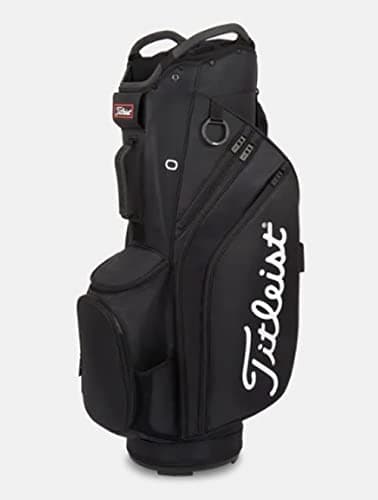
Cart-bag weights on this page run from a published 5.6 lb for the Titleist to a listed 8.7 lb for the Founders Club. Empty. Add a full set of clubs — commonly another 20–30 lb depending on what you carry — and the heavy bag is a genuinely awkward lift out of a sedan trunk, twice a round, every round.
That is the honest case for spending more. The Titleist costs roughly as much as two of the cheaper bags here and holds no more. What it buys is three pounds you lift about a hundred times a season. Whether that is worth it depends entirely on your back and your car, which is a decision we cannot make for you — but it is the real decision, and nobody in a product listing will frame it that way.
Skip this: paying for features your cart cannot use
Two features on this page are conditional, and both are easy to pay for by accident.
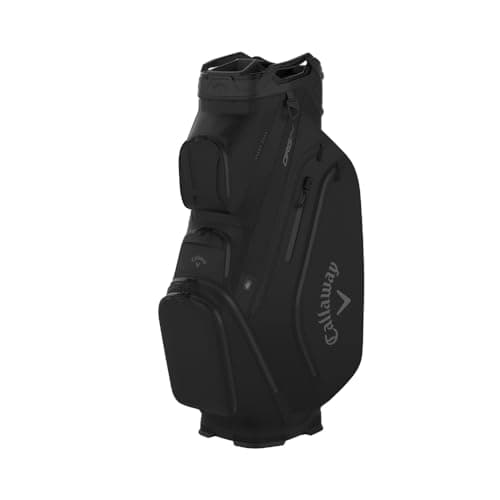
Cart-lock systems only work on matching carts.Bag Boy’s Top-Lok locks the Chiller Pro’s base to a compatible Bag Boy push cart so it cannot rotate. On a club’s riding cart, or on a Clicgear or CaddyTek frame, it is inert and you are buying a standard strap-down bag at a feature price. If you ride a course-supplied cart every round, the Sun Mountain C-130 or the Callaway Org 14 gives you the same organization without the premium.
Coolers are not all coolers.A removable insulated compartment rated for a six-pack is a real feature. An “insulated” sleeve that fits one bottle and shares a wall with the main body is marketing. If a cold drink on the twelfth is part of why you are buying, check the stated capacity rather than the word.
Read across, not down
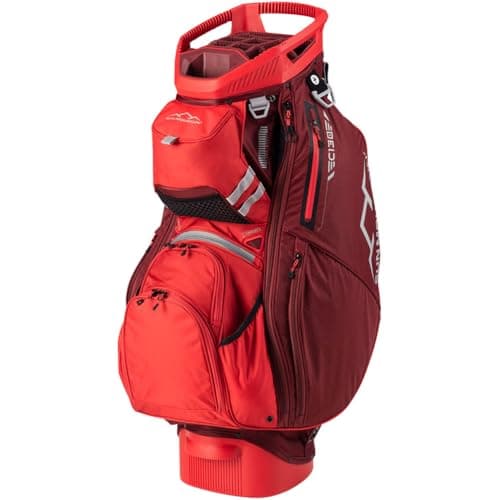
The order below is our overall ranking, but the “best for” line on each pick matters more than its number. If you want the most storage of anything here and weight is irrelevant because the bag lives on a cart, the Sun Mountain C-130is the bag — and our C-130 vs Callaway Org 14 comparison is the head-to-head between the two most-bought bags in the category. If you lift your bag constantly, the Titleist’s published 5.6 lb is worth the money. If you want the most pockets per dollar and will never pick the thing up, the Founders Club at the bottom of this list is the honest value answer, and the Callaway Org 14 review covers the full-length-divider middle ground in detail.
How much should you spend on a cart bag?
Think in three tiers, because the money buys different things in each one and the jumps are not where you would guess.
The value tierbuys you the organization and none of the polish. This is where the Founders Club sits: a genuine 14-way top with full-length rubberized slots, plenty of pockets, an insulated beverage compartment — and 8.7 listed pounds of bag to carry it all in. If the bag lives strapped to a cart and you are not precious about finish, this tier is all most golfers need. It is also where you should expect inconsistent spec sheets; listings for the same bag disagree on pocket count and warranty.
The mid tieris where the category’s best buys live, and it is where the Chiller Pro, the C-130 and the Org 14 all sit. The money over the value tier goes into build quality, pocket layout you can actually reach on a cart, and one differentiating feature — a cooler that works, a cart lock, a 14-way with full-length dividers and a putter well. For most riders this is the tier to buy in and the one we would spend our own money in.
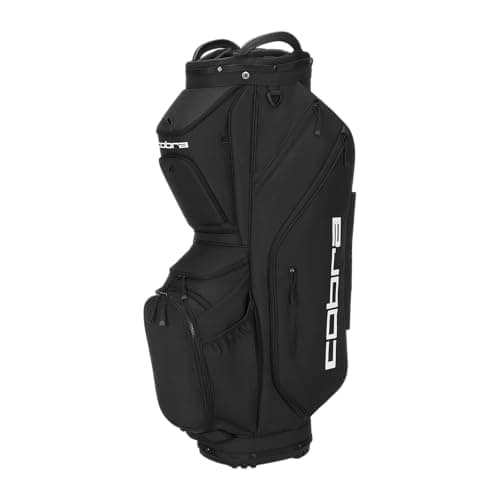
The premium tier— the Titleist and the Cobra here — buys weight savings, materials and finish. It does not buy more storage. That is worth saying twice, because the premium cart bag market implies the opposite: the most expensive bag on this page holds less than the cheapest one. Buy up here because you lift the bag a lot, because you want the brand on the side, or because the finish matters to you. Do not buy up here expecting more room.
Will the bag fit your cart? Three things to check
Cart bags and cart frames are not universally compatible, and the failure mode is annoying rather than catastrophic — a bag that sits too high, rocks, or covers the pocket you need most.
Base width and shape.A flat, wide base sits stably on a trolley’s lower bracket. A narrow round base wants to roll. Push-cart brackets are usually adjustable; riding-cart wells are not.
Where the strap crosses.This is the one people discover on the first tee. A single strap across the middle of a bag can land directly over the apparel pocket or the cooler. Bags built for carts have a pass-through channel or a recessed strap channel — a molded groove the strap sits in — so no pocket is blocked. Our top four picks all address it one way or another; check it on anything you are considering that is not on this page.
Proprietary lock systems. Top-Lok (Bag Boy) and similar systems from other cart makers physically key the bag to the cart. Brilliant on the matching frame, irrelevant on anything else. Match the bag to the cart you already own, not the other way around.
What actually wears out a cart bag
Cart bags rarely fail at the fabric. They fail at three points, and knowing them tells you what to inspect before you buy and what to look after afterwards.
Zippers go first, especially on the big apparel pockets that get opened with a full load pressing against them. Chunky molded zippers with a fabric storm flap last longer than fine metal ones on a bag that lives outdoors.
The top cuffis next. Every club you pull scrapes it, and a thin molded cuff with no rubberized lining starts to split at the slots. This is the thing a rubberized grip slot is actually protecting — the bag, as much as the grip.
The baseis last and worst, because a cart bag gets dragged and set down on concrete constantly. A hard molded base with reinforced feet is the difference between a bag that looks tired in three years and one that has a hole in it. None of this is exotic — but it is what you are buying when you move up a tier, far more than the badge.
One habit extends all three: empty the bag at the end of the season, brush the base, and store it upright and dry rather than on its side in a damp garage. A cart bag that gets that treatment outlives two that do not. The same logic applies to the clubs inside it — our guide to how often to replace golf clubs covers which parts of a set wear on a schedule and which do not.