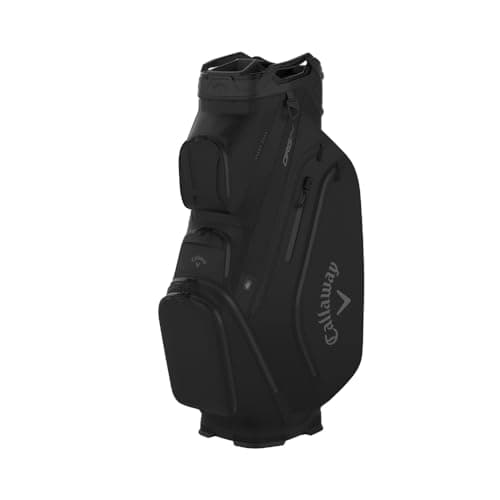
For a rider who wants the spec done plainly by a major brand: Callaway publishes 14 full-length dividers that run the whole length of the bag, plus an external putter well so a fat putter grip is not fighting for space in the crowded top.
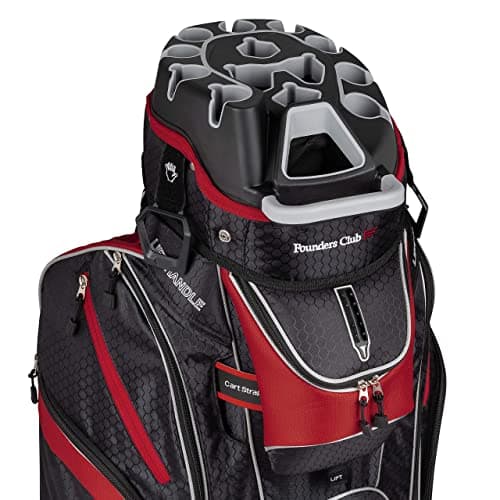
Budget pickFounders Club Premium Cart Bag — the cheapest bag here that publishes the real spec - full-length dividers with rubberized individual grip slots, at the cost of being the heaviest bag on the page at a listed 8.7 lb $139.50 on Amazon
The verdict: the Callaway Org 14 is the bag to buy if full-length dividers are the reason you are shopping. Callaway publishes dividers that run the whole length of the body rather than stopping below the cuff, so shafts never cross and grips never rub, and the external putter well keeps an oversize putter grip out of the top. The Bag Boy Chiller Pro is the better buy if you also want a cooler that holds a real six-pack and a cart lock. Budget pick: the Founders Club Premium Cart Bag, which publishes full-length dividers with rubberized grip slots for the least money here and weighs a listed 8.7 lb for the privilege. Prices are live from our price layer, stamped November 22, 2026.
“14-way” and “full-length dividers” are two different specs
This is the whole reason the page exists, and it is the single most commonly conflated pair of specs in bag retail. A 14-way top describes the cuff: fourteen openings, one per club. A full-length divider describes the body: a tube or a partition that runs from the cuff all the way to the base, so each shaft is in its own channel for its entire length.
A bag can have the first without the second, and plenty do. In that bag your clubs enter fourteen separate holes, then meet in the middle of the bag and lie against each other. What follows is the thing owners complain about: shafts crossing so two clubs come out together, and grips rubbing against grips on a bumpy cart path until the rubber polishes smooth. The full-length divider is the spec that prevents both, and it costs weight — every bag on this page is heavier than it would be without it.
Which 14-way bags do not qualify, and why we say so
Two of the six cart bags on our best golf cart bags page are not on this one, and both are good bags:
- Sun Mountain C-130. Sun Mountain publishes a 14-way divider top and the best pocket layout in the category, and it is our storage pick on the main cart-bag page. It does not publish full-length dividers, so it is out of scope here. If maximum storage matters more to you than grip separation, buy that bag and ignore this page.
- Titleist Cart 14 Lightweight.A full 14-way top at a published 5.6 lb with all ten pockets cart-accessible — genuinely the easiest bag in the category to lift on and off a cart. Titleist does not publish full-length dividers on this model, and that is arguably the deliberate trade behind the weight figure. If weight is your constraint, that is the bag.
We say this rather than quietly leaving them out because the alternative — a page that ranks every 14-way bag under a full-length-divider headline — is exactly the sleight of hand this spec invites. The side-by-side with a stand bag is in cart bag vs stand bag, and the full cart-bag field is in best golf cart bags.
The four that qualify, and what separates them
All four publish the spec, so the decision moves to what each one adds on top of it:
- Callaway Org 14 — the cleanest version of the spec. Full-length dividers plus an external putter well, which matters more than it sounds: the putter is the fattest grip in the bag and the one most likely to jam a crowded top. Our review of it is here.
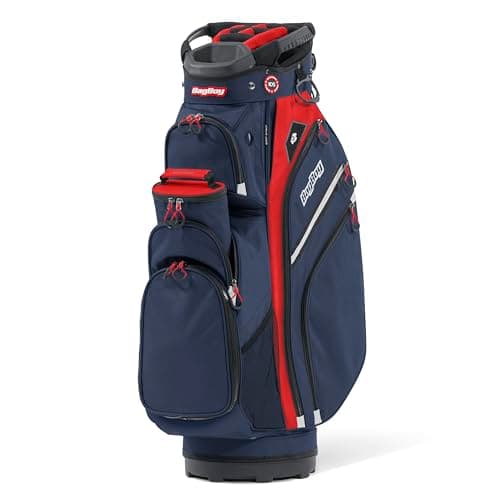
- Bag Boy Chiller Pro — the spec plus a real cooler. Bag Boy lists the removable insulated cooler as holding six 12-ounce cans, which is a cooler rather than the token insulated sleeve most bags call one, and the Top-Lok base locks the bag to a compatible Bag Boy cart so it cannot rotate. The caveat is in that word compatible: on any other cart, Top-Lok is a feature you have paid for and cannot use.
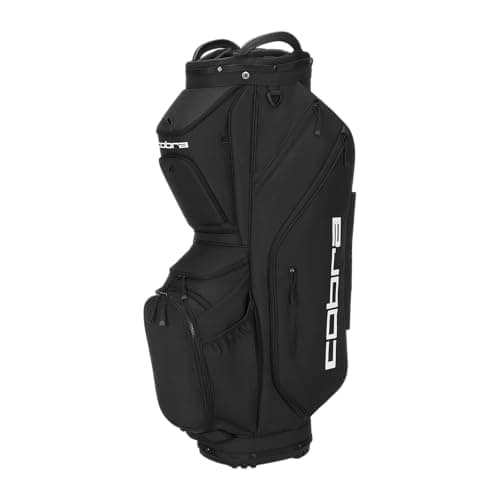
- Cobra Ultralight Pro — the spec at the lowest weight here. Most retailers list it at 6.26 lb with 11 to 13 pockets including two oversize apparel pockets. Retailers disagree on both numbers, so treat them as approximate; what is not approximate is that it holds more than anything else on this page.
- Founders Club Premium — the spec at the lowest price, with rubberized slots. Individual rubberized grip slots are the premium implementation of this feature and they are on the cheapest bag here, which is genuinely unusual. The cost is 8.7 lb listed, and the listing warns that a jumbo putter grip may not fit the putter well.
Who should not buy any of these
Walkers. Every bag on this page is built to strap to a cart, and full-length dividers add weight to a design that is already heavy on purpose. Carrying one more than a few yards is a punishment, and there is no stand on any of them. If you walk, the field you want is best golf stand bags or, if you walk with a trolley, best golf bags for walking.
Also worth saying: if you ride in a club cart and carry twelve clubs you can keep track of, this spec is a luxury rather than a fix. Grip-on-grip wear is real but slow, and a cheap 14-way top with a towel over the clubs solves most of it. Buy a full-length-divider bag because you are tired of pulling two clubs out at once, not because a spec sheet told you to.
The arithmetic: what grip wear actually costs
Here is the case for the spec in money rather than in adjectives. Grips are a consumable and they are the cheapest meaningful upgrade in golf, so a bag that shortens their life is a bag with a running cost. Shafts lying across each other on a cart path polishes the rubber on the contact faces, and a polished grip is a grip you hold tighter, which costs you clubhead speed long before it looks worn out. The test for when a grip is finished is in when to replace your grips.
Run the numbers on your own bag: a full re-grip of fourteen clubs at value-grip prices is a real sum, and the difference between the cheapest and dearest bag on this page is smaller than one re-grip. If full-length dividers buy you one extra season per set of grips, the spec pays for itself. If you re-grip every three years regardless, it does not, and you should buy on storage or weight instead.
The second reason, which nobody markets
Noise, and the behavior it causes. A bag where shafts touch rattles on every cart path, and golfers respond by stuffing a towel into the top — which is how a towel ends up covering the pocket you need. Full-length dividers make the bag quiet, and a quiet bag stays organized because nothing has to be jammed in to shut it up. It is a small thing that shows up on every hole.
Weight is the real trade, and it is published
The honest cost of this spec is mass, and the spread on this page proves it. The lightest bag here is listed at 6.26 lb and the heaviest at 8.7 lb, while the 14-way bag we excluded for not publishing full-length dividers is published at 5.6 lb. That is not a coincidence: the dividers are the material difference.
Whether that matters depends on one question nobody asks before buying a cart bag: how often do you lift it? A bag that lives on a cart at a club where staff load it is a bag whose weight is irrelevant. A bag you lift out of a trunk, onto a cart, off a cart and back into a trunk every round is a bag whose weight you will notice forty times a season. Pick accordingly, and note that retailer weight figures on this page disagree with each other on two of the four bags — we have said which, rather than picking the flattering number.
Why we do not print the price in the text
Every number on this page comes from the live Amazon listing through our price layer at the moment the page is served, behind a 48-hour freshness gate, stamped with the date above. Bags are discounted seasonally and the order of these four by price moves with them — which is exactly why this page is ranked on a published spec rather than on a price order that would be wrong next month. The only figures typed into the prose above are divider counts, pocket counts and weights the makers and their stocking retailers publish, each cited at the foot of the page.