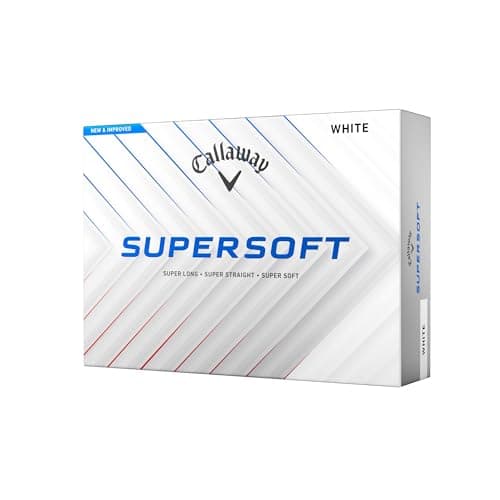
The Callaway Supersoft is the value default — one of the best-selling golf balls in the world, and for most amateurs a smarter buy than the tour ball their playing partner keeps recommending. This review is the honest version of that: the Supersoft is a genuinely good ball for the swing it is built for, it is not a tour ball in disguise, and knowing which of those you need is the whole decision. If your swing is slow to moderate and your short game runs the ball out rather than spinning it, the Supersoft does exactly what you need for a fraction of premium money. If you spin wedges on demand, it is the wrong tool.
What the Supersoft actually is
Callaway builds the Supersoft as a two-piece ball with a soft ionomer cover over one of the lowest compression cores in golf. That low compression is the entire point: compression is how much the ball squashes at impact, and a slower swing flattens a low-compression ball far more efficiently than a firm tour ball it can’t fully compress. Flattening the ball is where distance actually comes from for most amateurs, so for a moderate swing the Supersoft is, in effect, free yards. The cover material and relative compression here are manufacturer and widely-published construction facts, not numbers we measured — we don’t run a lab, and we say so on how we rank.
The short version: this is a soft, very-low-compression, ionomer-covered value ball built for slow to moderate swing speeds and a straight flight. It sits in the value tier — roughly half a tour ball per dozen — and it competes directly with the Srixon Soft Feel, the Titleist TruFeel and the Wilson Duo Soft. If you understand the urethane-versus-ionomer split, the Supersoft is squarely on the ionomer side; the best golf balls roundup lays out that divide in full.
Where it shines
The first strength is compression, and it is the real reason to buy it. One of the lowest compressions in golf means a slower swing gets more out of this ball than out of almost anything else on the shelf. Where a firm tour ball just sits there for a moderate swing, the Supersoft squashes and springs, and that translates into carry a firmer ball leaves on the tee. For the swing it targets, this is genuine, measurable distance — not marketing.
The second strength is straightness. The Supersoft’s low-spin, low-compression design produces a straight ball flight that flatters a slice or a hook, keeping a curving miss in play instead of sailing it out of bounds. For a player whose scorecard is wrecked more by lost balls than by a missed green, that straightness is worth more than any amount of greenside spin. The third strength is price: it costs little enough that losing a few doesn’t sting, which is exactly the right quality for the game that plays it.
Where it falls short (honestly)
The main limitation is greenside spin, and it is baked into the cover. The ionomer cover can’t produce tour-level greenside spin the way a urethane cover does — it releases more on chips and pitches, so the ball runs out rather than checking up on a number. For a player who genuinely spins wedges and wants one-hop-and-stop control, that is a real shortfall, and no amount of soft feel makes up for it. If your short game is built on spin, this is the wrong ball and a urethane ball is the right one, even at double the price.
The second limitation is feel preference. The Supersoft is very soft — genuinely one of the softest balls in golf — and not everyone wants that. Some players want more click and feedback off the putter and irons, and to them the Supersoft can feel a little mushy. That is a taste question, not a flaw, but it is worth a sleeve to check before you commit to a dozen. And like any value ball, it isn’t going to reward shot-shaping or aggressive spin control — that isn’t what it is for.
Who should buy it
Buy the Supersoft if your driver swing speed is on the slower side of average, you value a straight flight over greenside spin, and you’d rather not wince when a ball finds the water. It is an excellent first ball for a beginner, a sensible everyday ball for a high handicapper, and a genuine distance aid for a senior whose speed has eased off. It is also the ball to reach for if you fight a slice: the straight, low-spin flight keeps the big miss in bounds. For all of those players, the Supersoft is the value default for good reason.
Who should skip it
Skip it if you are a low handicapper whose short game lives on spinning wedges. The soft ionomer cover releases where you want it to bite, and you will feel the missing greenside control on every pitch and half-wedge — a urethane ball like the Srixon Q-Star Tour or a Pro V1 is the right tool for you even though it costs more. Skip it too if you simply prefer a firmer feel; the Srixon Soft Feel is a touch firmer and more responsive while still being a low-compression value ball, and for a lot of players it is the better middle ground. And if your swing is genuinely fast, you may over-compress the Supersoft and give up a little control for a softness you didn’t need.
The bottom line
The Callaway Supersoft earns its status as the value default. For a slow-to-moderate swing that wants distance, straightness and a soft feel without paying tour-ball money, it is one of the smartest buys in golf — and the money you save over a premium ball is genuine, not theoretical. It is not the ball for a spin-hungry short game, and it doesn’t pretend to be. Match it to your swing speed and the way you actually score, and the Supersoft is either exactly the right ball or the one you’ll outgrow when your wedge game starts asking for spin it can’t give.