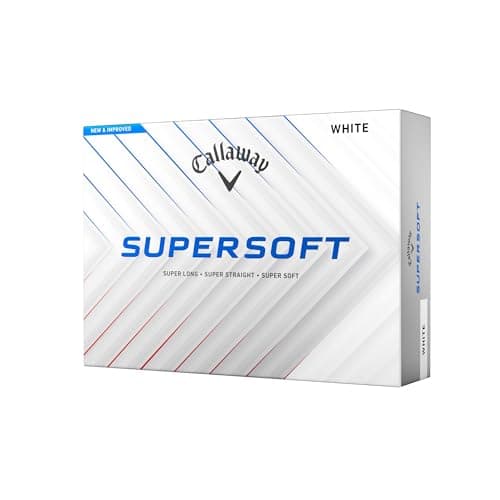
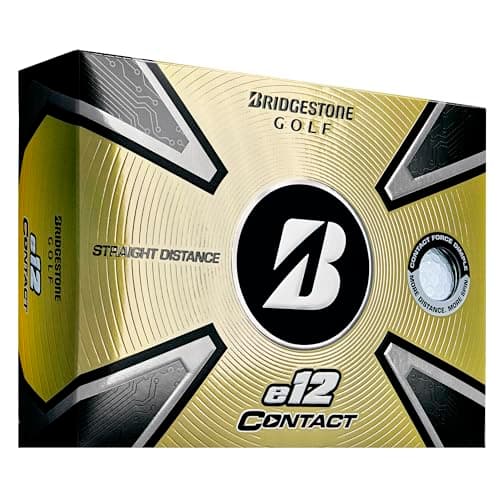
These are two of the most popular sub-premium golf balls in the game, and the mistake is treating them as interchangeable value balls — they are built to do different jobs. The Bridgestone e12 Contact is a three-piece distance ball tuned for straight, efficient flight, aimed at a moderate swing that wants yards without a slice. The Callaway Supersoftis a two-piece built around one of the lowest compressions in golf — a very soft feel and a straight flight for a slower swing. Both are ionomer-covered value balls, so neither is a spin machine around the green; the choice is about which flight and feel fit your swing, not about which is the better ball in the abstract.
Choose the e12 Contact if…
Your priority is straight distance and you have a moderate, repeatable swing. Bridgestone builds the e12 Contact as a three-piece distance ball, which typically means a slightly better feel than a hard two-piece rock, and markets its “Contact Force” dimple design around straighter, more efficient flight — treat that dimple story as sensible engineering rather than a breakthrough, and judge the ball as what it is: a solid, straight distance ball. The three-piece construction gives it a firmer, more responsive feel than the very softest value balls, and the low-spin design fights the sidespin that turns a decent swing’s miss into a slice. If you want a ball that flies straight and long off a swing that already makes reasonable contact, and you are not chasing a pillowy feel, this is your pick.
Choose the Supersoft if…
You have a slower swing, or you simply love a soft feel. The Supersoft is the value default for a reason: Callaway builds it around one of the lowest compressions in golf, so a slower swing can actually flatten it — and flattening the ball is where a slower player’s distance comes from — while a faster player who wants that soft feel gets it too. It feels notably softer than the e12 Contact off every club, from the putter to the driver, and its straight, low-spin flight flatters a slice or hook just as the Bridgestone’s does. The trade is the same one every value ball makes: the ionomer cover releases more on chips and pitches than a urethane ball, so it will not check and stop. If your swing is on the slower side, or a soft feel is what you enjoy most about a ball, the Supersoft is the more natural fit.
How they’re actually different
Three things separate them, and none of them is greenside spin — both give that up as the price of being value balls. Feel is the biggest: the Supersoft is one of the softest balls in golf, while the three-piece e12 Contact is firmer and more responsive, so the choice comes down to what you like hearing and feeling at impact. Construction and flightare the second: the e12 Contact’s three-piece, distance-tuned build is aimed squarely at straight, efficient yardage for a moderate swing, while the Supersoft’s two-piece, ultra-low-compression build is aimed at helping a slower swing compress the ball at all. Swing-speed fitis the third and the one that should decide it: the Supersoft’s very low compression rewards a slower swing, while the e12 Contact’s mid-low compression suits a moderate one that can take advantage of its distance design. Both fly straight and both feel value-tier around the green — match the compression to your speed and the feel to your taste.
Which one is actually longer?
It is the obvious question with a distance ball in the pairing, and the honest answer is: it depends on your swing, and the gap is smaller than either box implies. Both are conforming balls, so both live under the same USGA and R&A distance ceiling — neither is a magic yardage machine. The e12 Contact is the one designed first for distance, with a three-piece, low-spin build aimed at straight, efficient carry and roll for a moderate swing that can compress it, so for a mid-speed player who makes solid contact it is likely the marginally longer, straighter ball off the tee. The Supersoft’s distance comes from the other direction: its very low compression lets a slower swing flatten the ball where a firmer one would sit dead, so for a genuinely slow swing the Supersoft can carry further despite not wearing a “distance” label. In other words, match it to your speed — the moderate swing leans e12 Contact for a hot, straight flight, the slow swing leans Supersoft for easy compression — and do not expect a dramatic yardage gap either way, because the real distance levers are your strike and your clubhead speed, not the sticker on the box.
The slice question
Both of these balls are marketed, at least in part, at the golfer fighting a slice, so it is worth being precise about what a low-spin ball can and cannot do. A low-spin design reduces sidespin, and less sidespin means a slice curves less — so a ball like the e12 Contact or the Supersoft will genuinely finish closer to the fairway than a high-spinning tour ball hit with the same slicing swing. What it will not do is straighten a bad swing path; the curve comes from the club face and path at impact, and no ball removes that, it only softens the result. So both are legitimate help for a slice, and between them the tie-breaker is again swing speed and feel: a slower slicer who wants softness leans Supersoft, a moderate slicer who wants straight distance leans e12 Contact. If a slice is genuinely your main problem, note that the low-spin help comes bundled with a low-spin short game — you gain straightness off the tee and give up bite around the green, which is the right trade only while the tee shot is where you lose strokes.
Which fits a beginner or high handicapper?
Both are common choices for newer golfers, and for good reason: neither punishes a mishit the way a firm tour ball does, both fly straight, and both cost little enough to lose without pain. If you are brand new and your swing is slow, the Supersoft’s very low compression is the easier ball to get airborne and compress, so it is the more natural starting point. If you have played a while, make solid contact and just want to stop slicing it out of play, the e12 Contact’s straight distance design is the better tool. Either way, the honest advice at this stage is not to fuss — both are good value balls that will help more than they hurt, and your money is better spent on lessons and range time than on agonizing between two balls this close. When your wedge game sharpens and you stop losing sleeves, revisit the question and step up to a urethane ball then, not before.
What they cost, and how to buy them
Both sit in the value tier, and that is exactly where a ball with an ionomer cover belongs — you are paying for flight, feel and durability, not a urethane short game, so neither should command premium money. Because both are cheap enough to lose without wincing and durable enough to last, the sensible way to buy either is by the box rather than the sleeve, so a ball in the water is a shrug rather than a decision. Between the two, do not overthink a small price gap: if one is meaningfully cheaper the week you shop and it suits your swing speed, buy that one. Live prices for both sit on the cards above and refresh daily, so you can see the real per-dozen cost rather than trusting a remembered number — when a price cannot be verified you will see “check price” instead of a stale figure. For the broader question of when a cheaper ball is genuinely the right call, our are expensive golf balls worth it breakdown lays out the arithmetic.
Skip the decision entirely if…
Neither is your ball if your scoring lives on greenside spin. Both are ionomer value balls that release rather than bite, so a low-handicapper whose short game needs one-hop-and-stop control should be playing a urethane ball, not either of these — step up to the value-tour or premium options in our best golf balls roundup. And if a soft feel is your only real criterion, the Supersoft has a close value rival worth weighing first: settle that one in Supersoft vs Soft Feel. If, on the other hand, distance is the whole point and you want to see where the e12 Contact ranks against the firmer, hotter balls, our best golf balls for distance roundup lines them up by carry, straightness and price.