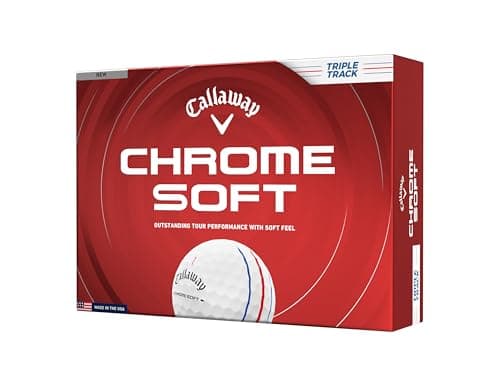
The Callaway Chrome Soft is the premium ball for the player who wants tour spin without the tour-firm feel. Where a Pro V1 or a TP5 rewards you with a firm, clicky strike, the Chrome Soft’s whole pitch is holding urethane greenside spin inside a genuinely soft, low-compression package. Here’s the honest version of that pitch: it is an excellent golf ball, and it is priced right alongside the firmest tour balls, so it is the wrong purchase for a lot of the players drawn to the word “soft” on the box. The Chrome Soft rewards a specific game. If you have it, few balls feel better while still checking a wedge. If you don’t, you’re paying premium money for spin your swing can’t yet bank — so this review is as much about whether you should buy one as how good it is.
What the Chrome Soft actually is
Callaway builds the Chrome Soft with a cast-urethane cover — the soft, grippy cover that separates a tour ball from a value ballin the first place — wrapped around a low-compression core that gives it its signature soft feel. Callaway’s claim is that you get genuine urethane greenside spin in a package that feels noticeably softer off the face than a firm tour ball, and it offers the Triple Track alignment lines as a putting aid. Those are the manufacturer’s claims, not numbers we measured — we don’t run a lab, and we say so on how we rank— but they match how the ball behaves for the players it suits: soft off every club, a urethane cover that bites, and a flight window a touch lower and softer than the firmest premiums.
The short version: this is a premium-tier, urethane ball built around feel, priced right alongside a Pro V1 rather than below it — this is not the value play. It is the ball we point players toward when they find the Pro V1 too firm, and it is most often cross-shopped against exactly that benchmark. We settle it in Chrome Soft vs Pro V1, weigh it against the five-layer TaylorMade in Chrome Soft vs TP5, and against the value-tour ball a rung down in Q-Star Tour vs Chrome Soft.
Where it shines
Feel is the headline, and it delivers. The Chrome Soft is genuinely soft off the face — softer than a Pro V1 and much softer than a TP5 — and for a lot of moderate swing speeds that softer strike off the putter and irons is a better feel match than the firm tour balls. Softness is a preference rather than a performance grade, but if it’s your preference, this is the premium ball built around it.
Crucially, that soft feel doesn’t cost you the cover. The Chrome Soft still wears a urethane cover, so it still grips a wedge and produces the one-hop-and-stop greenside spin that separates a scoring ball from a value ball — you simply get it in a softer-feeling package. For a player whose short game can use that spin, it is the rare ball that pairs premium greenside control with a soft strike.
The Triple Track alignment lines are the third strength, and they’re a real one. The lines give you a reference to start putts on, and it’s a genuine, free putting aid rather than marketing — if alignment is something you struggle with, that’s a concrete reason to lean Chrome Soft over a plainer tour ball. Between a soft feel, urethane spin and a useful alignment aid, the Chrome Soft’s case is that it’s the most well-rounded premium for a feel-first player.
Where it falls short (honestly)
The first limitation is money. The Chrome Soft is priced right alongside the Pro V1 — roughly double a very good value ball per dozen — and it does nothing to stop you losing them at the same rate as any other ball. A lost Chrome Soft is a more expensive lost ball, full stop, and we run that math in are expensive golf balls worth it.
The second is spin ceiling. The Chrome Soft’s pitch is feel, not the last degree of greenside bite — Callaway’s own line-up puts firmer, higher-spinning balls above it. For the vast majority of players that distinction is academic, but if outright maximum greenside spin is what you’re chasing, the softest premium isn’t the one that spins the most.
The third is the short game and swing it still assumes. Soft feel makes the Chrome Soft flattering, but the urethane cover only pays you back if your wedges can genuinely use the spin, and the ball still costs premium money whether or not your game can cash it. On our value metric the Chrome Soft scores low, and that’s deliberate: it is a brilliant ball that most amateurs, drawn in by the soft feel, shouldn’t be buying yet.
Who should buy it
Buy the Chrome Soft if you want a premium urethane ball and you prize a soft feel — particularly if you’ve found a Pro V1 or TP5 too firm off the face and the putter. It suits a moderate-to-fast swing that can compress it and a short game sharp enough to use urethane spin, and it earns extra points if the Triple Track alignment lines help your putting. It is the feel-first player’s premium: you get tour greenside control without the firm, clicky strike, and you keep most of your golf balls in play so the cover gets to matter. If that’s you, few balls are more satisfying to play a round with.
Who should skip it
Skip it — for now — if you shoot north of 90 and lose more than a sleeve a round, or if you’re buying it mostly because “soft” sounds appealing. Soft feel is not the same as easy performance: the Chrome Soft is a premium urethane ball, and if your short game still runs the ball out or your golf balls end up in the water, you’re paying top-tier money for a benefit you can’t bank. A slower or moderate swing chasing softness alone would do better with a soft low-compression value ball, which feels soft too and costs a fraction as much. And if you want the urethane cover at a friendlier price, the mid-priced Srixon Q-Star Tour is the smarter step up — we put the two side by side in Q-Star Tour vs Chrome Soft. Come back to the Chrome Soft when your wedges are asking for spin and you want it in the softest package going.
How it stacks up against the field
Against the other premiums, the Chrome Soft’s identity is feel and alignment rather than outright spin or a five-layer spec. The Pro V1is the firmer control benchmark, the ball more low-handicappers’ short games are calibrated to; the TP5is a firmer, five-layer ball chasing a wider driver-to-wedge spin gap. The Chrome Soft answers both with a softer strike and the Triple Track lines. None is clearly better — they’re different flavors of the tour-ball idea, and a sleeve of each plus a few wedges and putts is the honest way to choose. Against the full field, the Chrome Soft sits near the top for performance and near the bottom for value, the standard shape of every premium ball.
The bottom line
The Chrome Soft deserves its following. It’s the rare premium that pairs a genuinely soft feel with real urethane spin and a useful alignment aid, and for a moderate-to-fast player with a sharp short game who keeps it dry, it’s worth every cent. But softness sells a ball to a lot of golfers who can’t yet use what’s underneath it. The same low-compression feel that makes it lovely doesn’t change that it’s a premium urethane ball priced like one and built for a game that can spin a wedge. Match it to your short game and your lost-ball count, not to the word on the box, and the Chrome Soft is either the best-feeling ball in your bag or a costly way to enjoy a soft strike.