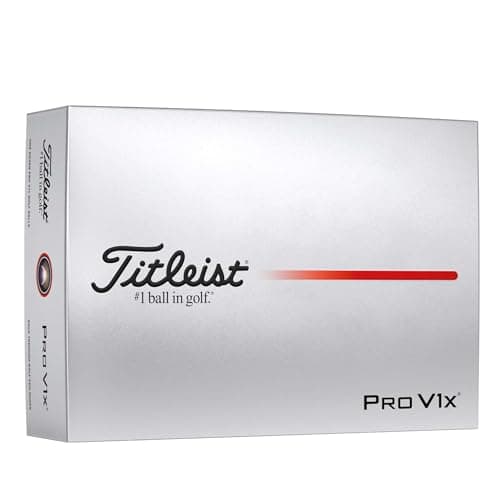
The Titleist Pro V1x is the Pro V1’s higher-flying, firmer-feeling sibling — the tour ball a lot of faster swingers quietly prefer. It shares the same cast-urethane cover and the same top-of-the-ladder price, so this review isn’t really about whether it is a good ball. It plainly is. It is about whether its particular flight and feel suit your swing better than the standard Pro V1, and whether either belongs in your bag at all. If you have the speed and the short game the Pro V1x is built for, nothing here launches higher or lands steeper. If you don’t, the extra height and firmer click are refinements you’ll pay for and never use.
What the Pro V1x actually is
Titleist builds the Pro V1x as a four-piece ball — one more internal layer than the three-piece Pro V1 — wrapped in the same soft cast thermoset urethane cover that grips a wedge and produces one-hop-and-stop greenside spin. Titleist’s published construction pairs a dual-core with a casing layer and a spherically-tiled dimple pattern the company says it tuned for a higher launch and a steeper landing angle than the Pro V1. Those are manufacturer claims, not numbers we measured — we don’t run a lab, and we say so on how we rank— but they match how the ball behaves for the players it suits: a firm, tour-level compression, a taller flight window, and a touch more spin through the bag than its sibling.
The short version of the spec sheet: this is a firm, premium-tier, four-piece urethane tour ball built for a golfer with real clubhead speed who wants height, a steep descent into firm greens, and a little extra spin. It sits at the very top of the price ladder — roughly double a very good value ball per dozen — and it is the higher-launching half of the two-ball Titleist tour line. If you want the softer-feeling, slightly lower-flying option instead, that is the standard Pro V1; we split the pair in full in Pro V1 vs Pro V1x.
Where it shines
The headline strength is flight. The Pro V1x launches higher and comes down steeper than the Pro V1, and on a full approach that steeper descent means the ball stops faster on the green with less run-out. Into firm, fast greens — the kind that release a lower-flighted ball off the back — a higher, more vertical landing is a genuine scoring advantage, not a spec-sheet curiosity. If your natural ball flight is on the low side and you fight to hold greens on approach, the Pro V1x’s height does real work for you.
The second strength is spin, and it is subtle but real. The Pro V1x tends to spin a touch more through the irons and wedges than the Pro V1, which pairs with the higher flight to make it the more aggressive stopping ball of the two. For a strong player who wants to attack pins and back the ball up rather than release it, that extra spin is exactly the tool. It is still a tour ball greenside — the cast urethane cover grips the grooves and checks on the second bounce — so you get the full short-game repertoire of the Pro V1 line, with a hair more bite.
The third strength it simply shares with the Pro V1: durability and consistency. The cover holds up better than most urethane balls before it scuffs, so you get more full rounds out of a ball than the softness would suggest — a real consideration at this price. And like anything in the Titleist tour line, it is consistent round to round and dozen to dozen, which is the quiet reason good players trust it: their wedge distances and spin numbers are calibrated to a ball that behaves the same way every time.
Where it falls short (honestly)
The first limitation is money, and it is identical to the Pro V1’s. The Pro V1x costs roughly twice a very good value ball per dozen, and nothing about the extra layer stops you losing them at the same rate as any other ball. A lost Pro V1x is simply a more expensive lost ball, and there is no performance argument that offsets one at the bottom of a pond. We do that arithmetic in full in are expensive golf balls worth it, and for a lot of golfers it is the single most important decision on this site.
The second is the swing-speed requirement. Like the Pro V1, the Pro V1x’s firm tour compression needs real clubhead speed to compress fully. Feed it a slower swing and it doesn’t squash the way a low-compression ball does, so you leave distance on the tee and never generate the spin you paid for. The extra height that helps a fast swing hold a green does nothing for a slow one that couldn’t hold it anyway. Our compression explainer lays out why matching compression to speed matters more than the badge on the box.
The third is feel, and it is a preference rather than a flaw. The Pro V1x is firmer than the Pro V1 — a clicky-er, more solid strike off the putter and irons. Some players love that feedback; others want the softer, more muted feel of the Pro V1 or the noticeably softer Callaway Chrome Soft. If soft feel off the putter is what you value, the Pro V1x is the wrong end of the Titleist line, and we weigh it against the softest premium in Pro V1x vs Chrome Soft. On our value metric the Pro V1x scores low, and that is deliberate: a brilliant ball most amateurs shouldn’t buy.
Who should buy it
Buy the Pro V1x if three things are true. You have the clubhead speed to compress a firm tour ball — broadly a driver in the region of 105 mph and up, though delivery matters as much as the raw number. You want a higher, steeper flight, either because your natural trajectory runs low or because you play firm greens that punish a flatter ball. And you keep most of your golf balls in play, so the cover material and the extra spin actually get a chance to matter across a round. Tick all three and the Pro V1x is exactly what it claims to be: the higher-launching, slightly higher-spinning tour ball, and worth its premium for the faster swing who wants a taller flight.
Who should skip it
Skip it — for now — if you shoot north of 90 and lose more than a sleeve a round. That is the honest core of this review: you would be paying tour-ball money for height and spin your swing can’t unlock, and then hitting a good share of it into the water. A slower or moderate swing gets more distance and a straighter flight from a soft low-compression ball, and a game that already flights the ball high or likes a soft strike will actively dislike the Pro V1x’s firmer feel. If you like a soft feel off the putter, the standard Pro V1 is the better buy at the same price; the extra height and firmer click are the whole difference, and if you don’t want either, you are paying premium money for the wrong strengths.
How it stacks up against the field
Against the Pro V1, the choice is flight and feel, not better-or-worse: the Pro V1x flies higher, spins a shade more and feels firmer, while the Pro V1 flies a touch lower and feels softer — the full breakdown is in Pro V1 vs Pro V1x. Against the Callaway Chrome Soft, the Pro V1x is the firmer, higher-spinning, higher-flying option and the Chrome Soft is the soft-feel alternative with Triple Track alignment lines. And against the full field, the Pro V1x lands where every tour ball does: at the top for outright performance and near the bottom for value. If you have already decided the tour-ball money is right for your game, read our Titleist Pro V1 reviewalongside this one and pick on flight and feel; if you haven’t, that is the decision to settle first.
The bottom line
The Pro V1x is not a “better Pro V1” — it is a different flavor of the same tour-ball idea, tuned higher and firmer. For a fast-swinging player who wants a towering flight, a steep stop on firm greens and a touch more spin, and who keeps it dry, it is worth every cent. But the same qualities that make it brilliant for that player — firm compression, height that has to be earned with speed, a firmer feel, a price that assumes you don’t lose them — make it the wrong buy for the mid-to-high handicapper it is often sold to. Match the ball to your swing speed, your flight and your lost-ball count, not to the tour broadcast, and the Pro V1x is either a precise fit or an expensive mismatch.