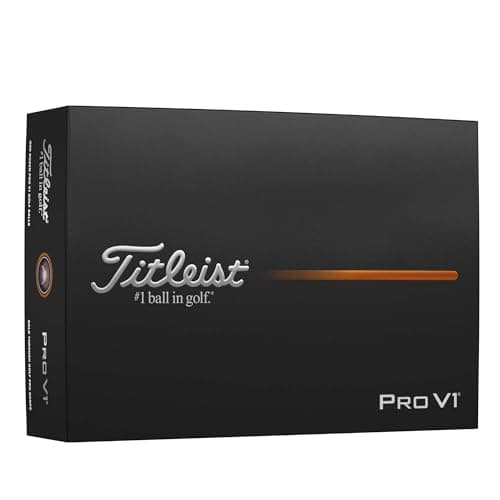
The Titleist Pro V1 is the default tour ball — the one your playing partner keeps telling you to buy, and the one a large share of the field genuinely tees up. Here’s the honest version of that recommendation: it is a superb golf ball, and it is also the wrong purchase for a lot of the people who reach for it. The Pro V1 is built to reward a specific game. If you have that game, nothing here spins or flies more predictably. If you don’t, you’re paying tour-ball money for performance your swing can’t yet unlock — so the review below is as much about whether you should buy one as how good it is.
What the Pro V1 actually is
Titleist builds the Pro V1 as a three-piece ball with a cast thermoset urethane cover — the soft, grippy cover that separates a tour ball from a value ballin the first place. Titleist’s published construction wraps a reformulated high-gradient core in an ionomer casing layer and finishes it with a 388-tetrahedral-dimple pattern the company says it tuned in a wind tunnel for a penetrating, mid-height flight. Those are manufacturer claims, not numbers we measured — we don’t run a lab, and we say so on how we rank— but the construction matches how the ball behaves for the players it suits: a firm, tour-level compression, a repeatable flight window, and the one-hop-and-stop greenside bite that urethane exists to deliver.
The short version of the spec sheet: this is a firm, premium-tier, urethane tour ball built for a golfer who delivers real clubhead speed and spins wedges on purpose. It sits at the very top of the price ladder — roughly double a very good value ball per dozen — and it is the reference point every other tour ball, from the TaylorMade TP5 to the Callaway Chrome Soft, gets measured against. If you want the higher-flying, firmer sibling, that’s the Pro V1x; we split them in Pro V1 vs Pro V1x.
Where it shines
Greenside, it is the best ball here, and it isn’t especially close. The cast urethane cover grips the grooves of a wedge and produces the most consistent spin and flight window of anything in this category — the pitch that checks on the second bounce, the half-wedge that sits, the flighted chip that behaves the same way twice. For a player whose scoring depends on stopping the ball on a number, that repeatability is the whole point, and it is what the price actually buys.
It flies the way Titleist says it does, too: a mid, penetrating trajectory that holds its line in wind better than a higher-launching ball. That matters on a firm, breezy course where a ballooning flight gets punished — the Pro V1 bores through the wind on a full shot and still drops softly enough to hold a green on approach. It is a narrower, more predictable flight window than most balls offer, and predictability is exactly what a scoring player is buying.
Two other strengths matter. First, durability: the cover holds up better than most urethane balls before it scuffs, so you get more full rounds out of a ball than the softness would suggest — a real consideration when each one costs what it does. Second, calibration: for a low handicapper, the Pro V1 is the ball their short game is genuinely dialed to. Wedge distances, spin off a tight lie, the release on a running chip — those are learned against a specific ball, and the Pro V1 is the one more good players have learned on than any other. That consistency, round to round and dozen to dozen, is the quiet reason it stays in the bag.
Where it falls short (honestly)
The first limitation is money, and it is not small. The Pro V1 costs roughly twice a very good value ball per dozen, and it does nothing to stop you losing them at the same rate as any other ball. There is no durability or performance argument that offsets a ball at the bottom of a pond — a lost Pro V1 is simply a more expensive lost ball. We do that arithmetic in full in are expensive golf balls worth it, and for a lot of golfers it is the single most important page on this site.
The second is the swing-speed requirement. The Pro V1’s firm, tour compression needs real clubhead speed to compress fully. Feed it a slower swing and it doesn’t squash the way a low-compression ball does, so you leave distance on the tee andyou don’t generate enough spin to see what you paid for. The ball isn’t underperforming in that case — it is the wrong tool. Our compression explainer lays out why matching compression to speed matters more than the badge on the box.
The third is feel, and it is a preference rather than a flaw. The Pro V1 is firmer than a Callaway Chrome Soft and softer than the Pro V1x, and some players simply want more softness off the putter or more height in the air than it gives. That is not the ball being worse — it is the ball being a particular profile. If you want the softest premium feel, the Chrome Soft is the closer match; if you want more launch and a firmer, clicky-er strike, that is the Pro V1x. On our value metric specifically the Pro V1 scores low, and that is deliberate: it is a brilliant ball that most amateurs shouldn’t buy.
Who should buy it
Buy the Pro V1 if three things are true. You have the clubhead speed to compress a firm tour ball — broadly, a driver in the region of 105 mph and up, though feel and delivery matter as much as the raw number. Your short game spins wedges on demand and you want the ball to stop on a target rather than release. And you keep most of your golf balls in play, so the cover material actually gets a chance to matter across a round. Tick all three and the Pro V1 is exactly what it claims to be: the most consistent, controllable ball you can play, and worth its premium. It is the pick for the low handicapper who spins it on demand, and it earns the reputation.
Who should skip it
Skip it — for now — if you shoot north of 90 and lose more than a sleeve a round. That is the honest core of this review: you would be paying tour-ball money for spin your swing can’t unlock, and then hitting a good share of it into the water. A slower or moderate swing gets more distance and a straighter flight from a soft low-compression ball, and a game that still runs the ball out around the green can’t bank the greenside spin a urethane cover exists to provide. If you want the urethane cover without the tour-firm compression or the top-tier price, the mid-priced Srixon Q-Star Tour is the smarter step — we put the two side by side in Q-Star Tour vs Pro V1. Come back to the Pro V1 when your ball-in-play rate climbs and your wedges start asking for spin you don’t yet have; it will still be the benchmark when you do.
How it stacks up against the field
Against the other premiums, the Pro V1’s case is consistency rather than any single standout number. The TaylorMade TP5 matches it on greenside performance and chases a wider spin gap from driver to wedge with its five-layer build; the Chrome Soft undercuts it on firmness with a softer feel and adds Triple Track alignment lines; the Vice Pro Plusmatches the performance class and undercuts the price if you buy in bulk. None of them is clearly “better” than the Pro V1 — they are different flavors of the same tour-ball idea, and the Pro V1’s edge is that it is the most repeatable and the most widely calibrated-to. Where it sits against the full field is at the top for outright performance and near the bottom for value, which is the honest summary of every tour ball.
The bottom line
The Pro V1 deserves its reputation. It is the most consistent, controllable ball you can put in play, and for a fast-swinging low handicapper who keeps it dry, it is worth every cent of the premium. But a reputation isn’t a fitting. The same qualities that make it brilliant for that player — firm compression, spin that has to be generated, a price that assumes you don’t lose them — make it the wrong buy for the mid-to-high handicapper it is most often sold to. Match the ball to your game, not to the tour broadcast, and the Pro V1 is either the best decision in your bag or the most expensive mistake. Only your swing speed, your short game and your lost-ball count decide which.