For most club golfers the answer is a mallet, and it is a mallet for one unglamorous reason: a bigger head resists twisting on an off-center strike, and club golfers strike putts off-center. But “most golfers” is not you, and the real decision is narrower than the shapes. It comes down to whether your putter travels in a straight line or on an arc — because that sets how much toe hang you need, and toe hang is where mallets and blades genuinely differ. Get that right and either shape works. Get it wrong and you will fight the face open for years with the prettiest putter in the shop.
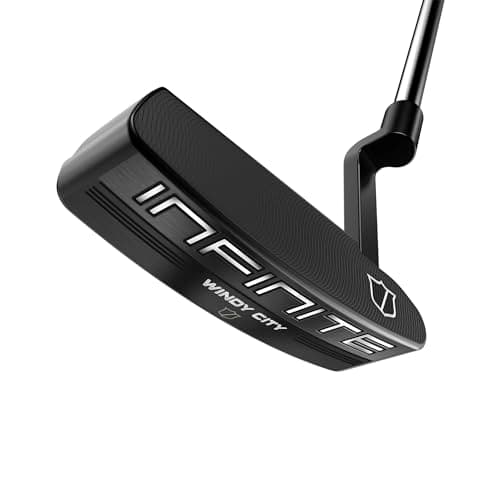
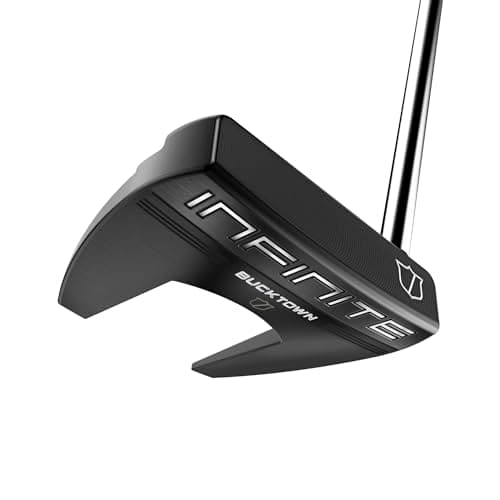
The pair at the top of this page is deliberately chosen to isolate it. Wilson’s Infinite line sells the Bucktown fang mallet and the Windy City blade with the same double-milled face, the same thick-center-line alignment, the same midsize no-taper grip, the same two-tone PVD finish and the same price. Head shape is the only variable left. If you want to know what a mallet does and what a blade does, with nothing else changing, that is the cleanest comparison money can buy.
The two things that actually separate the shapes
Strip away the marketing and a putter head has two properties that matter to the stroke.
Toe hang. Balance a putter on your finger halfway down the shaft. If the face points at the ceiling, it is face balanced— zero toe hang. If the toe droops toward the floor, it has toe hang, measured in how far it drops. Face-balanced heads want to stay square through the stroke; toe-hang heads want to rotate open and closed. That is not a quality difference, it is a fit: a stroke that rotates the face needs a head that rotates with it, and a stroke that does not needs one that does not. Odyssey publishes its DFX V-Line Fang as face balanced with 0° toe hang and says in its own fitting language that it is “best suited for strokes with minimal arc and face rotation.” That is the clearest statement of the principle any maker puts in print.
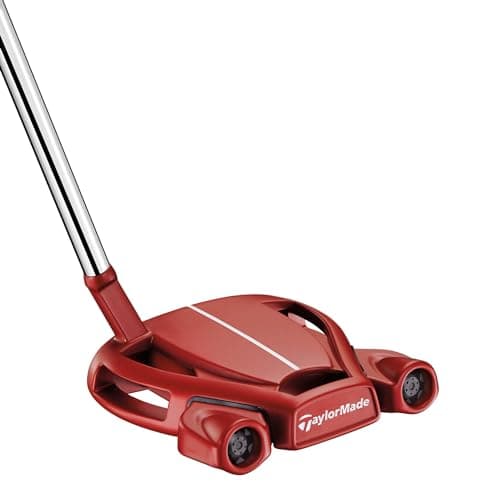
Moment of inertia.MOI is resistance to twisting. Push mass out to the heel and toe, away from the center, and a strike half an inch off the sweet spot turns the face less, so the ball starts closer to your intended line and loses less speed. Mallets have more room to do this, which is the whole architectural point of them. TaylorMade builds the Spider around “a lightweight 6061 aluminum core with a heavy 304 Stainless Steel perimeter” — light in the middle, heavy at the edges, which is the textbook high-MOI recipe. A blade has nowhere to put that mass.
Everything else — insert versus milled face, sight lines, grip size, finish — is available in both shapes and should not decide this. The Wilson pair proves it: identical face, identical alignment, identical grip, different heads.
Mallet vs blade, side by side
| Property | Mallet | Blade |
|---|
| Stroke it suits | Straight back and through, or minimal arc | Noticeable arc with face rotation |
| Typical balance | Face balanced to light toe hang | Moderate to strong toe hang |
| Forgiveness on a mis-strike | Higher — more perimeter weight to resist twist | Lower — the face turns more |
| Alignment help | Usually more: a frame, wings or multiple lines | Usually a single sight line (the Windy City is the exception) |
| Feel and feedback | Quieter — you feel the mis-hit less | Sharper — you know exactly where you struck it |
| Looks behind the ball | Busy; some golfers cannot settle over it | Clean; the traditional view |
| Best for | Higher handicaps, inconsistent strikes, aim trouble | Repeatable strikers, arcing strokes, feel players |
Find out which stroke you make (two minutes, no equipment)
You do not need a fitting bay for this, and you should not guess. Do both of these before you buy anything.
- The balance test, on the putter you already own.Rest the shaft on one extended finger at its balance point. Face to the ceiling means face balanced; toe drooping means toe hang. Whatever you have been putting adequately with is evidence — if you have putted well for years with a toe-hang blade, a face-balanced mallet is a bigger change than it looks.
- The two-line test, on a carpet. Lay an alignment stick or a strip of tape on the floor on your target line and make ten slow strokes with the putter head just inside it. Watch the head, not the ball. If the head stays over the line going back and through, you have a straight stroke and want face balanced. If it drifts inside the line on the way back and the face visibly rotates, you have an arc and want toe hang. Our alignment stick drills page has the setup, and a putting mat makes the same test repeatable indoors all winter.
One warning about the second test: do it slowly and do not try to make a “correct” stroke. You are diagnosing what you actually do, not auditioning. The whole value of the exercise is that it tells you something you did not already believe.
The four putters on this page, and why each is here
Scores are judgments from published manufacturer specifications, listing details and aggregated owner feedback against our rubric— not lab measurements. We have not rolled these on a putting robot; we do not have one.
| Pick | Shape | Published face | The job it does here |
|---|
| Wilson Infinite Bucktown | Fang mallet | Double-milled | The mallet half of the controlled pair, and the most alignment help per dollar |
| Wilson Infinite Windy City | Blade | Double-milled (same) | The blade half — identical everything except the head |
| TaylorMade Spider RED #3 | High-MOI mallet, slant neck | Pure Roll surlyn insert, 45° grooves | What a mallet looks like built for an arc, not against one |
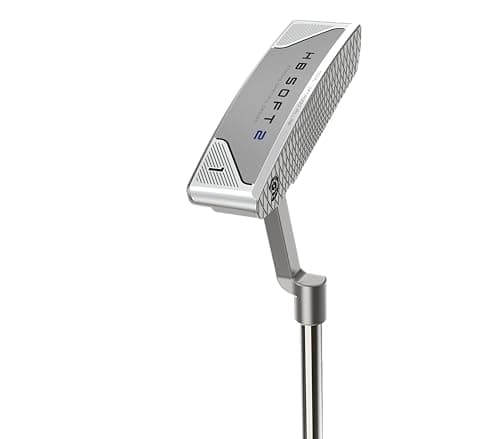
| Cleveland HB Soft 2 #1 | Blade, plumber’s neck | Speed Optimized Face Technology milling | The traditional blade done properly, at a sane price |
The Spider is on this page to kill the laziest version of this debate — that mallets are for straight strokes and blades are for arcs. TaylorMade sells the Spider RED with a Small Slant #3 neck specifically for an arcing stroke, and also in a Double Bend for a straight one. A mallet can have toe hang. A blade can be made more forgiving. The shapes correlate with balance; they do not define it, which is exactly why you check the balance point rather than the silhouette.
So which should you buy?
Buy a mallet if you do not know what stroke you make, you miss the center of the face more often than you would like, you struggle to aim the putter at all, or you have putted badly for long enough that you want the club to help. That is the large majority of golfers who read a page like this one, and it is why our best putters roundup has a face-balanced fang mallet at the top.
Buy a blade ifyour balance test shows toe hang and your carpet test shows an arc, or you simply putt better with one and have the scores to prove it. Feel players and good putters often genuinely do: a blade tells you more about the strike, and if you can act on that information it is worth more than the forgiveness you give up. There is also no shame in the aesthetic answer — a putter you cannot settle over is a putter you will miss with regardless of its MOI.
Do not buy either until you have checked your length. A putter too long for you pushes your hands out and your eyes inside the ball, which produces a pull that no head shape fixes. That, grip size and loft are a fitting conversation, and they move the needle more than this entire shape debate. The same logic applies one slot up the bag in cavity back vs blade irons: the head shape argument is downstream of whether the club fits you.
The stroke-to-head cheat sheet
| Your stroke | What you want | On this page |
|---|
| Straight back, straight through | Face balanced, high MOI | Wilson Infinite Bucktown |
| Slight arc | Light toe hang — a plumber’s-neck blade or a slant-neck mallet | Cleveland HB Soft 2 #1, or the Spider RED #3 |
| Strong arc with obvious face rotation | Moderate to strong toe hang | Wilson Infinite Windy City or the Cleveland blade |
| You have no idea | Face balanced, maximum alignment help | Wilson Infinite Bucktown |
Price brackets, and what the money actually buys
Putters are the one club where the price range is almost entirely decoupled from performance. The cheap end gets you a plain head with a sight line and no published face technology. The middle bracket — where both Wilsons and the Cleveland sit — buys you a milled face, a considered grip and a finish that does not glare, which is genuinely everything a club golfer needs. The top bracket, where the Spider lives, buys multi-material construction, higher MOI and tour pedigree. All three brackets will hole a six-footer.
Our honest recommendation on allocation: if you have a fixed budget for putting, spend it on the middle bracket and put the difference into a putting mat and a lesson. A milled-face mallet plus two hundred putts a week will beat a tour putter and no practice every time, and it is not close. The same reasoning runs through how much to spend on golf clubs.
Things that are not real reasons to switch shape
- “A tour pro uses it.” Tour players are fitted, practice daily, and putt on surfaces you will never see. Their shape choice tells you about their stroke, not yours.
- “Mallets are for beginners.” There are mallets on the tour leaderboard every single week. Higher MOI is not a handicap category.
- “Blades feel better.”Feel comes from the face and the grip, both of which are available in either shape — which is the entire point of the Wilson pair on this page.
- “I three-putt a lot.” Three-putts are usually a pace problem from distance, and neither head shape fixes pace. That is a practice problem, and a mat with marked distances or a practice green is the fix.