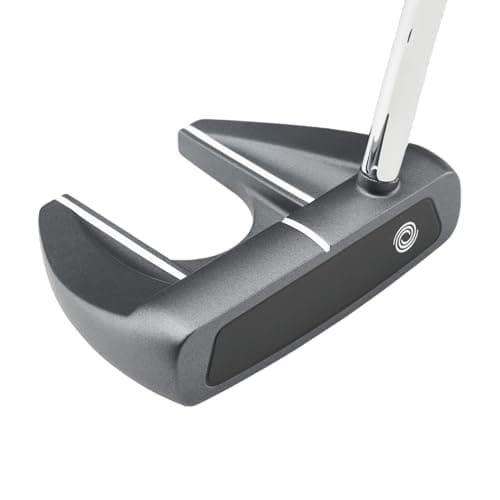
Par is built on the assumption that you take two putts on every green — 36 of the 72 strokes on a standard card. No other club is handed half your score before you tee off, and no other club is bought the way this one is: by eye, off a rack, in whatever length the shop had. The best putter for you is the one whose head matches the stroke you already make, aims where you are actually looking, and rolls the ball at a pace you can judge. The Odyssey DFX V-Line Fangtops this list because it does all three for the stroke most club golfers own — but read the “best for” line on every pick, because choosing a putter is a fitting question more than a ranking question.
How we ranked these
Putters are the club where marketing runs furthest ahead of evidence, so we ranked on the things a manufacturer has to publish and a buyer can check, in this order:
- Does the head match a real stroke? A face-balanced head suits a stroke that goes nearly straight back and through; a head with toe hang suits a stroke that arcs. Get this wrong and every other feature is decoration.
- Does it help you aim? Most missed putts are started on the wrong line, not struck badly. Sight lines, a framed head shape and a contrast finish do more for the average golfer than any face technology.
- What does the face do to the ball? An insert, a milled pattern or a bare face changes feel and how quickly the ball starts rolling. We report what each maker publishes and say plainly where the claim is theirs, not ours.
- How much does it forgive?A wide mallet resists twisting on a heel or toe strike far better than a blade. That matters most for the golfer who misses the middle — which is most golfers, and the whole of that argument is in mallet vs blade putter.
- What does it honestly cost? Putters run from about sixty dollars to several hundred for heads that do the same job. We ranked what the money buys, not the badge.
What we deliberately did notrank on: tour wins, the number of putts a robot holed in a manufacturer’s own test, or “feel,” which is real but personal and impossible for us to measure for you. We did not roll a single putt in a lab, because we do not have one — every technical claim below is the maker’s published wording, attributed and sourced at the foot of the page. Our full method is in how we rank.
The one decision that sorts this list: your stroke
Before you compare a single price, find out whether your putting stroke arcs. There is a thirty-second version of the fitting: rest the shaft across your finger near the balance point and look at the head. If the face points at the sky, the putter is face balanced— built for a stroke that moves nearly straight back and straight through with very little face rotation. If the toe droops toward the ground, the putter has toe hang— built for a stroke that swings inside and rotates the face open and shut.
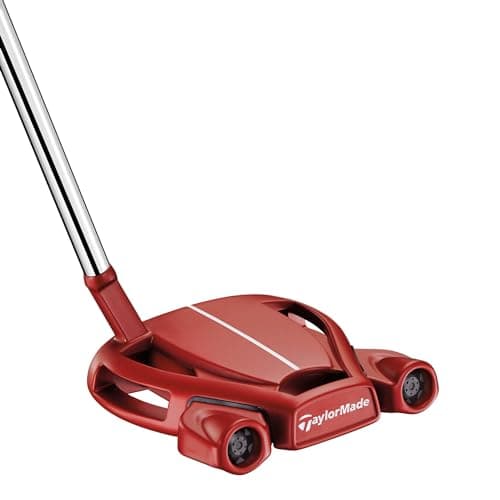
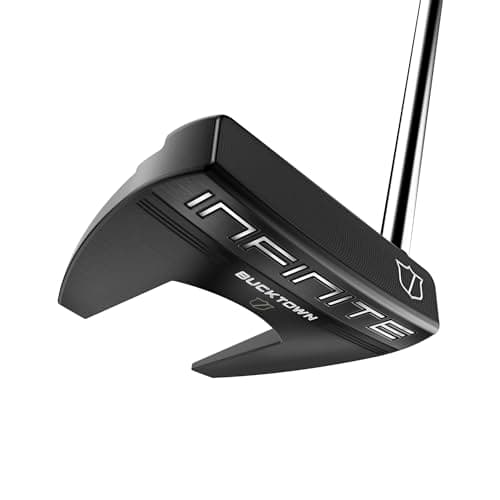
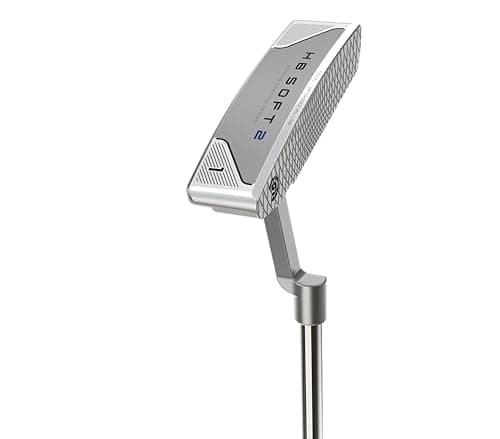
That single split decides this page. Odyssey publishes the double-bend DFX as face balanced with 0° toe hang and says it is best suited to “strokes with minimal arc and face rotation.” The Wilson Bucktown is the same camp: a fang mallet on a shaft built to sit square. The Cleveland blade’s plumber’s neck and the Spider RED’s Small Slant #3 hosel both give toe hang for a stroke that arcs. Buy across that line and you spend the season fighting a face that will not square up when you need it — no amount of milling or insert technology compensates.
The picks in brief
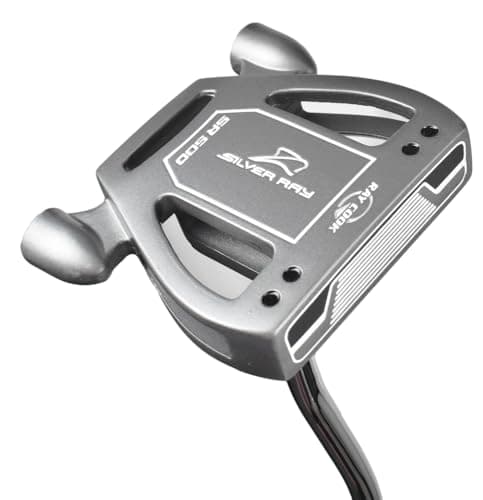
The Odyssey DFX V-Line Fang is the pick for most golfers: a mid-size fang mallet, face balanced, with the softest insert Odyssey publishes and an oversize grip on this listing that takes the wrists out of a short putt. The TaylorMade Spider RED #3is the stability play — an aluminum-core, steel-framed high-MOI head with a slant neck for an arcing stroke — and it is also the most expensive thing here by a distance. The Wilson Infinite Bucktown is the value pick from a real brand: the most aggressive alignment aid on the page, a double-milled face and a counterbalanced grip for meaningfully less than the Odyssey. The Cleveland Huntington Beach Soft 2 #1 is here for the golfer who wants a blade and should have one: a milled face from a major brand at a price the boutique blades never approach. And the Ray Cook Silver Ray SR500is the honest budget answer — a real branded mallet with a proper sight line and a headcover, for roughly a third of the mainstream field.
Skip this: the expensive mallet, if your problem is pace rather than line
Here is the caveat the putter market never volunteers. Three-putts come in two flavors. If you keep starting putts on the wrong line, a better-aiming, more forgiving head genuinely helps, and the Bucktown or the DFX will do something for you. But if your three-putts are lag putts left eight feet short from forty, no putter on this page will fix that — distance control is a practice problem, and a $250 head buys you nothing at all. Spend the difference on a pressure putt trainer or an alignment mirror, keep the cheap putter, and put the rest toward a lesson. Where the rest of your budget is best spent is the whole subject of how much to spend on clubs.
Length is the fitting that matters most — and the one nobody does
Putters are sold off the rack in 34 and 35 inches because those two numbers cover the widest range of adults, not because they fit you. A putter that is too long pushes your hands away from your body and your eyes inside the ball, which aims the face right of where you think it is pointing before you have moved a muscle. Too short and you crouch and manipulate the face with your hands. The check is simple: take your normal posture with your eyes over or just inside the ball, let your arms hang, and see whether the sole sits flat. If the toe or the heel is in the air, the length and lie are fighting you.
The good news is that this field gives you options. Odyssey lists the DFX in 32, 33, 34 and 35 inches; Ray Cook lists the SR500 in 34 (right hand only) and 35; Wilson and TaylorMade both list 34 and 35. Buying the right number off the shelf costs nothing. Cutting a putter down afterwards is possible but it lightens the feel of the head, which is exactly the property you were trying to buy in a heavy mallet — so pick the length first and the head second.
Insert or milled face: what actually changes
Every putter here treats the face differently, and the four approaches are worth understanding because they are the main thing your money buys after head shape. An insert— Odyssey’s DFX, which they list as their softest — is a polymer face that damps the impact, so a putt feels quieter and softer. Some golfers judge pace better from that feedback; others find it dead and want a firmer strike. Millingcuts a pattern into the face itself. Cleveland’s Speed Optimized Face Technology varies the density of that pattern across the face — tight grooves in the center opening outward toward heel and toe — with the published aim of evening out ball speed so an off-center putt still finishes near the right distance. A groove insertlike TaylorMade’s Pure Roll is a hybrid: soft surlyn cut with 45° grooves that, in TaylorMade’s own robot testing, adds topspin and gets the ball rolling sooner than a solid face. And a plain face, which is what you get on a budget putter like the SR500, does none of the above; it simply hits the ball.
Be clear about what all of this is worth. These are the manufacturers’ claims, tested on their own equipment. None of them turns a bad stroke into a good one, and the difference between a good insert and a good milled face is preference, not performance. What is not preference is head shape, alignment and length — get those right first and treat the face as the tiebreaker it is.
Blade or mallet, in one paragraph
A blade is small, light in the head and low in resistance to twisting, which means it gives you feedback and punishes a strike off the middle. A mallet spreads its weight wide, resists twisting, and takes some of the sting out of a heel or toe hit — the same forgiveness logic that makes a game-improvement iron easier to play than a blade iron. If you strike your putts reliably out of the middle and like a clean look at address, buy the blade. If your strike wanders, or you find aiming hard, buy the mallet and take the help. There is no prize for using the harder tool.
The rules bit: grips, anchoring and long putters
Two rules matter when you shop for a putter, and both surprise people. First, putter grips are allowed to be non-circular. The Rules of Equipment require the grip on every other club to be circular in cross-section, but a putter grip may have a flat front provided it has no concavity, is symmetrical and stays broadly similar in shape along its length. That is why the flat-fronted oversize grip on the Odyssey and the counterbalanced grip on the Wilson are entirely legal — and why an oversize aftermarket putter grip is a legitimate upgrade rather than a loophole.
Second, the long putter is legal but anchoring it is not. Rule 10.1b prohibits making a stroke while the club, or the hand gripping it, is held against your body, and equally prohibits holding a forearm against the body to create an anchor point. Incidental contact — the putter or your hand brushing your clothing — is fine. Breach it and it is loss of hole in match play or two strokes in stroke play. Every putter on this page is a conventional length, so none of this is a problem, but if you inherit a broomstick, that is the rule you need to know.