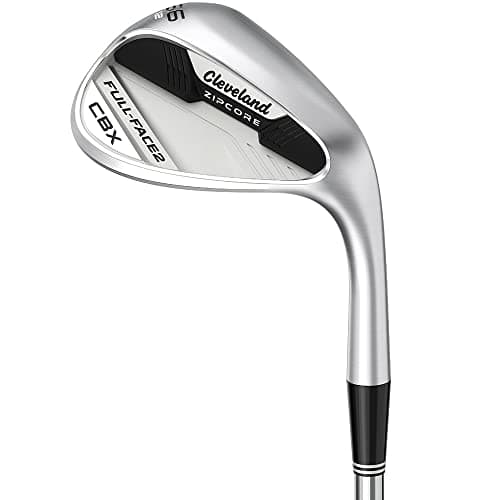
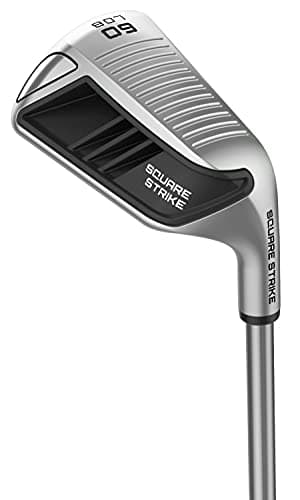
Both of these wedges exist to rescue a short game, but they solve different problems, and choosing between them starts with naming yours. The Square Strike Wedgeis a specialist: a heavy, anti-dig club built to make one shot — the low, running chip — almost foolproof for a player who chunks it. The Cleveland CBX Full-Face is a generalist: a cavity-back, full-face game-improvement wedge that forgives a mishit while still doing everything a real wedge does, from bunker shots to open-faced flops. One fixes a fault; the other upgrades your whole short game. Work out which you need and the choice makes itself.
Choose the Square Strike Wedge if…
You chunk your chips, and it is wrecking your short game and your confidence. The Square Strike’s heavy, wide sole is built specifically to resist digging, so instead of the leading edge burying itself in the turf behind the ball, the club glides through and makes contact — it really does stop the fat chip. It is simple to use, too: a putting-style stroke sends the ball low and running, which is the highest-percentage short shot for most amateurs and far more reliable under pressure than a high, soft flop. And it is tournament-legal — a USGA conforming club — so you can actually carry it in a real round, not just on the practice green. If a chunked chip is the shot you dread, this is the club that takes the dread away. Just be clear-eyed that it is a one-shot tool: you will not flop it, spin it, or hit it full, and you will still need a proper sand wedge for bunkers and higher shots.
Two players get the most from it. The first is the higher-handicapper or nervous chipper whose hands quit over a delicate shot — the Square Strike removes the decision, because there is only one shot to play and the sole does the hard part. The second is the golfer, often a senior, who has started catching chips heavy as tempo and hand action change; the anti-dig sole buys back clean contact without a swing rebuild. What it will not do is teach you a short game. It is a crutch, and a very effective one, but a crutch: lean on it to stop the bleeding, keep practicing the actual stroke, and know that the day your chipping steadies you may want a more versatile wedge back in that slot.
Choose the Cleveland CBX Full-Face if…
You want one forgiving wedge that does everything, not a single-fault tool. The CBX is a cavity-back, game-improvement wedge, so it forgives an off-center strike through perimeter weighting, but it is still a full wedge: you bunker with it, pitch with it, open the face and flop with it, and hit it full. Its full-face grooves grip on the open-faced and toe-side contacts that come up around the green, its wide sole resists digging, and because it is a Cleveland it spins like one. Where the Square Strike replaces a technique problem with a specialist club, the CBX gives you a genuinely versatile scoring wedge that flatters your misses. This listing is the 58°, a high-lofted greenside wedge, and it is the game-improvement pick in our wedge roundup.
The CBX also asks a little more of you than the Square Strike, and gives more back. It is a real wedge with a real face, so you can present it open, catch a flop, spin one back and control distance with the length of your swing — none of which the single-purpose Square Strike is built to do. That range is why it earns a permanent place in the bag rather than a situational one: it is your sand wedge, your pitching wedge for the tricky ones, and your greenside forgiveness all in one. If you want a club you will still be glad you own once your strike improves, this is it, because the forgiveness quietly stops mattering while the versatility keeps paying off. It is a keeper, not a patch.
How they’re actually different
Three things separate them. Range of shotsis the big one: the Square Strike does one job — the low, running chip and short pitch — and does it superbly, while the CBX is a full 58° wedge you can use from the bunker, the rough, a tight lie and an open face. If you want a club to play every greenside shot with, that is the CBX; if you want a club to make one specific shot foolproof, that is the Square Strike. How each one fights the chunk is the second: the Square Strike’s heavy, wide sole physically stops the club digging, which is the most direct anti-chunk fix you can buy, whereas the CBX’s wide sole and forgiving head reduce the damage of a fat or thin strike without idiot-proofing it to the same degree. Bag slot and role is the third: the Square Strike takes a slot for a single-purpose club, and you will still carry a sand wedge alongside it, while the CBX is your scoring and sand wedge, so it earns its place doing more than one thing.
There is a skill-trajectory difference too. The Square Strike is, honestly, a crutch — a very good one — that fixes a fault now and lets you score while your technique catches up. The CBX is a club you grow with: as your strike improves, the forgiveness stops mattering and the versatility keeps paying off. Neither is “better” in the abstract; they are aimed at two different problems, and the honest question is which problem is yours.
Cost is worth a word, and it runs in the CBX’s favor on value-per-use even where the sticker is similar. The Square Strike is a single-purpose club you use for one shot; the CBX is a wedge you play on dozens of shots a round, so the money spreads across far more of your game. Neither is expensive in the scheme of a set, and we show a live price on both cards — the CBX listing may read “check price” rather than a fixed figure, which simply means we would rather show you today’s number than a stale one.
Square Strike vs CBX at a glance
The quick version, before the recommendation:
| What matters | Square Strike Wedge | Cleveland CBX Full-Face |
|---|
| Main job | Kill the chunked chip on the low, running shot | A forgiving all-round scoring and sand wedge |
| Range of shots | One — the low chip and short pitch | Chips, pitches, bunkers, flops and full shots |
| How it fights the chunk | Heavy, wide sole physically stops the dig | Wide sole and forgiving head reduce the damage |
| Greenside spin | Not its purpose — it is about the running shot | Cleveland grooves, full-face; spins like a real wedge |
| Bag slot | An extra club, alongside a sand wedge | Replaces your scoring/sand wedge outright |
| Best for | A golfer whose specific fault is a fat chip | A higher handicapper who wants one forgiving wedge |
The honest recommendation for most golfers
If you had to own only one of them, and your short game is generally inconsistent rather than broken in one specific way, buy the CBX. It does more, it lasts through your improvement, and its forgiveness covers the chunk along with every other greenside miss. Reach for the Square Strike instead when the problem is narrow and severe — you chunk chips specifically, it is costing you real shots and confidence, and you want it gone now. Plenty of golfers are best served carrying the CBX as their wedge and, if chunking is a genuine recurring fault, adding the Square Strike as the specialist for the one shot that haunts them. They are not really rivals so much as a generalist and a specialist; the mistake is buying the specialist to solve a general problem, or the generalist to solve a very specific one.
Skip the decision entirely if…
Neither of these is your wedge if you already chip cleanly and strike your wedges well. A golfer with a reliable short game does not need the Square Strike’s crutch or the CBX’s forgiveness — you want the feel, spin and shot-making of a tour blade like the Cleveland RTX 6, and you can read that case in our RTX vs CBX comparison. And if the real problem is technique rather than equipment, be honest about that too: a lesson or some structured short-game practice will do more than any wedge, and no club can make a stroke for you. If you are still building a short game from scratch, the forgiving options are ranked in best golf wedges for beginners. And whichever you choose, do not buy three wedges to solve one problem: name the single shot that is costing you strokes, buy the club that fixes it, and spend the rest of your practice on the stroke itself — no wedge, however clever, swings for you.