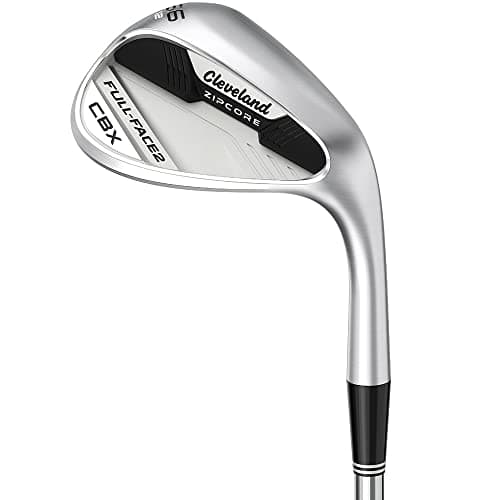
The Cleveland CBX Full-Face 2 is the forgiving answer to a tour wedge, and it exists because most golfers do not strike their short shots like a tour player. Where a blade wedge concentrates its mass behind a small sweet spot and punishes anything else, the CBX is a cavity-back, game-improvement wedge that moves weight to the perimeter to flatter a mishit — and it does it while still spinning like the Cleveland it is. This listing is the 58° loft, at the high-lofted end of the range where forgiveness helps most. If your short game is a work in progress, this is very likely the wedge that lowers your scores; if it is already sharp, you may want less club, and we will be honest about both.
What it is
It is a cavity-back, full-face wedge from Cleveland’s CBX family, built to bring game-improvement forgiveness to a part of the bag that usually demands precision. Two design choices define it. The first is the cavity-back, hollow construction: rather than a solid muscle-back blade, the CBX redistributes weight around the perimeter of the head, which raises stability on off-center strikes so a slightly heel or toe contact loses less and stays truer. The second is in the name — a full-face groove pattern that runs the grooves right across the face to the toe, so the open-face shots and toe-side contacts that come up around the green still grab and spin. Cleveland pairs that with a wide, forgiving sole designed to resist digging into the turf. This listing is 58°, and Cleveland’s pitch is simple: their spin, in a head that forgives. Every design claim here is Cleveland’s own published wording, not a lab result of ours — how we score clubs is set out in how we rank.
Where it shines
Forgiveness is the whole point, and it is where the CBX earns its place. A tour blade gives up a lot of distance and control the moment you catch a chip or pitch slightly fat or thin, which is exactly the miss most amateurs make under pressure. The cavity-back head is far kinder to those strikes: the perimeter weighting keeps the face more stable, so an off-center contact holds its line and its speed better than it ever would off a blade. For a higher-handicap golfer, or anyone whose short game runs hot and cold, that is the difference between a chip that finishes near the hole and one that comes up short in the collar.
The full-face grooves are the second real strength, and they matter more than they sound. Around the green you do not always present the middle of the face — you open the club for a flop, you catch one out towards the toe on an awkward lie, you hit a delicate cut from thick grass. On a conventional wedge those toe-side contacts slide; the CBX runs its grooves all the way across the face so they grip and spin instead. Cleveland builds this specifically for the open-face and toe-side shots, and it is genuinely useful the moment the lie stops being perfect.
The third thing it does well is refuse to dig. The wide, forgiving sole is designed to glide through the turf and the sand rather than stab into it, which is a real help for the steeper, more descending strike a lot of higher handicaps bring to a wedge. And crucially, none of this forgiveness comes at the cost of spin: it is still a Cleveland, with Cleveland’s grooves, so you get greenside bite that holds close to a tour blade’s on a clean strike. Forgiveness that kept the ball airborne but killed the spin would be a poor trade; this keeps both.
There is a quieter benefit worth naming: confidence. The fuller head and the grooves running right to the toe give you something reassuring to look at over a fiddly greenside shot, and confidence over a chip or a bunker shot is worth real strokes to a nervous short game. It is also a current Cleveland design rather than an old blade on clearance, so you get modern grooves and a modern sole in a head built specifically to forgive — the kind of club you can buy once and keep as your scoring wedge for years. For the golfer it suits, that mix of help and staying power is exactly the point.
Where it falls short
The honest trade a game-improvement wedge makes is feel and workability. The CBX is not as pure-feeling or as manipulable as the RTX 6 blade, and a skilled short game will notice. All the perimeter weighting that steadies a mishit is the same weighting that makes the club less responsive to a player who wants to flight a wedge down, take a yard off with the hands, or shape a spinning cut on demand. For a good ball-striker that is a loss; for the golfer the CBX is built for it is a price worth paying, because the shots they need are the straightforward ones the forgiveness protects. None of that is a flaw; it is simply the wrong tool for a player whose hands want to do more with a wedge, and the right one for a player who just wants the shot to come off.
It also looks like what it is. The forgiveness comes from a larger, fuller-shaped head, and some better players simply do not like the look of it sitting behind the ball, particularly next to the compact profile of a tour wedge. That is a matter of eye, not performance, but it is real — and if you have played blades for years, the CBX will look like a lot of wedge. On price, one honest note about this exact listing: it renders a live “check price” on our cards rather than a fixed figure, so buy it on today’s number. We never print a remembered price, and where one cannot be verified you see “check price” instead of a stale one.
Finally, one wedge does not make a short game. The CBX in 58° is a high-lofted scoring wedge, excellent for greenside forgiveness, but you still have to think about your loft gaps — a 58° on its own leaves a stretch between it and your pitching wedge that most golfers fill with a 54° or 56°. Buy the loft your bag actually needs, not just the one in the photo, and gap the rest of your wedges around it.
How to fit it into your bag
Because this listing is the 58°, think of it as a high-lofted scoring and greenside wedge, and build the rest of your short game around it. Most golfers pair a 58° with a 54° sand wedge and their set’s pitching wedge, keeping roughly four to six degrees between each so the distances step down evenly — a 58° on its own next to a pitching wedge leaves a gap you will feel on half-shots. The CBX’s wide, forgiving sole is a genuine help on the fuller bunker shots and pitches you will ask a 58° to play, and its full-face grooves earn their keep most on the delicate, open-faced shots this loft is for. If you already carry a forgiving 54° or 56° you are happy with, adding this 58° gives you a higher, softer option for tight pins; if you are building from scratch, a 56° is usually the first wedge and a 58° or 60° the second. Either way, buy the loft the bag needs rather than duplicating one you have.
Who should buy it
The CBX is for the golfer whose short game is honest about its misses. If you are a mid-to-high handicapper, if your strike is inconsistent, or if you want a wedge that helps on the flop and the open-faced shot rather than punishing anything off-center, this is the pick — and it does all of that without giving up Cleveland’s greenside spin. It is also the smart choice for a player moving up from a beginner set who wants one genuinely good, forgiving scoring wedge to build a short game around. It sits as the game-improvement wedge in our wedge roundupfor exactly these reasons. In short: if you would rather your wedge helped you than tested you, this is the one — and you give up less spin to get that help than you might expect.
Who should skip it
The golfer who should skip it is the accomplished ball-striker who wants a compact blade to flight, shape and spin on command. If you strike your chips and pitches cleanly and you use the feedback and workability of a tour wedge, the CBX will feel muted and bulky, and the Cleveland RTX 6 blade is the wedge for you — we put the two head to head in RTX vs CBX wedges. If chunked chips are your specific problem rather than general inconsistency, an anti-dig specialist may fix it more directly than any full wedge — the forgiving picks for a developing short game are ranked in best golf wedges for beginners.