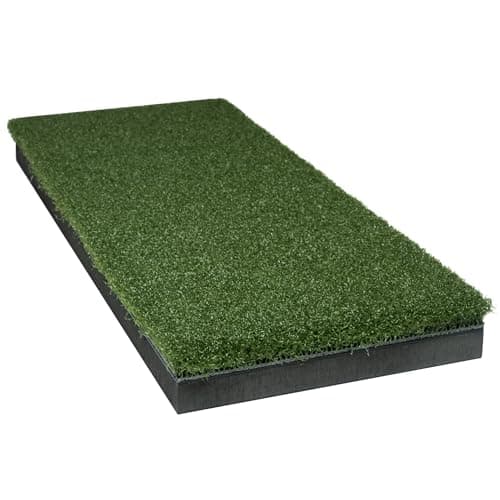
Hit a few hundred balls off a cheap, hard mat and your wrists and elbows will tell you about it. The SIGPRO Softy Hitting Strip exists to solve exactly that — it is the surface piece of a home setup, built to take the jarring out of a firm floor so you can practice through a winter without paying for it in your joints. It is a hitting strip rather than a full stance mat, which is a deliberate trade of footprint for feel, and it uses a plush turf top that is designed to mimic real grass and accept a real tee. This review covers who the Softy is for, why the cushioning is the whole point, the honest compromise of the strip format, and where it sits in a home build. It is based on the manufacturer’s published specifications and documented owner feedback, not a hands-on lab test.
Who it’s for
The Softy is for the golfer building a home practice station who intends to hit real volume off it — and who would rather protect their body than save a few dollars on the surface. If you are pairing a net and a launch monitor in a garage or basement and you plan to grind wedges and irons through the off-season, the cushioned base is the difference between a sustainable habit and sore joints that end the session early. It is also for the player in a tight space: the strip format asks for less room than a full stance mat, which suits a narrow garage bay. It is not the pick for someone who wants a large mat they can also stand on, or a mat with a ball tray built in — this is the compact hitting-surface piece, chosen for feel over footprint.
The cushioning is the point
The reason to spend up on a mat like this is joint protection, full stop. Cheap hard mats transmit the shock of a slightly fat strike straight into your wrists and elbows, and over a winter of practice that adds up to real strain. The Softy’s cushioned, joint-friendly construction is built to absorb that impact, so a heavy session is easier on your body and a mishit does not punish you the way it does on a thin mat over concrete. The plush Teeline turf top is designed to feel closer to real grass than the plastic bristles bundled with budget nets, and it accepts a real tee, so you can practice driver as well as ball-striking off the deck. For anyone who hits a lot of balls, that combination — shock absorption plus a realistic turf interaction — is what you are actually paying for, and it is money well spent if practice volume is the plan.
The strip format — footprint versus stance
The Softy is a hitting strip, not a full stance mat, and that shape is the central trade to understand before you buy. A strip gives you a realistic hitting surface in a compact footprint, which is exactly right for a tight garage bay or a corner where a full mat will not fit. The flip side is that you stand on the floor beside the strip rather than on the mat itself, so you want a level, forgiving surface underfoot — ideally the same height as the strip — for a natural, repeatable stance. If your floor is hard concrete, plan to stand on something kinder to your feet. It is a sensible compromise for most home setups, but it is a compromise: you are choosing feel and footprint over the stand-on-it convenience and ball tray of a larger mat.
The honest limits
A mat is a single piece of the setup, and it is honest to say so. The Softy is a hitting surface only — ball return, data and a screen are all separate purchases, so on its own it does nothing but give you a good place to hit from. The strip format means you supply the stance surface, as covered above. And no mat, however plush, perfectly replicates turf you can take a real divot from; the Teeline top is designed to mimic grass and is a clear step up from a hard budget mat, but it is still a mat, and a fat strike behaves differently than it would on a fairway. None of this is a flaw so much as the definition of the piece — a very good hitting surface that does one job well.
How it fits a home setup
Remember the three-purchase reality: a home simulator is a monitor to read the shot, a net to catch the ball, and a mat to hit off, before you add a screen. The Softy is the mat in that equation, and it pairs naturally with a ball-return net like the Spornia SPG-7and a launch monitor of your choice. If you are starting small, the sensible order is usually the monitor and the net first — the pieces you use every session — with a quality mat like this added as soon as your practice volume justifies protecting your joints. Our home-setup cost breakdown puts illustrative figures on each piece so you can plan the sequence and the budget.
The verdict
As the hitting surface in a home setup, the SIGPRO Softy is an easy pick for anyone who plans to hit real volume: the cushioning genuinely protects your joints, the Teeline turf feels closer to grass and takes a real tee, and the strip format fits where a full mat will not. Buy it for feel and footprint, mind the stance-surface trade, and treat it as one of three or four purchases rather than a setup in itself. For a garage practicer who wants their wrists intact in March, it is money well spent.