Skip to content
Divot&Draw

The Numbers · Launch Monitors

The Best Golf Practice Nets

Six nets ranked on the things that actually decide this purchase: how big the face is, whether the ball comes back, and what the frame is made of. Priced live.

By Stephen V.Updated How we rank
#ad

We earn a commission when you buy through our Amazon links, at no extra cost to you. It never changes our rankings — and we'll tell you when the cheaper ball or club is the better buy. How this works.

The best golf practice net for most golfers is the cheapest one that is big enough for your actual miss — which is why our number one pick is also nearly the least expensive net on this page. A practice net has exactly one job, and every net here does it. What separates them is not how well they stop a golf ball; it is how big the target is, whether the ball comes back to you afterwards, and whether the frame survives its second winter. Those three questions are the whole category, and the marketing talks about almost none of them.

We have ranked six nets against those questions: a wide budget net, two auto-return nets at very different prices, a steel-framed net for anyone who has already snapped a cheap one, a brand-backed outdoor net with the largest published face here, and a full eight-foot cage for the golfer whose bad shot goes sideways. Every one is a real, currently-purchasable product whose stock we re-checked before writing a word about it, and every price on this page is pulled live rather than typed in by hand.

The ball-speed rating is the most-marketed and least-useful number here

Net listings love a ball-speed rating, and two of the picks on this page publish one: Callaway rates its Base Hitting Net netting to 190 mph, and The Net Return rates the Home Series to 225 mph. Both numbers are real, and both are effectively irrelevant to your decision — because neither you nor anybody you play with is anywhere near them.

Trackman publishes driver ball-speed averages from tour play and from its own Combine testing. A PGA Tour player averages 171 mph. An LPGA Tour player averages 143 mph. A scratch male amateur averages 161 mph, a 10-handicap 138 mph, and the average golfer — Trackman puts that at a 14.5 handicap — 133 mph. The gap between the fastest of those and the lower of the two published net ratings is nineteen miles an hour of headroom for a tour professional, and more than fifty for most readers of this page.

So treat a published rating as a tick-box, not a tie-breaker: it tells you the maker has thought about the netting, which is genuinely worth something, but a higher number does not buy you a better net for your swing. The absence of a rating is more interesting than the size of one, and we have flagged it as a con on every pick whose maker publishes nothing.

How we ranked these (the criteria)

We ranked on five things, in this order. Price sets expectations rather than buying a place in the order — which is how a $90 net ends up above a $695 one.

  • How big the face is. This is the criterion that actually protects your garage door, and the one buyers under-weight most. A net you can hit the middle of ten times out of ten is not being tested; the shot that matters is the pull, the thin one and the shank. Published face dimensions decide this, and they range from 7 ft x 7 ft to 10 ft x 8 ft across this page.
  • Whether the ball comes back. A net without a return is a net you use for about fifteen balls before the walk out and back starts costing you more than the practice is worth. An automatic return is the single feature most likely to change whether the net gets used in February. It is also the single most expensive feature here.
  • What the frame is made of, and whether the maker will say. Netting rarely fails first; the frame does. A published steel or aluminum frame outranks an unspecified one, and “no frame material published” is scored as the gap it is.
  • Space, setup and whether it can be put away. A net that needs an afternoon of assembly and then lives there permanently is a different purchase from one that packs into a bag between sessions. Neither is wrong; they suit different houses, and we score them for what they are.
  • What it honestly costs for what it adds. Every net here catches a golf ball. The money above the cheapest one buys a return mechanism, a better frame or a longer warranty — and we say which, on every pick, so you can decide whether you want it.

Scores are judgments from published manufacturer specifications and listing details against our ranking rubric — not lab measurements. We have not hit a ball into any of these nets. We do not run a test lab, and we say so rather than implying an equipment test we never ran.

Ball return: the feature that decides whether you practice

Here is the honest behavioral argument for spending more than $90, and it has nothing to do with safety. Without a return, a home session goes: hit eight balls, walk to the net, crouch, gather, walk back, reset. That loop is fine for the first week. By week four it is the reason the net is folded behind the lawnmower.

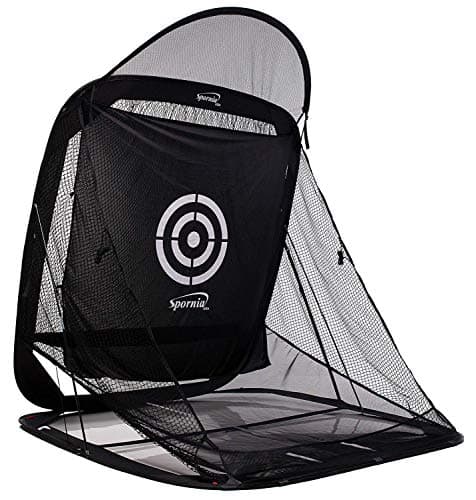
Two picks here solve it mechanically and publish how. The Spornia SPG-7 uses a ramp that returns the ball toward you after impact; The Net Return uses a patented S-shape that the maker says absorbs the shot and rolls the ball back to your feet automatically, every time. A third, Gagalileo’s cage, solves it by accident of geometry: in a closed eight-foot cube the ball simply ends up near your feet with no mechanism at all, which is a quietly underrated argument for the shape.

The budget GoSports net lists “an innovative golf ball return feature”, but publishes no description of the mechanism and no indication of how far the ball travels back. We are not going to characterize a feature the maker will not describe, so treat that net as a net and let the return, if any, be a bonus. If the ball coming back is the thing you are buying, buy one of the two that documents it, and read our Spornia SPG-7 review for the detail on the cheaper of the pair.

Skip this: the premium net, before you have proved the habit

The pick nobody in this category will sell you is the one not to buy yet. A $695 net is a genuinely better object than a $90 one — better frame, longer warranty, a return that works. It is also a bet that you will still be hitting balls into it in three years, and that is a bet most first-time buyers lose.

The cheap net answers the question you actually have, which is not “which net is best” but “am I the kind of golfer who practices at home”. Buy the wide, cheap one. Use it through one winter. If it is still coming out twice a week in March, you will know exactly which of its limitations bothers you — the walk to fetch balls, the frame flexing, the face being too small — and you will buy your second net knowing what you are paying to fix. That is a much better position than guessing now, and it costs a tenth as much to find out.

The same logic runs the other way for one specific golfer: if you already know your miss is a shank, no amount of habit-proving will make a flat 7 ft net the right answer. Go straight to the cage. Containment is not a luxury upgrade for that player, it is the entire point of the purchase.

Read across, not down

The order below is our combined score, but the “best for” label on each pick matters more than its number. The cage finishes last because assembly and permanence are real costs that we score honestly — not because it is a worse backstop; on containment it is the best product on this page. The Net Return finishes third despite being the best-built net here, because most of the money goes on a frame and a warranty that a golfer who practices twice a month will never cash in. Find the row that describes your space and your miss, and buy that one.

The short answer

Quick picks

#ProductBest forScorePrice
01
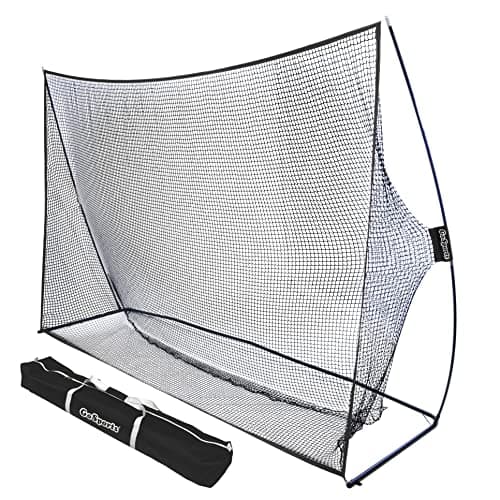
GoSports GoSports Golf Practice Hitting Net (10 x 7 ft)
GoSports Golf Practice Hitting Net (10 x 7 ft)

The biggest net face on this page for the least money — the honest default backstop for a garage bay or a back yard.

Most golfers building a first home practice setup
8.0
$89.99Amazon
02
Spornia Spornia SPG-7 Golf Practice Net
Spornia SPG-7 Golf Practice Net

A practice net with an auto ball-return ramp — the honest backstop for a garage or backyard setup.

The net in a home practice setup
7.8
$349.99Amazon
03
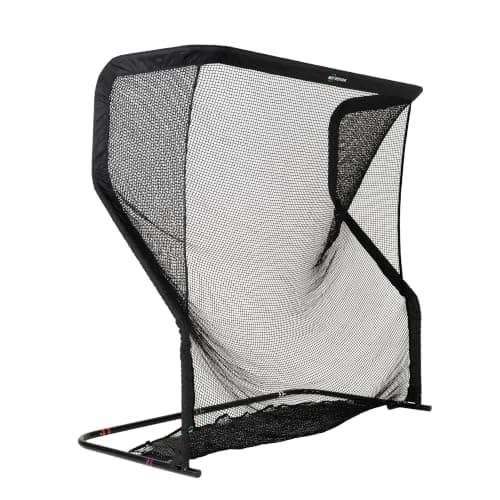
The Net Return Net Return Home Series (7 ft x 7 ft)
Net Return Home Series (7 ft x 7 ft)

The buy-it-once net: an aluminum frame, a patented ball return and a published 225 mph rating, at a price that only makes sense if you will use it for years.

A permanent practice bay you expect to keep
7.6
$695.00Amazon
04
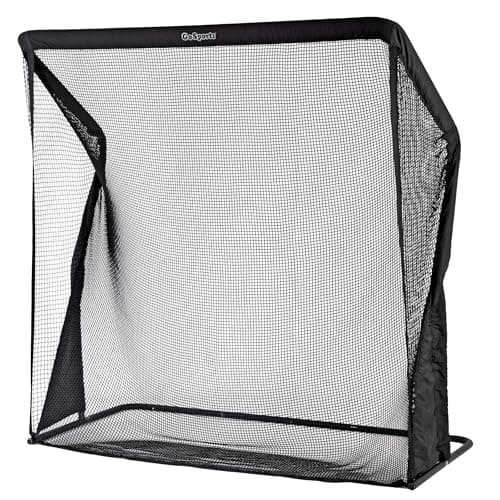
GoSports GoSports Golf Net Elite Steel Frame (7 x 7 ft)
GoSports Golf Net Elite Steel Frame (7 x 7 ft)

A steel frame and high-tension netting rated for repeat use — the answer if your last net's frame is the part that failed.

A golfer who has already broken a budget net
7.4
$499.99Amazon
05
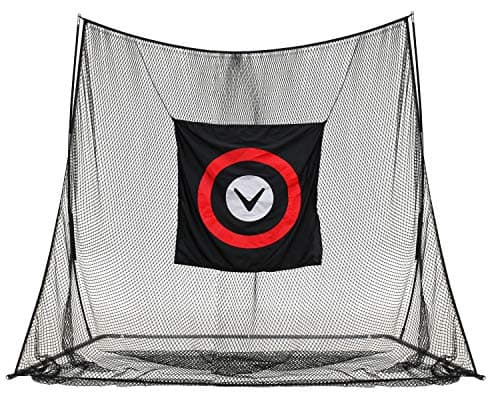
Callaway Callaway Base Hitting Net (10 ft)
Callaway Base Hitting Net (10 ft)

The widest and tallest published face here, with a documented 190 mph netting rating and a stainless base — a brand-backed outdoor net.

A permanent spot on a lawn
7.2
$184.62Amazon
06
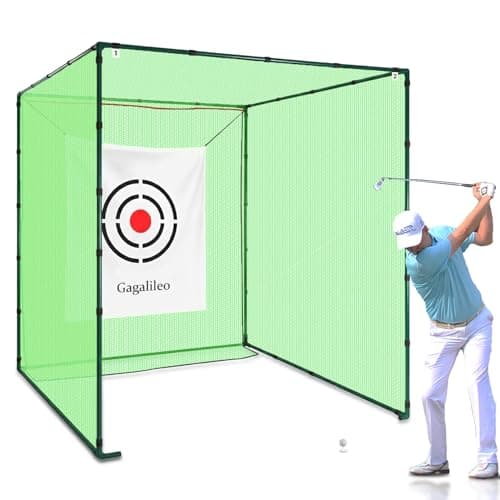
Gagalileo Gagalileo Golf Driving Cage (8 x 8 x 8 ft)
Gagalileo Golf Driving Cage (8 x 8 x 8 ft)

A full eight-foot cube with a steel frame — the only pick here that contains a shank instead of watching it leave.

A golfer whose bad miss goes sideways
6.2
$263.78Amazon

#ad · Live prices from the Amazon Product API, as of Sep 26, 2026. Where we have no verified live price, we show none — we would rather leave a gap than print a number that has rotted.

In detail

The picks, in full

01
GoSports GoSports Golf Practice Hitting Net (10 x 7 ft)

Most golfers building a first home practice setup

GoSports Golf Practice Hitting Net (10 x 7 ft)

10 ft x 7 ft faceReinforced nylon nettingCarry case + 4 U stakes6-month warranty
8.0/10

The biggest net face on this page for the least money — the honest default backstop for a garage bay or a back yard.

Build quality
6
Value
10
Ease of use
8
Portability
9
Effectiveness
7

Pros

  • A 10 ft x 7 ft face is the widest cheap target here, which matters far more than any marketing spec when your miss is a pull or a shank
  • Packs into the included carry case and takes four U stakes for grass, so it moves between a garage and a lawn without a rebuild
  • GoSports states it can be used indoors or outdoors and pairs it with a launch monitor, which is exactly how most home setups start

Cons

  • GoSports publishes no frame material, no net ply and no rated ball speed for this model — you are buying on the face size and the price, and nothing else is documented
  • The 6-month warranty is the shortest on this page by a wide margin; the premium nets carry one to three years

Skip this if…

…you want the ball to come back to you. GoSports lists an ‘innovative golf ball return feature’ but publishes no description of how it works or how far the ball travels — if a genuine ramp return is what you want, buy one of the nets that documents it.

$89.99View on Amazon

Price as of Sep 26, 2026. Prices change — Amazon's is the one that counts.

#ad · we may earn a commission from this link to GoSports Golf Practice Hitting Net (10 x 7 ft)

02
Spornia Spornia SPG-7 Golf Practice Net

The net in a home practice setup

Spornia SPG-7 Golf Practice Net

Auto ball-returnPop-up frameBackyard / garage usePacks into a carry bag
7.8/10

A practice net with an auto ball-return ramp — the honest backstop for a garage or backyard setup.

Build quality
8
Value
8
Ease of use
8
Portability
7
Effectiveness
8

Pros

  • The ball-return ramp rolls each shot back to you, which turns a net from a backstop into a real practice station
  • Sets up and folds down without tools and packs into a carry bag for storage
  • A generous hitting area that's forgiving of a slightly off-line strike

Cons

  • It's a net, not a screen — pair it with a launch monitor if you want numbers or a projected simulator image
  • Full-swing driver use into any net still demands sensible space and a safety margin

Skip this if…

…you were hoping for a projected simulator picture. This is the catch-and-return piece of a setup; the image and the data come from a monitor and a screen you add separately.

$349.99View on Amazon

Price as of Sep 26, 2026. Prices change — Amazon's is the one that counts.

#ad · we may earn a commission from this link to Spornia SPG-7 Golf Practice Net

03
The Net Return Net Return Home Series (7 ft x 7 ft)

A permanent practice bay you expect to keep

Net Return Home Series (7 ft x 7 ft)

7 ft W x 7 ft H x 3 ft 6 in D26 lb, aluminum frameRated to 225 mph ball speed3-year warranty
7.6/10

The buy-it-once net: an aluminum frame, a patented ball return and a published 225 mph rating, at a price that only makes sense if you will use it for years.

Build quality
10
Value
4
Ease of use
9
Portability
6
Effectiveness
9

Pros

  • The only net here with a published ball-speed rating above 200 mph — The Net Return quotes 225 mph, comfortably clear of any human swing
  • A patented S-shape return that the maker says absorbs impact and rolls the ball back to your feet on every shot, so a solo session never stops for ball collection
  • Three-year warranty on a 26 lb aluminum frame, and the maker lists compatibility with FlightScope, Foresight, Full Swing, Garmin and Uneekor monitors

Cons

  • It costs several times the price of a net that catches a ball just as safely — you are paying for the return, the frame and the warranty, not for stopping the ball
  • At 7 ft wide and 3 ft 6 in deep it is no more forgiving of a genuine shank than the cheap nets; a wider face or a cage contains a bad miss better

Skip this if…

…this is your first net and you are not yet sure the habit will stick. Buy the cheap one, find out whether you actually practice twice a week, and step up to this only once you know the answer.

$695.00View on Amazon

Price as of Sep 26, 2026. Prices change — Amazon's is the one that counts.

#ad · we may earn a commission from this link to Net Return Home Series (7 ft x 7 ft)

04
GoSports GoSports Golf Net Elite Steel Frame (7 x 7 ft)

A golfer who has already broken a budget net

GoSports Golf Net Elite Steel Frame (7 x 7 ft)

7 ft x 7 ft facePowder-coated steel frameNetting rated for 10,000+ hitsSetup under 5 minutes
7.4/10

A steel frame and high-tension netting rated for repeat use — the answer if your last net's frame is the part that failed.

Build quality
9
Value
6
Ease of use
8
Portability
6
Effectiveness
8

Pros

  • A powder-coated steel frame rather than the fiberglass bow used across the budget end, which is the part that usually fails first
  • GoSports rates the netting for over 10,000 hits at any swing speed and calls it three times stronger than their bestselling golf net — a durability claim they publish rather than imply
  • Quoted at less than five minutes to set up or take down, with a carry case, and GoSports sells a simulation screen that fits it

Cons

  • The 7 ft x 7 ft face is narrower than the 10 ft net GoSports sells for a fraction of the price, so you pay considerably more for a smaller target
  • GoSports publishes no weight and no rated ball speed for the Elite, and the warranty is still only six months despite the price

Skip this if…

…you want a net you can pack away weekly. The steel frame is the reason to buy it and the reason it is heavier and slower to move than the fiberglass nets above and below it.

$499.99View on Amazon

Price as of Sep 26, 2026. Prices change — Amazon's is the one that counts.

#ad · we may earn a commission from this link to GoSports Golf Net Elite Steel Frame (7 x 7 ft)

05
Callaway Callaway Base Hitting Net (10 ft)

A permanent spot on a lawn

Callaway Base Hitting Net (10 ft)

10 ft W x 8 ft H x 3.5 ft DNetting rated to 190 mphFiberglass frame, stainless baseTarget, stakes and carry bag
7.2/10

The widest and tallest published face here, with a documented 190 mph netting rating and a stainless base — a brand-backed outdoor net.

Build quality
8
Value
7
Ease of use
8
Portability
7
Effectiveness
6

Pros

  • 10 ft wide by 8 ft high is the largest documented target on this page — the single most useful number when your miss is sideways
  • Callaway publishes a 190 mph netting rating, which is above every published amateur and tour driver ball-speed average
  • Ships with a hanging center target, ground stakes and a carry bag, and the base is stainless steel rather than plastic

Cons

  • No ball return of any kind — the hanging target gathers missed shots, but you still walk out and collect after every handful of balls
  • A flat net with no roof or side barriers, so a thinned or shanked shot that misses the face entirely carries on into whatever is behind it

Skip this if…

…you are setting up in a garage. This is a freestanding outdoor-shaped net with ground stakes and a 3.5 ft footprint, and the height that makes it good on a lawn is what makes it awkward indoors.

$184.62View on Amazon

Price as of Sep 26, 2026. Prices change — Amazon's is the one that counts.

#ad · we may earn a commission from this link to Callaway Base Hitting Net (10 ft)

06
Gagalileo Gagalileo Golf Driving Cage (8 x 8 x 8 ft)

A golfer whose bad miss goes sideways

Gagalileo Golf Driving Cage (8 x 8 x 8 ft)

8 ft x 8 ft x 8 ft enclosureSteel frameTarget includedPermanent or semi-permanent siting
6.2/10

A full eight-foot cube with a steel frame — the only pick here that contains a shank instead of watching it leave.

Build quality
7
Value
7
Ease of use
5
Portability
3
Effectiveness
9

Pros

  • An enclosure rather than a flat net, so a thin, shanked or heavily pulled shot is caught by a side wall instead of leaving the yard
  • The maker states the 8 ft height gives complete swing freedom for a full driver swing, and a target is included
  • A steel frame at roughly half what the premium branded nets cost, and the cube shape means the ball drops at your feet by gravity rather than by a mechanism

Cons

  • Gagalileo publishes no frame wall thickness, no netting denier or ply, no weight and no rated ball speed for this cage on any page we could read — you are buying on the dimensions and the photographs
  • It is a genuine build: an eight-foot cube takes real assembly time and real floor space, and it is not something you put up and take down between sessions

Skip this if…

…you need the net gone before the car comes back in. This is the pick for a dedicated corner of a garage, a barn or a lawn you are happy to give over to it permanently.

$263.78View on Amazon

Price as of Sep 26, 2026. Prices change — Amazon's is the one that counts.

#ad · we may earn a commission from this link to Gagalileo Golf Driving Cage (8 x 8 x 8 ft)

Space, ceiling height and the safety margin

Before the net, the room. Three measurements decide whether a home practice bay is viable, and none of them are on the box.

The first is ceiling height. A full driver swing needs room for the club above you at the top and through the finish, and a garage ceiling that clears your head does not necessarily clear a driver. Gagalileo makes the height claim explicitly for its cage — it says the 8 ft dimension gives complete swing freedom for a full driver swing — and that figure is a reasonable sanity check for any indoor bay: if you have appreciably less than eight feet, plan on irons and wedges rather than driver, and accept that as a real constraint rather than finding out by putting a club through a light fitting.

The second is distance from the net. Standing too close is the classic home-net mistake: it gives the netting no room to decelerate the ball, and it puts you inside the rebound path. GoSports states the plain version of this on its own product page — the net can be used indoors or outdoors as long as you have a large enough space to safely swing a club. Give the ball travel room, keep people and glass out of the line, and set the frame on level ground.

The third is depth behind the frame, which is what the published depth figures on this page are for. The Net Return quotes a 3 ft 6 in footprint; Callaway quotes 3.5 ft; the Spornia is a 7 ft deep enclosure plus a roof; and the cage is a full 8 ft cube. That depth is not optional space, it is the net doing its job — the netting has to travel backwards to absorb the shot. Measure your bay from the ball position to the back wall before you choose, not after.

What to spend, in three honest tiers

Think in tiers rather than brands, because the brands cross all three.

The entry tier is a wide fiberglass-bow net with a carry case. You get the biggest target on this page, a bag to put it in, and a short warranty. You do not get a documented frame, a documented ball-speed rating or a return mechanism. For a first net, for a golfer who is not yet sure how often they will practice, and for anyone who needs the bay to disappear when the car comes back in, this is the correct purchase and everything above it is optional.

The middle tier is where you buy one specific thing and it is usually the ball return, occasionally the frame. This is the Spornia, the Callaway and the cage: two to four times the entry price, each solving a different problem — the return, the face size, the containment. Work out which of those three actually annoys you about practicing, and buy the one that fixes it. Buying all three at once is how people end up with a net they resent.

The top tier is the buy-it-once net: an aluminum or steel frame, a published ball-speed rating well beyond any human, and a multi-year warranty. It is the right purchase for a permanent bay that will see hundreds of sessions, and genuinely the wrong one for a golfer whose garage is also a garage. The Net Return’s three-year warranty is the longest here by some distance and is a fair proxy for what the tier is really selling: not better ball-stopping, but a longer service life.

The net is one of three pieces — and the cheapest way to make it a practice room

A net on its own is a backstop. What turns it into practice is what you add, and the order matters more than the budget. Add a mat first: hitting off a garage floor or a worn patch of lawn will hurt your wrists long before it helps your swing, and our SIGPRO Softy hitting strip review covers the joint-friendly surface that pairs with any net here.

Add a launch monitor second, and only if you want numbers. Hitting into a net without data is fine for grooving a motion but tells you nothing about where the ball would have gone — which is the one thing a net cannot show you. A budget radar unit fixes that for less than the price gap between the cheapest and dearest net on this page; our launch monitors under $1,000 roundup ranks that field, and launch monitor data explained covers which of the numbers are worth acting on.

The screen and the projector come last, if ever. Our home golf simulator roundup walks through the full build as pieces rather than as one mythical box, and what a home setup really costs does the line-item arithmetic including the subscriptions that catch people out.

Making a net last

Nets fail in two predictable ways, and both are avoidable. The netting goes at the impact zone, because you hit the same square yard of it a thousand times — so if your net ships with a target sheet, hang it, and if you can shift the frame a foot left or right every few months, do. Spornia includes a noise-reduction target sheet with the SPG-7 for exactly this reason, and Callaway includes a hanging center target with its Base net.

The frame goes at the joints, usually over a winter left outside. UV and freeze-thaw are harder on a fiberglass bow than golf balls are. If the net lives outdoors, take it down in the worst of the weather or accept a shorter life; if you will not do that, the steel-framed and aluminum picks on this page are worth their premium for that reason alone rather than for anything to do with stopping a ball. And check the netting and the frame periodically, because a net with a weakened panel is a net that lets one through, and you only need that to happen once.
How we ranked this

We don't run a testing lab — and we say so

We compiled published manufacturer specifications, official standards and aggregated owner reviews, computed the running costs the big test-labs leave out, and scored each pick against a published rubric. The scores are judgments from documented research — they are not lab measurements we took, because we don't have a lab and we're not going to pretend we do. You can check every number we publish.

Questions

Frequently asked

What is the best golf practice net?
For most golfers it is the widest net you can buy cheaply — on this page, the GoSports 10 ft x 7 ft. Every net here stops a golf ball safely; the wide budget one gives you the biggest margin for a mishit at the lowest price, packs into a carry case, and lets you find out whether you actually practice at home before you spend more. Step up to the Spornia SPG-7 if the walk to collect balls is what stops you practicing, or to the Net Return Home Series if you want a permanent bay with a three-year warranty.
Can you hit a driver into a golf practice net?
Into a full-size net, yes — that is what these are built for, and Spornia states plainly that the SPG-7 is rated for all clubs including driver. The constraints are your room rather than the net: you need ceiling height for the swing (Gagalileo quotes 8 ft as giving complete swing freedom for a driver), enough distance from the face for the netting to decelerate the ball, and a sensible margin around the frame. If your ceiling is low, practice irons and wedges into the net and save driver swings for a range.
What ball speed rating does a golf net need?
Far less than the marketing implies. Trackman publishes driver ball-speed averages of 171 mph for a PGA Tour player and 133 mph for the average golfer, so the 190 mph rating Callaway publishes for its Base net already clears a tour swing with room to spare, and The Net Return’s 225 mph rating clears it by a wide margin. Use a published rating as evidence the maker has specified the netting, not as a number to maximize. What is worth noticing is when a maker publishes no rating at all.
Do you need a mat with a golf net?
If you are hitting off concrete, yes, and it is not optional — a hard floor sends the shock of every fat shot straight into your wrists and elbows. If you are hitting off grass you can go without, though you will wear a bare patch fast. A cushioned strip is the cheaper and more joint-friendly answer than a thin hard mat; the SIGPRO Softy hitting strip is the surface we rank for that job.
Is a golf net worth it if I can't see where the ball goes?
For grooving a repeatable motion, contact and tempo, yes — volume of decent-quality reps is worth a lot, and a net is by far the cheapest way to get them at home. What a net cannot do is tell you the shot shape or the carry, which is exactly the blind spot a launch monitor fills. If ball flight is what you want to work on, budget for the pair rather than the net alone; our are launch monitors worth it guide covers who genuinely needs one and who does not.
Should I buy a golf net or a full cage?
It depends entirely on your miss, not your budget. A flat net catches everything you strike roughly as intended, and it packs away. A cage catches the shot you are embarrassed about — the shank, the thin one that squirts sideways — because it has walls. If your bay backs onto a neighbor's fence, a greenhouse or your own car, the containment is worth the assembly time and the permanent floor space. If your bad shot is just a pull, the wider flat nets on this page handle it for much less money and much less commitment.
How long does a golf practice net last?
Nobody can give you an honest number, because it depends on how hard you hit it, how often, and whether it lives outdoors. What you can compare is what the makers are willing to stand behind: The Net Return carries a three-year warranty on the Home Series, Spornia carries one year on the SPG-7, and GoSports carries six months on both of its nets here. Those figures are the clearest signal in the category about expected service life. Hanging the supplied target sheet and taking an outdoor net down through the worst weather will both extend it.

Keep reading

Receipts

Sources

We do not run a testing lab, and we do not pretend to. Every spec number here comes from a manufacturer's published sheet or an official standard, cited above. Where we could not verify something, we say so on the page rather than quietly leaving it out. Read our full method.