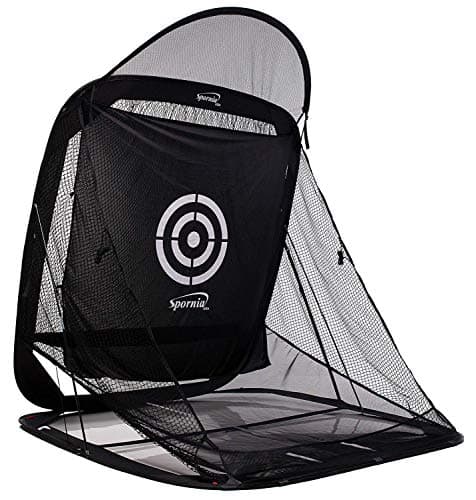
A launch monitor tells you the truth about your swing; a net is what lets you swing at all without putting a ball through the garage door. The Spornia SPG-7 is the piece most home practice setups are actually built around, and its one genuinely clever feature is an automatic ball-return ramp that rolls each shot back to your feet. That turns a net from a passive backstop into a real practice station — you hit, the ball comes back, you hit again, and you are not walking to a pile of balls every dozen swings. This review looks at what the SPG-7 does well, where a net’s honest limits sit, and how it fits into the three-purchase reality of a home setup. As with everything on this site, it is based on the manufacturer’s published specifications and documented owner feedback, not a lab test — we do not test units in hand.
Who it’s for
The SPG-7 is for the golfer who wants to practice at home without building a room. If you have a garage bay, a backyard, or a basement with enough height, and you want to hit real shots on days you cannot get to the range, this is the catch-and-return piece that makes it viable. It suits the player pairing a net with a launch monitor especially well: the ball-return keeps your rhythm intact so you can hit shot after shot and actually read the numbers, instead of breaking concentration to gather balls. It is not for someone who wants a projected simulator image — a net catches and returns, it does not display anything — and it is not a substitute for the space and safety margin that any full-swing driver practice demands. Match it to the job of catching and returning, and it is one of the highest-value pieces in a home build.
The ball-return ramp is the point
Plenty of nets will stop a golf ball. What separates the SPG-7 from a cheap backstop is the patented automatic ball-return system: a ramp that gathers the ball after impact and rolls it back toward you, so a solo practice session flows instead of stopping every few swings. It sounds like a small thing until you have spent twenty minutes of a thirty-minute window bending over to collect balls. The return is what makes the net a station you will actually use on a Tuesday night, which is the real test of any home gear — the piece you use every week beats the better piece that sits folded in a closet. The hitting frame is generous, too, with a large target area that is forgiving of a slightly off-line strike, so a mishit still gets caught rather than sailing past the net. For a solo practicer feeding a launch monitor, the combination of a big catch area and an automatic return is exactly the workflow you want.
Setup, storage and portability
The SPG-7 uses a pop-up frame that goes up and comes down without tools — the manufacturer quotes roughly a thirty-second setup and takedown — and it packs into an included carry bag for storage between sessions. That matters more than it sounds for a home piece, because a net that lives in a bag and comes out in half a minute gets used, while a net that needs an afternoon of assembly gets resented. It is portable enough to move from the garage to the backyard on a nice day, or to take down entirely when you need the space back. On our home-setup scoring — build quality, value, ease of use, portability and effectiveness — the tool-free setup and the carry bag are where it earns its portability and ease-of-use marks, and the ball-return is where it earns its effectiveness. It is a well-judged balance of sturdy-enough and packable.
Build quality and everyday durability
A net earns its keep over hundreds of sessions, so build matters more than a spec sheet lets on. The SPG-7’s frame is designed to take repeated full-swing impacts, and the large, deep catch area does double duty here — a ball striking a generous net with room to decelerate is easier on the whole assembly than one snapping a small, taut backstop. Owners tend to praise the return mechanism and the forgiving target area as the features that hold up in real use. That said, no consumer net is indestructible against a steady diet of driver, and the honest expectation is a piece that gives you years of regular practice rather than a lifetime guarantee. Treated as a well-built consumable at the center of a setup — deployed in seconds, returning every ball, folded away in its bag — it represents strong value for what a home practicer actually does with it.
The honest limits
Now the caveats, because a net is not magic. First and most important: it is a net, not a screen. It catches and returns the ball; it does not project a simulator image and it does not read a single number. If you want a picture of a fairway or a carry figure, those come from a launch monitor and, eventually, a projector and impact screen you add separately — the net is one piece of that puzzle, not the puzzle. Second, full-swing driver use into any net still demands sensible space and a safety margin; a net is a backstop, not a guarantee, and you owe it to your walls and your family to leave room and check the frame. Third, like any fabric-and-frame product, it will wear with heavy driver use over time — that is the nature of hitting golf balls into netting, not a fault specific to this model. None of that undermines the SPG-7; it just defines what a net is and is not.
A net is one of three purchases
It is worth being blunt about the money, because the marketing rarely is. The “home golf simulator” you see online is almost never one product — it is a monitor to read the shot, a net to catch the ball, and a mat to hit off, three separate buys before you add a screen or a laptop. The SPG-7 is the net in that equation, and treating it as one piece is the honest way to budget the whole thing. The good news is that this is also how you start small and sensibly: a launch monitor and a good ball-return net is a genuine practice station for a fraction of the full-room dream, and you can add the mat, then a screen and projector, as the habit sticks. Most abandoned home setups failed because someone bought the projector fantasy first; the ones that last usually started with the two pieces you use every single session — the monitor and the net. Our home-setup cost breakdown puts illustrative figures on each piece so you can plan the order.
The verdict
As the catch-and-return piece of a home practice setup, the Spornia SPG-7 is an easy recommendation: the automatic ball-return genuinely changes how a solo session flows, the tool-free pop-up frame and carry bag make it a net you will actually deploy, and the large catch area is forgiving of real-world strikes. Buy it as one of three purchases — monitor, net, mat — not as a simulator in itself, and pair it with a launch monitor if you want numbers and a mat if you want to protect your body and your floor. For most golfers building a garage corner, it is the net we would start with.
What to pair it with
On its own the SPG-7 is a backstop with a clever return; paired well, it is the core of a real practice room. Add a launch monitor to turn caught shots into numbers — a free-app radar like the Garmin R10 is a common budget brain, and a camera unit like the Rapsodo MLM2PRO layers on measured spin and video. Add a joint-friendly hitting mat so a winter of reps does not wreck your wrists. That trio — net, monitor, mat — is a home setup; the screen and projector are an upgrade you add later, not the starting point. The home simulator roundup walks through the pieces and where the money is best spent first.
Space and safety
Give the net room. Full-swing driver practice into any backstop needs a sensible distance and a margin behind and around the frame, and enough ceiling height that your natural swing is not cramped. Check the frame periodically for wear, because hitting golf balls into fabric is hard on fabric over time. Set it on a level surface, stand a safe distance back, and keep people and windows out of the miss cone. None of this is unique to the Spornia — it is the price of hitting real golf balls indoors — but it is the difference between a net that lasts and a repair bill.