Skip to content
Divot&Draw

The Numbers · Launch Monitors

The Best Golf Hitting Mats

The surface decides whether home practice helps your golf or hurts your wrists. Six mats ranked on footprint, backing and turf density — not on the photograph — with live prices.

By Stephen V.Updated How we rank
#ad

We earn a commission when you buy through our Amazon links, at no extra cost to you. It never changes our rankings — and we'll tell you when the cheaper ball or club is the better buy. How this works.

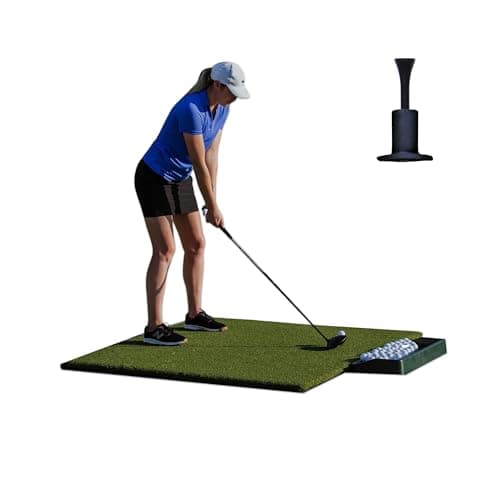
The best golf hitting mat for most home setups is the Dura-Pro Premium Residential 4 x 5 ft— the smallest mat here you can genuinely stand on, with dense nylon turf on a backing thick enough that your wrists are not paying for the practice. It is not the most durable mat on this page and it is nowhere near the cheapest. It is the one that gets the two specs right that decide whether a mat is worth owning: a footprint that includes your feet, and enough between the turf and the floor to absorb a strike.

A hitting mat is the least glamorous purchase in a home golf setup and the one that most changes whether you use the setup at all. A monitor measures. A net catches. The mat is the only part your club actually hits, several hundred times a session — so turf density, backing thickness and the floor underneath matter more than any feature on the box. Below are six ranked on exactly that, with a live price on each and an honest note on who should buy something else. If you are assembling the whole bay, our what a home golf setup costs breakdown puts the mat in context, and the practice net roundup covers the other half of the room.

Stance mat or hitting pad? Decide this before you look at brands

Every mat in this category is one of two products, and the listings use the same word for both.

A stance mat is big enough that you stand on it: roughly 4 x 5 ft and up. Your feet and the ball are on the same surface, at the same height, with the same amount of give. That is how a golf shot works on grass, and it is why a stance mat feels like golf.

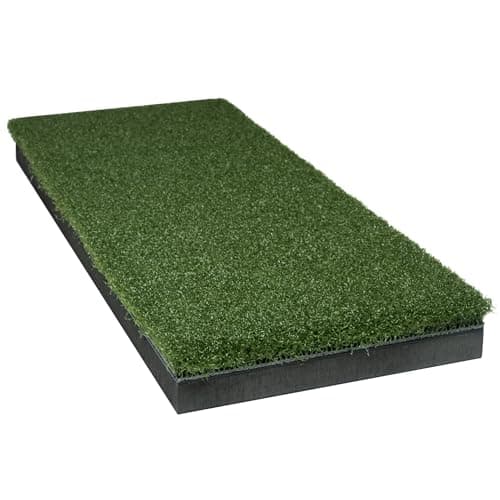
A hitting padis a square or strip you place in front of you and stand beside — the GoSports and CHAMPKEY mats here, and the SIGPRO strip. Pads are cheaper, they fold or roll away, and they are the only realistic option in a shared garage. The catch is that the surface under your feet is now part of your setup: if you stand on concrete and hit off a half-inch pad, the ball is effectively sitting slightly above your feet, and your low point has to find a different place than it does on grass.

Neither is wrong. Buying a pad while expecting stance-mat practice is. If the mat has to disappear between sessions, buy a pad with your eyes open and put something level and forgiving underfoot — a second cheap mat, an exercise mat, or a flat lawn.

How we ranked these (the criteria)

We ranked on five things, in this order. Price sets expectations rather than buying a place in the order:

  • Footprint — do you stand on it? A mat that includes your feet reproduces a golf lie. A pad does not, and gets scored as the compromise it is.
  • What is under the turf. Backing is the spec that decides how much of each strike goes into your hands and wrists instead of into the mat. Closed-cell foam under dense turf absorbs; a thin rubber sheet on concrete does not. Where a maker publishes a thickness we use it; where only sellers do, we say so.
  • Turf density and fiber.Nylon fibers at a stated weight (the Country Club Elite’s 110 oz, for instance) resist flattening. Cheap plastic bristle mats pack down into a hard board, and a flattened mat changes how the club interacts with it — which is the one thing a practice surface must never do.
  • Whether it takes a real tee. A mat you can push a wooden tee into lets you practice driver at your real tee height. A mat that only takes a rubber tee fixes your tee height at whatever the rubber is, which quietly changes your driver setup.
  • Honest portability. Folding into thirds and weighing little is a real feature for a shared space and a real compromise in a dedicated bay. We score it according to which one you are buying for.

Scores are judgments from published manufacturer specifications, listing details and aggregated owner feedback against our rubric— not lab measurements. We have not hit a ball off any of these mats, we do not run a lab, and we say so on every page.

What every mat hides about your strike

This is the part the category never leads with, and it matters more than any product difference on this page: a mat does not punish a fat shot the way turf does.

Hit two inches behind the ball on grass and the club digs, the shot goes nowhere, and you get unmistakable feedback. Hit two inches behind the ball on a mat and the sole skids off the dense turf, the club bounces into the back of the ball, and the shot flies almost normally. Nothing tells you that you were two inches heavy. Practice enough of those and you can groove a low point behind the ball without ever knowing it — which shows up on the first course round as a run of chunked irons.

Two things help, and both are cheap. Put a line of foot spray, chalk or baby powder on the turf behind the ball and look at where the club actually enters: a mat lies to you about the result, but it tells the truth about the mark. And pay attention to the strike on the mat itself — a scuffed sole and a jarred wrist are feedback. If fat contact is your pattern already, our training aids for fixing a fat shot covers the drills and devices that give you the feedback the mat is swallowing, and how to practice golf at home structures the session around them.

The floor under the mat is part of the mat

Two identical mats behave completely differently on a garage slab and on a wooden deck. Concrete has no give at all, so every bit of a heavy strike that the mat cannot absorb goes into the clubhead, the shaft and your hands. The same mat on a lawn, or on a sheet of plywood over a rubber underlay, is noticeably kinder.

That is why thickness and backing dominate our scoring, and why the two cheapest mats here carry an explicit warning rather than a cheerful “great value”. If your floor is a slab and you practice regularly, buy up a tier or add an underlay. It costs less than one sports-medicine appointment, and the joint you are protecting is the lead wrist that every part of your golf swing runs through.

Skip this: the thinnest mat your floor can’t forgive

The pick nobody sells you is the one not to buy. A sub-$35 single-density pad on bare concrete, used three times a week by a golfer who hits down steeply, is the worst combination in this category — and it is also the most-bought one, because it is cheap and it photographs exactly like the expensive mats.

If that describes your setup, you have three honest options, in order of preference: spend the mid-tier money on a thicker mat with real backing, keep the cheap pad and put something compliant under it, or keep the cheap pad and practice chipping and putting indoors instead — our putting mat roundup covers the surface for that, and it asks nothing of your wrists at all.

Read across, not down

The order below is our overall ranking, but the “best for” line on each pick matters more than its number. If you are building a permanent bay and will hit thousands of balls, the Country Club Elite is the mat that will still be flat in five years and the only one here that takes a real wooden tee. If your wrists are the limiting factor, the SIGPRO Softy stripis built for exactly that and reviewed in full. If the mat has to live in a cupboard, the GoSports Tri-Turf XL folds in thirds and gives you three lies to practice from. And if the budget is the budget, the two CHAMPKEY mats are honest for what they are — just read their cons before you buy, because we mean them.

The short answer

Quick picks

#ProductBest forScorePrice
01
Dura-Pro Dura-Pro Premium Residential Golf Mat (4 x 5 ft)
Dura-Pro Premium Residential Golf Mat (4 x 5 ft)

A full stance mat at a residential price — the size and the backing that matter, without the commercial-grade bill.

Most home setups
7.4
$109.00Amazon
02
Real Feel Golf Mats Country Club Elite Real Feel Golf Mat (5 x 5 ft)
Country Club Elite Real Feel Golf Mat (5 x 5 ft)

The mat that takes a real wooden tee and a real divot-depth swing — commercial-grade turf, and priced like it.

A permanent bay you will hit thousands of balls in
7.2
$599.00Amazon
03
SIGPRO SIGPRO Softy Hitting Strip
SIGPRO Softy Hitting Strip

A joint-friendly hitting strip that takes the jarring out of a hard mat — the surface piece of a home setup.

The hitting surface in a home setup
7.8
$187.49Amazon
04
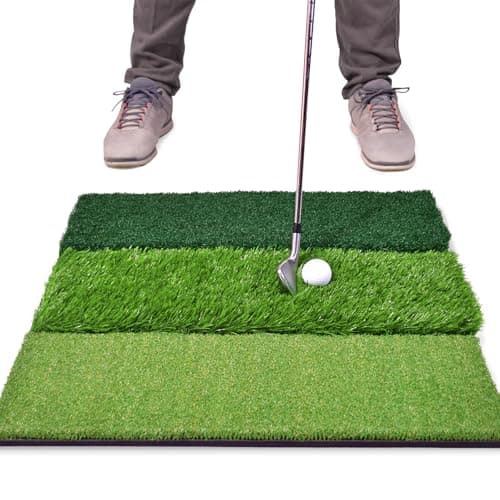
GoSports GoSports Tri-Turf XL Golf Hitting Mat (24 x 24 in)
GoSports Tri-Turf XL Golf Hitting Mat (24 x 24 in)

Three lies in one 24-inch square — the practice mat for working a ball out of rough as well as off a fairway.

Varying the lie without buying three mats
8.4
$59.99Amazon
05
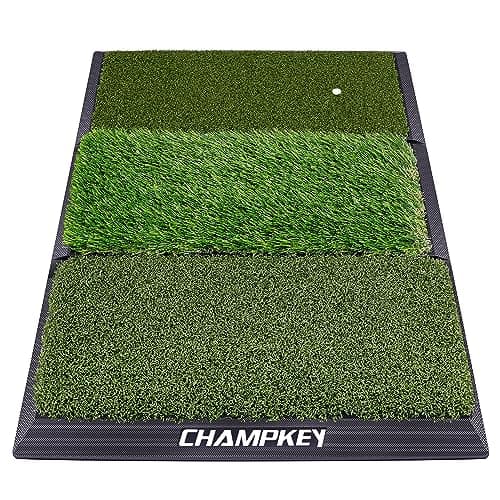
CHAMPKEY CHAMPKEY Professional Tri-Turf Golf Hitting Mat
CHAMPKEY Professional Tri-Turf Golf Hitting Mat

The cheap way to get three lies — a tri-turf pad on a heavy rubber base, for about half what the name brand asks.

Three lies on a tight budget
8.0
$44.99Amazon
06
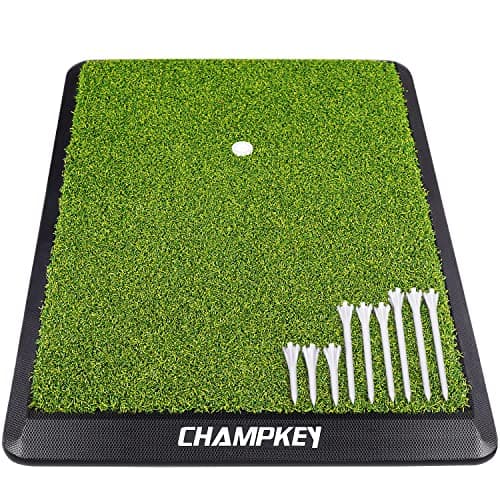
CHAMPKEY CHAMPKEY Premium Synthetic Turf Golf Hitting Mat
CHAMPKEY Premium Synthetic Turf Golf Hitting Mat

The cheapest honest mat here — one single-density surface, a rubber base, and no pretense about anything else.

A first mat, or a second one for the yard
7.6
$29.99Amazon

#ad · Live prices from the Amazon Product API, as of November 2, 2026. Where we have no verified live price, we show none — we would rather leave a gap than print a number that has rotted.

In detail

The picks, in full

01
Dura-Pro Dura-Pro Premium Residential Golf Mat (4 x 5 ft)

Most home setups

Dura-Pro Premium Residential Golf Mat (4 x 5 ft)

4 ft x 5 ft stance matNylon turf fibers (listing)19 mm listed thicknessIndoor or outdoor use
7.4/10

A full stance mat at a residential price — the size and the backing that matter, without the commercial-grade bill.

Build quality
8
Value
9
Ease of use
8
Portability
4
Effectiveness
8

Pros

  • 4 x 5 ft is the smallest footprint that genuinely lets you stand on the mat with a full driver setup — the spec that separates a hitting mat from a hitting pad
  • The listing claims dense nylon fibers rather than the thin plastic bristle on bargain mats, which is what keeps a mat from flattening into a hard board after a season
  • It is priced in the same bracket as a decent net, so a full home bay (net plus mat) stays within reach of a single sensible budget

Cons

  • Thickness claims for this mat conflict across sellers — the listing we resolved states 19 mm while another seller's page for the same product describes a 5/8 in (about 16 mm) build; buy it for the size and turf, and treat the millimeter figure as approximate
  • No manufacturer warranty length is published anywhere we could read; the UV claim on the listing is a materials claim, not a warranty
  • It will not accept a real wooden tee the way the commercial Country Club Elite does — you use a rubber tee

Skip this if…

…your wrists and elbows are already the limiting factor in how much you practice. A thicker commercial mat or a cushioned strip is kinder, and no amount of saving is worth practice you cannot do.

$109.00View on Amazon

Price as of November 2, 2026. Prices change — Amazon's is the one that counts.

#ad · we may earn a commission from this link to Dura-Pro Premium Residential Golf Mat (4 x 5 ft)

02
Real Feel Golf Mats Country Club Elite Real Feel Golf Mat (5 x 5 ft)

A permanent bay you will hit thousands of balls in

Country Club Elite Real Feel Golf Mat (5 x 5 ft)

5 ft x 5 ft commercial mat110 oz nylon turf (listing)5/8 in closed-cell foam backingAccepts a real wooden tee
7.2/10

The mat that takes a real wooden tee and a real divot-depth swing — commercial-grade turf, and priced like it.

Build quality
10
Value
6
Ease of use
8
Portability
2
Effectiveness
10

Pros

  • Dense 110-ounce nylon turf bonded to closed-cell foam is the construction driving ranges buy — it is built for continuous use rather than a bucket a week
  • It takes a real wooden tee pushed into the surface, which no thin mat does, so your driver setup is the same indoors as it is on a course
  • A full 5 x 5 ft footprint means you stand ON the mat, which is the difference between practicing your swing and practicing your swing while standing on concrete

Cons

  • It is far and away the most expensive mat here — multiples of the mid-tier price, and it is a commercial product sold at a commercial price
  • Listings describe the turf as 110 oz on a 5/8 in foam backing, but one dealer quotes a 1-3/4 in total assembly thickness and no source publishes a total weight; treat the stack-up as approximate
  • It is heavy and rigid: this is a mat you site once, not one you move between a garage and a lawn

Skip this if…

…you hit a bucket a week into a net in the garage. The money here buys continuous-use durability you will never consume — a mid-tier residential mat is the honest buy.

$599.00View on Amazon

Price as of November 2, 2026. Prices change — Amazon's is the one that counts.

#ad · we may earn a commission from this link to Country Club Elite Real Feel Golf Mat (5 x 5 ft)

03
SIGPRO SIGPRO Softy Hitting Strip

The hitting surface in a home setup

SIGPRO Softy Hitting Strip

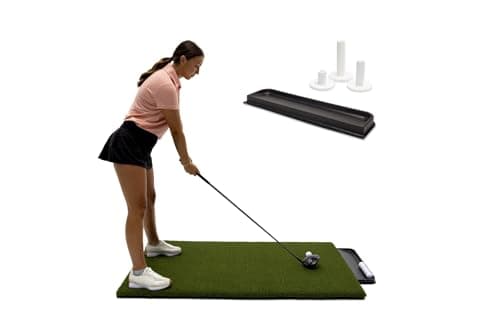
Cushioned, joint-friendly baseHitting-strip formatHome / garage practiceCompact footprint
7.8/10

A joint-friendly hitting strip that takes the jarring out of a hard mat — the surface piece of a home setup.

Build quality
8
Value
7
Ease of use
9
Portability
7
Effectiveness
8

Pros

  • Built to be softer on wrists and elbows than a cheap hard mat, which matters if you hit a lot of balls
  • The strip format takes up less room than a full stance mat, suiting a tight garage bay
  • A more realistic turf interaction than the thin mats bundled with budget nets

Cons

  • A strip means you stand on the floor beside it, not on the mat — you'll want a level, forgiving surface underfoot
  • It's a hitting surface only; ball return, data and a screen are all separate purchases

Skip this if…

…you want a full stance mat you can also stand on, or a mat with a ball tray built in. This is the compact hitting-surface piece, chosen for feel over footprint.

$187.49View on Amazon

$249.9925% off

Price as of November 2, 2026. Prices change — Amazon's is the one that counts.

#ad · we may earn a commission from this link to SIGPRO Softy Hitting Strip

04
GoSports GoSports Tri-Turf XL Golf Hitting Mat (24 x 24 in)

Varying the lie without buying three mats

GoSports Tri-Turf XL Golf Hitting Mat (24 x 24 in)

24 in x 24 inThree turf surfaces (fairway, rough, tee)Rubber baseFolds in thirds for storage
8.4/10

Three lies in one 24-inch square — the practice mat for working a ball out of rough as well as off a fairway.

Build quality
7
Value
9
Ease of use
9
Portability
10
Effectiveness
7

Pros

  • Three different turf densities in one mat means you can practice a shot out of rough, off a tight fairway lie and off a tee without changing anything — nothing else here does that
  • At 24 x 24 in it folds in thirds and goes in a cupboard, which makes it the realistic pick for a shared garage or a back lawn
  • The turf takes a real tee pushed in at the tee end per the listing, so it covers driver practice as well as irons

Cons

  • You stand beside it, not on it — at 24 inches square this is a hitting pad, so the surface under your feet has to be level and forgiving on its own
  • GoSports publishes no thickness, weight or fiber-density figure for this mat, so durability is a judgment from owner feedback rather than a spec
  • A 24-inch square gives you less margin for a fat strike than a full mat; a heavy strike behind the ball finds the floor

Skip this if…

…you are building a permanent bay. The portability is the whole point of this mat, and in a dedicated bay it is a compromise you are not being paid for.

$59.99View on Amazon

Price as of November 2, 2026. Prices change — Amazon's is the one that counts.

#ad · we may earn a commission from this link to GoSports Tri-Turf XL Golf Hitting Mat (24 x 24 in)

05
CHAMPKEY CHAMPKEY Professional Tri-Turf Golf Hitting Mat

Three lies on a tight budget

CHAMPKEY Professional Tri-Turf Golf Hitting Mat

Tri-turf surfaceHeavy-duty rubber basePortable pad formatIndoor or outdoor
8.0/10

The cheap way to get three lies — a tri-turf pad on a heavy rubber base, for about half what the name brand asks.

Build quality
6
Value
9
Ease of use
9
Portability
9
Effectiveness
7

Pros

  • The same three-lie idea as the GoSports at a lower price, which makes a varied-lie practice session the cheapest thing on this page
  • The listing specifies a heavy-duty rubber base, which is what stops a light pad sliding forward through a session on a smooth floor
  • Cheap enough that the garage mat and the back-lawn mat can be two different mats

Cons

  • CHAMPKEY publishes no turf weight, pile height or thickness, and no warranty term we could find — you are buying on the format and the price
  • Like any pad, you stand off the mat, and the smaller the pad the less room you have for an off-center strike
  • The cheapest turf in a category wears fastest; expect to replace it sooner than a mid-tier mat rather than expecting it to last like one

Skip this if…

…you practice several times a week. Buy a mat built for the volume instead — replacing a cheap mat twice costs more than buying a mid-tier one once.

$44.99View on Amazon

Price as of November 2, 2026. Prices change — Amazon's is the one that counts.

#ad · we may earn a commission from this link to CHAMPKEY Professional Tri-Turf Golf Hitting Mat

06
CHAMPKEY CHAMPKEY Premium Synthetic Turf Golf Hitting Mat

A first mat, or a second one for the yard

CHAMPKEY Premium Synthetic Turf Golf Hitting Mat

Single-density synthetic turfHeavy-duty rubber baseMultiple size optionsLowest price on this page
7.6/10

The cheapest honest mat here — one single-density surface, a rubber base, and no pretense about anything else.

Build quality
5
Value
10
Ease of use
9
Portability
8
Effectiveness
6

Pros

  • It costs less than a sleeve of premium balls and a bucket at the range, so it pays for itself almost immediately if it gets used
  • A heavy rubber base rather than a foam one, which is the difference between a mat that stays put and a mat that creeps
  • Size options mean you can buy the one that fits the space rather than the one the brand wants to sell you

Cons

  • One turf density means one lie — no rough, no tee section; it is a fairway lie and nothing else
  • No published thickness, pile weight or warranty, and the thinner builds in this price class transmit more of the strike into your hands on a hard floor
  • At the cheap end turf flattens with use, and a flattened mat changes how the club interacts with it — which is the one thing a practice surface must not do

Skip this if…

…you hit down steeply or already have sore wrists. A thin mat on concrete is the worst combination for both, and this is the thinnest class of mat on the page.

$29.99View on Amazon

Price as of November 2, 2026. Prices change — Amazon's is the one that counts.

#ad · we may earn a commission from this link to CHAMPKEY Premium Synthetic Turf Golf Hitting Mat

How much should you spend on a hitting mat?

Think in three tiers. The jumps are about construction, not features, which makes this one of the easier spends in golf to reason about.

The budget tierbuys a pad: one or three turf densities on a rubber base, small enough to store, thin enough that the floor underneath becomes your problem. It is a genuinely good buy for an occasional practicer on a lawn or a wooden floor, and a genuinely bad buy for a regular practicer on a slab. Expect no published specs and no warranty at this tier — you are buying a format at a price.

The mid tier is where most home setups should land, and where our top pick sits. The money buys a stance-sized footprint, denser nylon fibers that resist flattening, and a backing thick enough to take the sting out of a heavy strike. This is the tier where a mat stops being a compromise and starts being a practice surface.

The commercial tier— the Country Club Elite here — buys continuous-use durability, the ability to use a real wooden tee, and turf that behaves the same on day one and year five. It costs several times the mid tier. It is the right buy for a dedicated bay, a shared family setup, or anyone whose practice volume would wear out a residential mat in a season; it is money wasted on a bucket a week.

What footprint do you actually need?

Work backwards from your swing, not from the space. Three sizes cover almost everyone:

A pad (about 24 in square, or a strip). Irons and wedges, stood beside the mat, on a surface you trust. Perfect for a lawn or a garage with a forgiving floor, and the only realistic option if the mat must be put away. Driver is possible where the pad takes a tee, but your stance is off the mat.

4 x 5 ft. The smallest size that puts your feet and the ball on the same surface for a full-swing setup. This is the sweet spot for a home bay and the size we would buy. Anything smaller and you are buying a pad with extra steps.

5 x 5 ft and up. Room to move your ball position around for driver, irons and wedges without re-siting the mat, and the size commercial mats come in. Worth it in a dedicated space; a waste of floor in a garage you also park in.

One warning that applies at every size: mats smaller than about 4 ft deep will not let most golfers hit driver comfortably, regardless of what the listing implies. If driver practice is the reason you are buying, size up or plan to hit it off a tee from the floor next to the mat.

Where a mat sits in the cost of a home setup

A mat is rarely bought alone, and it is usually the piece people under-budget. A realistic first home bay is three purchases: something to catch the ball, something to hit off, and (optionally) something to measure. The net and the mat are the two that decide whether you use the room; the monitor is the one that decides whether you learn from it.

If you are spending a fixed total, spend it in that order. A mid-tier mat and a sturdy net with no monitor is a setup you will use for years. A launch monitor on a pad that hurts your wrists is a setup you will stop using in a month. Our home setup cost breakdown prices the whole room at three budget levels, and best home golf simulators covers the measurement end once the surface and the backstop are sorted.

How a mat dies — and how to delay it

Mats fail in two ways. The turf flattensin the one spot you always hit from, which changes the club’s interaction with the surface and makes your practice slowly less relevant. And the backing compresses, which is the same failure you cannot see: the mat gets harder, your hands take more, and you practice less without quite knowing why.

Three habits delay both. Move your ball position around the mat rather than wearing one patch. Rotate the mat end-for-end every month or two if it is symmetrical. And keep it out of standing water and direct sun when it is not in use, because UV and damp attack the backing far faster than your 7-iron does. A mat treated that way lasts years longer than the same mat hit from one spot in a wet corner — and it stays honest about your strike for all of them.
How we ranked this

We don't run a testing lab — and we say so

We compiled published manufacturer specifications, official standards and aggregated owner reviews, computed the running costs the big test-labs leave out, and scored each pick against a published rubric. The scores are judgments from documented research — they are not lab measurements we took, because we don't have a lab and we're not going to pretend we do. You can check every number we publish.

Questions

Frequently asked

What is the best golf hitting mat?
For most home setups, the Dura-Pro Premium Residential 4 x 5 ft: a stance-sized footprint with dense nylon turf and enough backing to take the sting out of a heavy strike, at a residential price. If you are building a permanent bay and will hit thousands of balls, the commercial-grade Country Club Elite is more durable and takes a real wooden tee. If sore wrists are your limit, the SIGPRO Softy strip is built specifically to be kinder to joints.
Are golf hitting mats bad for your wrists?
A thin mat on a hard floor can be, and it is the main reason to spend more than the minimum. The mechanism is simple: whatever the mat and the floor don't absorb goes into the clubhead, the shaft and your hands, and a heavy strike into an unforgiving surface is a jarring impact. Thickness, a compliant backing and dense turf all reduce it, as does hitting off a lawn or plywood-over-underlay rather than bare concrete. If you already have wrist or elbow trouble, buy a thicker mat or a cushioned strip rather than the cheapest pad.
Will a hitting mat hide my fat shots?
Yes, and that is the single biggest limitation of mat practice. On turf, a strike two inches behind the ball digs and the shot goes nowhere. On a mat, the sole skids and bounces the club into the ball, so the result looks almost normal and you get no feedback. Put foot spray, chalk or powder on the turf behind the ball and read the entry mark instead of the ball flight — and if heavy contact is already your pattern, our fat-shot training aids give you the feedback the mat is swallowing.
What size golf mat do I need?
4 x 5 ft is the smallest size that lets you stand on the mat with a full-swing setup, which is why it is our default recommendation for a home bay. Smaller squares and strips (around 24 in) are hitting pads: cheaper and far easier to store, but you stand beside them, so the surface under your feet has to be level and forgiving. Go to 5 x 5 ft or larger for a dedicated bay where you want to move your ball position for driver, irons and wedges without re-siting the mat.
Can you use a real tee on a golf mat?
Only on mats thick enough to take one — the commercial Country Club Elite is marketed on exactly that, and some pads have a tee section you can push a wooden tee into. Thinner residential mats and most budget pads need a rubber tee instead, which fixes your tee height at whatever the rubber gives you. That matters more than it sounds for driver practice: if your real tee height is higher or lower than the rubber, you are practicing a slightly different setup than the one you use on the course.

Keep reading

Receipts

Sources

We do not run a testing lab, and we do not pretend to. Every spec number here comes from a manufacturer's published sheet or an official standard, cited above. Where we could not verify something, we say so on the page rather than quietly leaving it out. Read our full method.