Skip to content
Divot&Draw

The Carry · Bags, Carts & Travel

How to Pack Golf Clubs for a Flight

Clubs do not break from being knocked. They break from an end-drop that loads the whole weight of the set onto the longest shafts in the bag. Everything below is written to stop that one thing.

By Stephen V.Updated How we rank
#ad

We earn a commission when you buy through our Amazon links, at no extra cost to you. It never changes our rankings — and we'll tell you when the cheaper ball or club is the better buy. How this works.

The short version: brace the bag from the inside with a support rod, pull the driver head below the top of the bag, pack soft clothing around the club heads rather than in the pockets, strap the set so nothing slides, and weigh the whole thing at home before you leave. That sequence matters more than which travel bag you own, because almost every broken club that comes off a plane breaks the same way — and the travel bag is not what stops it. If you only want the bag recommendation, the CaddyDaddy Constrictor is the one most flyers should own, and it is first in the picks below.

How golf clubs actually break on a plane

Not by being scuffed, and almost never by being hit side-on. The damage that matters happens when a loaded travel bag is set down hard on its end, or stacked on end in a container. At that moment the entire mass of the set — irons, wedges, putter, balls, shoes, everything you optimistically put in the side pocket — presses down through the longest and thinnest shafts in the bag. That is your driver, then your fairway woods. A graphite shaft is extremely strong in the direction it is designed to be loaded and much less so in a straight axial crush with twenty-five pounds behind it.

Two consequences follow, and they drive the whole method. First, the top of the bag is the critical zone— everything you do should be aimed at making sure nothing can press down onto a club head or a shaft tip. Second, padding is not the same as structure. Foam absorbs a knock. It does not resist a crush. The distinction is worked through in full in our hard vs soft travel bag guide, and it is why the picks below span a padded soft bag, a hard-top hybrid and a full molded shell.

The method, in order

  1. Fit a support rod first. A telescopic stiff arm extends from the base of the travel bag to above the club heads and takes the end-drop load itself. It is the cheapest and by some distance the most effective thing on this list. If you buy nothing else before a trip, buy one.
  2. Shorten the driver, or lower it.Either remove the head if your driver has an adjustable hosel — pack the head wrapped in a towel, at the bottom — or invert the driver so its head sits below the top rim of the bag. A driver head standing proud of the rim is the single most exposed object you are checking.
  3. Band the irons. Wrap a strap, a towel or a length of bubble wrap around the iron heads so they cannot chatter against each other for six hours. This is the scratch-prevention step rather than the breakage-prevention step, but it costs nothing.
  4. Pack clothing around the heads, not in the pockets. Soft layers at the top of the bag fill the void where everything moves. Shoes, rain gear and a jacket are doing more good jammed around your club heads than zipped into a side pocket where they only add weight away from where you need it.
  5. Use the internal compression straps. Most padded travel bags have them; most people never fasten them. They stop the golf bag sliding inside the travel bag, which is what turns a flat landing into an end-drop.
  6. Lock the zippers, then weigh it.Lockable zippers deter the casual opportunist. The scale is the part that saves you money — see the next section.

The weight math, because this is where the money goes

American Airlines and Delta both treat a golf bag as an ordinary checked bag: you pay the standard checked-bag fee, the 50 lb line is where the overweight charge starts, and American publishes a 70 lb hard maximum above which it will not be carried at all. Delta additionally will not accept an item outside 115 linear inches. Read our airline golf club fees page for the carrier-by-carrier detail and the travel bag size guide for the dimensional side.

The arithmetic that catches people out is this: a fourteen-club set is roughly twenty pounds, a golf bag is typically four to six, and a travel bag is anywhere from three pounds for a bare cover to eighteen for a full ATA case. Start from an eighteen-pound case and you have about twelve pounds of headroom for shoes, balls and clothing before you are paying an overweight fee on every leg of the trip. Start from a four-pound soft bag and you have twenty-six. That is the real, recurring cost of a heavy case, and it is why the cheapest option on this page is also the lightest.

What goes inRough weightNote
14-club set~20 lbThe fixed cost. Nothing you can do about it.
Your golf bag~4–6 lbA carry bag saves two to three pounds over a cart bag.
Travel bag, soft~3–8 lbThe lightest hard-top hybrids sit at the bottom of this band.
Travel case, molded ATA~18 lbSKB’s own published empty weight for the Staff ATA case.
Shoes, balls, rain gear~5–8 lbThe part you control. Pack it around the heads.
Airline limit50 lb / 70 lbOverweight fee at 50, refusal at 70 (American).

Three things not to do

Do not try to carry clubs on. The TSA lists golf clubs as a checked-bag item; they are not permitted in the cabin, so there is no version of this where you keep them with you.

Do not pack valuables in the travel bag. Airlines limit their liability for fragile and high-value contents, and a travel bag that has been through a baggage system is the last place you want a watch or a camera. Our guide to what to do when an airline loses or damages your clubs covers the liability limits in detail.

Do not assume the bag is the protection. A padded soft bag plus a support rod protects a set better than an unbraced hard case, because the rod addresses the actual failure mode. Buy the rod first and the bag second.

The short answer

Quick picks

#ProductBest forScorePrice
01
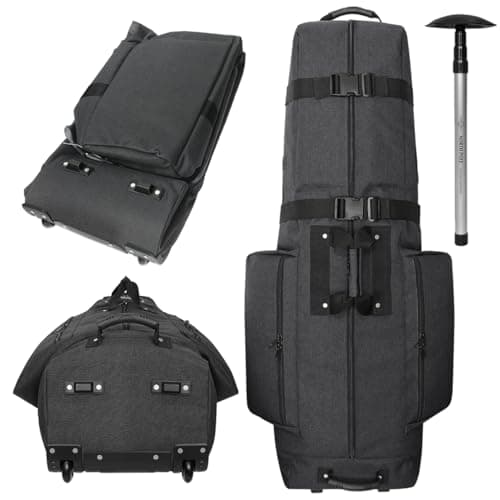
CaddyDaddy CaddyDaddy Constrictor
CaddyDaddy Constrictor

A padded soft-sided travel bag with lockable zippers that covers the essentials — protection, wheels and security — without the premium price.

The default travel bag for most flyers
7.6
$149.95Amazon
02
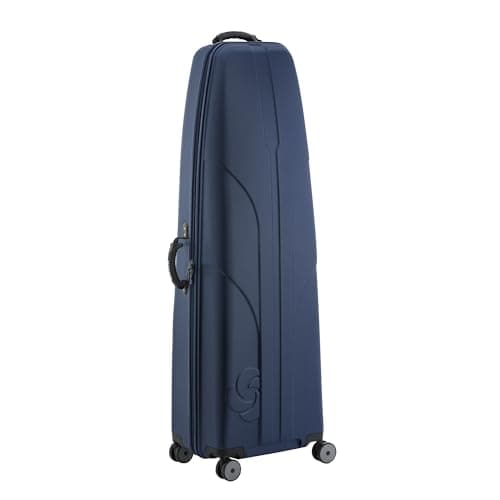
Samsonite Samsonite Tour Classic Hardside Golf Travel Case
Samsonite Tour Classic Hardside Golf Travel Case

The hard case most golfers who fly should actually buy — a genuine molded ABS shell on multi-directional spinner wheels, without ATA-case money or ATA-case weight.

Flyers who want a rigid shell, not just padding
7.8
$219.99Amazon
03
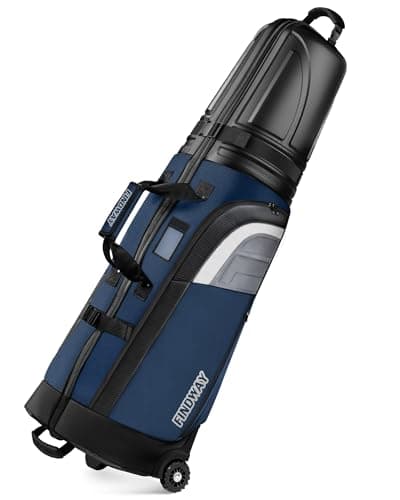
findway findway Golf Travel Bag with ABS Hard Case Top
findway Golf Travel Bag with ABS Hard Case Top

The cheapest honest way to get something rigid over your club heads — a wheeled soft travel bag with an ABS cap where it matters most.

One or two trips a year, on a budget
7.2
$115.99Amazon

#ad · Live prices from the Amazon Product API, as of October 18, 2026. Where we have no verified live price, we show none — we would rather leave a gap than print a number that has rotted.

In detail

The picks, in full

01
CaddyDaddy CaddyDaddy Constrictor

The default travel bag for most flyers

CaddyDaddy Constrictor

Soft-sided travel bagDense foam padded topWheelsLockable zippers
7.6/10

A padded soft-sided travel bag with lockable zippers that covers the essentials — protection, wheels and security — without the premium price.

Protection
8
Wheels/Handling
7
Storage
7
Build quality
8
Value
8

Pros

  • A dense foam padded top guards the club heads, the most vulnerable part in transit
  • Lockable zippers add a bit of security and deter casual tampering
  • Rolls on wheels and packs down when you're not using it, at a mid-tier price

Cons

  • Soft-sided, so it won't match a hard case for outright impact protection
  • Wheels and handling are fine, not the effortless glide of a leg-system bag

Skip this if…

…you fly constantly and want the easiest handling or the most protection. This is a strong value for occasional trips; a road warrior may want a leg-system bag or a hard case.

$149.95View on Amazon

Price as of October 18, 2026. Prices change — Amazon's is the one that counts.

#ad · we may earn a commission from this link to CaddyDaddy Constrictor

02
Samsonite Samsonite Tour Classic Hardside Golf Travel Case

Flyers who want a rigid shell, not just padding

Samsonite Tour Classic Hardside Golf Travel Case

Full hardside ABS shell4 multi-directional spinner wheelsPadded quilted interior + compression strapsFits 10.5" top bags / 48" clubs
7.8/10

The hard case most golfers who fly should actually buy — a genuine molded ABS shell on multi-directional spinner wheels, without ATA-case money or ATA-case weight.

Protection
9
Wheels/Handling
9
Storage
5
Build quality
8
Value
8

Pros

  • A rigid shell on every side is the only thing that resists a crush or a stack — padding alone can't, however thick it is
  • Multi-directional spinner wheels mean you push a loaded case rather than drag it, which is the difference that shows up at the end of a terminal
  • Samsonite's published spec includes a padded quilted interior and internal compression straps, so the bag can't shift around inside the shell

Cons

  • It doesn't fold — you are storing a five-foot rigid box for the fifty weeks a year you aren't flying
  • The shell's own weight comes straight out of your checked-bag allowance before a single club goes in
  • Fixed internal dimensions: Samsonite quotes 10.5" top bags and 48" clubs, so measure your bag's widest point before ordering

Skip this if…

…you fly with clubs once a year on a direct flight, or you have nowhere to keep a rigid case between trips. A padded soft bag plus a support rod handles the failure that actually breaks clubs — an end-drop into the shafts — for far less money and folds into a cupboard afterwards.

$219.99View on Amazon

Price as of October 18, 2026. Prices change — Amazon's is the one that counts.

#ad · we may earn a commission from this link to Samsonite Tour Classic Hardside Golf Travel Case

03
findway findway Golf Travel Bag with ABS Hard Case Top

One or two trips a year, on a budget

findway Golf Travel Bag with ABS Hard Case Top

ABS hard case topSoft bodyWheeledLightweight class
7.2/10

The cheapest honest way to get something rigid over your club heads — a wheeled soft travel bag with an ABS cap where it matters most.

Protection
6
Wheels/Handling
7
Storage
8
Build quality
6
Value
9

Pros

  • An ABS cap over the club heads is a real step up from a bare padded cover, at close to bare-cover money
  • The lightest option on this page, which leaves the most headroom against a checked-bag weight limit
  • Folds far smaller than any molded shell, so it's the easiest of these to live with between trips

Cons

  • Only the top is rigid; everything below it is fabric, so this protects heads far better than it protects the rest of the bag
  • The lightweight build means thinner body padding than a premium soft travel bag, let alone a shell
  • The listing claims no lock, so add your own if you want even a deterrent

Skip this if…

…you fly often, connect through multiple airports, or are checking an expensive set. This is occasional-trip protection at an occasional-trip price; a road warrior should be looking at a full shell instead.

$115.99View on Amazon

$139.9817% off

Price as of October 18, 2026. Prices change — Amazon's is the one that counts.

#ad · we may earn a commission from this link to findway Golf Travel Bag with ABS Hard Case Top

Which of these three should you actually buy?

If you fly once or twice a year, the findway hard-top hybrid is the sensible floor: a rigid ABS cap over the club heads, a soft body that folds into a closet, and the lightest option here, which leaves the most headroom against the 50 lb line.

If you fly a few times a year, the CaddyDaddy Constrictor is the pick. A dense foam padded top over the heads, lockable zippers and wheels is the right amount of bag for a golfer who travels but does not live on a plane, and it stores flat.

If you fly often, or the set is expensive, the Samsonite Tour Classic is a genuine molded ABS shell on spinner wheels — real rigidity, and far less money and weight than a full ATA case. If you want the absolute maximum, the hard case roundup ranks the SKB ATA case that is built to a published airline shipping-container standard.

Before every trip: the five-minute check

Photograph the clubs laid out, and photograph the packed bag on a bathroom scale showing the weight. It takes two minutes, it settles any later argument about what was in the bag and what condition it was in, and it is the single most useful thing you can do in advance of a claim you hope never to make. Then confirm your carrier’s current sporting-goods policy on its own site — policies change, and the fee you paid last year is not a guarantee.
How we ranked this

We don't run a testing lab — and we say so

We compiled published manufacturer specifications, official standards and aggregated owner reviews, computed the running costs the big test-labs leave out, and scored each pick against a published rubric. The scores are judgments from documented research — they are not lab measurements we took, because we don't have a lab and we're not going to pretend we do. You can check every number we publish.

Questions

Frequently asked

How do you pack golf clubs for a flight so they do not break?
Fit a telescopic support rod that extends above the club heads, lower or remove the driver head so nothing stands proud of the bag rim, band the iron heads together, pack soft clothing around the heads rather than in the pockets, and fasten the travel bag’s internal compression straps so the golf bag cannot slide. The rod is the important one: clubs break from an axial end-drop that loads the longest shafts, and the rod takes that load instead of your driver.
Can you take golf clubs as carry-on luggage?
No. The TSA lists golf clubs as a checked-bag item, so they cannot go in the cabin on a US flight. Plan on checking them, and plan the packing accordingly — a driver head you could have protected in the cabin is exactly the thing most at risk in the hold.
How much does a packed golf travel bag weigh?
Figure roughly 20 lb for a fourteen-club set, 4 to 6 lb for the golf bag itself, and anywhere from 3 lb for the lightest hard-top hybrid to SKB's published 18 lb for a full ATA case. That puts a typical soft-bag setup in the low-to-mid thirties and a heavy case in the mid-to-high forties before you add shoes and clothing — which is why a heavy case quietly costs you an overweight fee on both legs of every trip.
Do I need a stiff arm or support rod in a golf travel bag?
It is the highest-value thing you can add, yes — and it matters more than which travel bag you own. A support rod transfers an end-drop load from your driver shaft to the rod itself, which is precisely the failure the bag cannot prevent. A padded soft bag with a rod protects a set better than an unbraced hard case does.
Should I put clothes in my golf travel bag?
Yes, but around the club heads rather than in the pockets. Soft layers packed at the top of the bag fill the void where everything shifts in transit and cushion the most vulnerable part of the set. Watch the scale as you do it — the 50 lb line is where the overweight fee starts, and our airline fee guide has the carrier-by-carrier numbers.

Keep reading

Receipts

Sources

We do not run a testing lab, and we do not pretend to. Every spec number here comes from a manufacturer's published sheet or an official standard, cited above. Where we could not verify something, we say so on the page rather than quietly leaving it out. Read our full method.