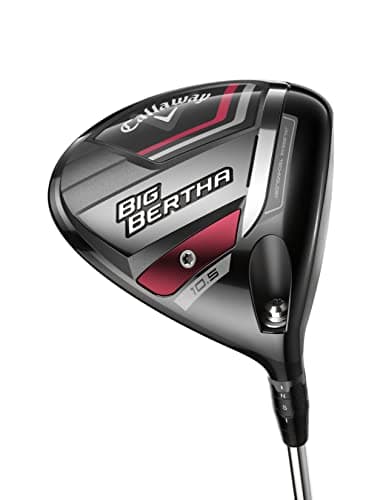
The Callaway Big Bertha is the most forgiving driver we rank, and if the budget stretches it is the one we point most golfers toward — a genuine game-improvement head with a big, stable footprint that holds ball speed on the off-center hits the rest of us actually make. But there is a spec detail that matters more than the badge, and we’ll say it up front: the listing we track is the high-launch 12.5° build with a light flex shaft. That is a specific, deliberate combination, and it makes this a brilliant driver for a moderate or slower swing and the wrong one for a fast swinger. Here is the honest, full review.
What it is
It is a current-generation Callaway Big Bertha driver — the 2023 model, not a decade-old design on clearance. Big Bertha is Callaway’s game-improvement line, which means the whole design brief is forgiveness and easy launch rather than shot-shaping. This exact listing is built at 12.5° of loft with a light-flex shaft, which is the single most important thing to understand about it: high loft launches the ball higher and easier, and a lighter, softer shaft helps a smoother or slower swing generate clubhead speed. Read that spec the right way round and it tells you exactly who the club is for. The forgiveness class, loft and flex here are the listing’s and Callaway’s own published details, not anything we measured — our approach to specs and scoring is set out in how we rank.
Where it shines
Forgiveness first. The Big Bertha has the biggest, most stable footprint of any driver in our driver roundup, and on off-center strikes it holds ball speed better than anything else we rank there. For a golfer who does not find the middle of the face every time — which is nearly everyone — that is the difference between a drive that limps into the rough and one that still finds the short grass. This is the reason to buy a game-improvement head at all, and the Big Bertha does it as well as any driver at its price.
The 12.5° loft and light flex are the second thing it does well, provided they match you. Together they launch the ball high and easy, which for a moderate or slower swing is precisely where carry distance comes from — height and a soft landing, not a low, hot flight the swing can’t support. A lot of amateurs leave distance on the tee by playing too little loft; this build does the opposite, and for the right swing it turns a struggle to get airborne into an effortless, towering drive. If your swing is smooth or slowing down, this is a driver working with you rather than against you.
And it is a real, current major-brand club. That buys you a head that has kept up with the technology, resale value when you move on, and the confidence of a name that genuinely knows how to build forgiving drivers. Against a budget offset driver, the Big Bertha gives up nothing on forgiveness and adds feel and finish; against a compact tour head, it gives up shot-shaping and gains a much larger margin for error. For the golfer it is built for, that is the right trade every time.
Where it falls short
The honest limitation is the same spec that makes it good: this is a high-launch, light-flex, 12.5° build. Feed it a genuinely fast swing and you will balloon it — the ball climbs too high, spins up, and you lose the distance the loft was supposed to add, while the light shaft feels loose and unruly at speed. A fast swinger who wants a Big Bertha should be shopping a lower loft and a firmer flex, not this listing. We call that out plainly because a driver’s loft and flex are not cosmetic; they are the club, and buying the wrong pair is the most common way golfers end up blaming a perfectly good head.
The second limitation is price. The Big Bertha costs multiples of the budget offset drivers we rank, and while the forgiveness is real, a brand-new golfer on a tight budget can get airborne and pointed straight for far less. The Big Bertha is the buy when the budget stretches and you want to keep the driver for years; it is not the buy when money is short or you are not yet sure the game will stick. Our cost guide puts that decision in plain budget terms.
Finally, like any game-improvement driver, it is built for stability rather than working the ball. If you like to shape drives on purpose, the big, forgiving head will resist you — that is a feature for most golfers and a limit for a skilled few. None of this is a knock on the club; it is simply what a forgiving, high-launch driver is and isn’t.
Who should buy it
Moderate and slower swings that want maximum forgiveness and easy height. This is the standout buy for a player with a smooth tempo, a swing that is slowing down with age, or anyone who struggles to get the driver airborne — the 12.5° loft and light flex are tuned for exactly that golfer, and the big, stable head forgives the mishits along the way. It is also a fine choice for an improving player who wants one forgiving driver to keep, as long as the loft and flex suit their speed. If your swing is on the gentler side, this is very likely the best driver on our list for you — and it shares its logic with the picks in our best golf clubs for seniors guide.
Who should skip it
Fast swingers, first and foremost. This specific high-loft, light-flex listing will balloon on a quick, aggressive swing, and you should choose a lower-loft, firmer-flex driver instead — the head is good, the spec isn’t yours. Skip it too if the budget is tight or the game isn’t yet a habit: a value offset driver from our driver roundupgets a beginner airborne for a fraction of the price. And if you like to shape your drives, a more compact players’ head will give you the workability the Big Bertha deliberately trades away for forgiveness.