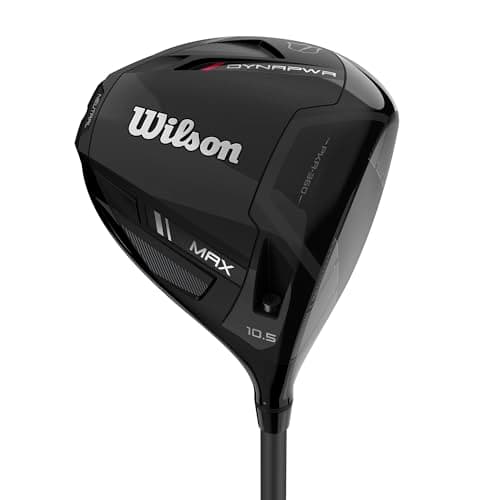
The Wilson DYNAPWR Max Lite is a driver with one clear job: help a slower swing that leaks the ball right. The listing we track is the women’s, ladies-flex “Lite” build in 12°, and everything about it — the 40-gram shaft, the draw-biased head, the weight pushed to the perimeter — is engineered around that single mission. It took over the anti-slice slot in our driver roundup when the Cobra Air-X was discontinued. Read as what it is, it is an honest, effective club; read as a neutral men’s driver, it is the wrong tool.
What it is
Wilson’s most forgiving driver head in its lightest build. The company’s published pitch for the Max is direct: “designed with a draw bias and enhanced stability … the ultimate blend of stability and forgiveness.” The stability comes from increased front-to-back and heel-to-toe length for a high MOI and a low center of gravity; the ball speed comes from what Wilson calls a PKR-360 AI-driven face designed to hold speed across the whole hitting area. The “Lite” part is the build around it: a UST Helium NCT4 40-gram shaft in a ladies flex, with an undersize Lamkin grip, so the total weight is low enough for a slow tempo to move it. Those are Wilson’s design claims, not measurements we took; we don’t run a lab, and the way we score clubs is set out in how we rank.
Where it shines
Two things, and it does both well. First, speed for a slow swing: a 40-gram shaft and a ladies flex genuinely help a slower tempo generate more clubhead speed than a heavier, stiffer driver would, and for that golfer speed is distance. Second, slice correction: the draw bias leans the flight left, so a ball that used to sail out to the right starts holding its line, and the high-MOI, low-CG head gets it airborne easily on top of that. The 12° loft on this listing pushes the same direction — more loft is one of the few genuinely free distance gains available to a slow swing.
There is a third thing worth flagging, because the driver it replaces did not have it: this head is adjustable. A 6-way adjustable hosel lets you change face angle, and a flippable 19-gram rear weight lets you dial the shot shape further. That matters for a golfer whose swing is still changing — you can soften the draw bias as your slice improves instead of buying a different driver, which is not something a fixed offset budget head can offer.
Where it falls short
Be clear about what this listing is: the women’s, ladies-flex Lite build on a 40-gram shaft. That is a feature for the golfer it is built for and a liability for anyone else. Feed it a moderate-to-fast swing and the light, whippy build will cost you control, while the draw bias that cures a slice turns into a hook. It is also a fix aimed at one specific miss — a slice — so if you already draw the ball or like to work it, the draw bias gets in your way. And it is a real-money purchase: a budget offset driver gets a beginner airborne for a fraction of it, if the only thing you need is a playable tee shot while you learn.
Who should buy it
A golfer with a slow swing speed whose miss is a slice, and who wants a light, easy-to-launch driver from a real brand that helps straighten the ball out. That describes a lot of players — many senior and women golfers among them — and for them this is a genuinely helpful club, not a compromise. The adjustability makes it a better long-term buy than a fixed anti-slice head, too: it can follow your swing rather than being outgrown by it. See how it stacks up in the driver roundup.
Who should skip it
Anyone with moderate-to-fast swing speed, and anyone who doesn’t slice. The lightweight, ladies-flex build is tuned for a slow swing that leaks right; give it real speed or a straight ball flight and you will lose control and over-turn it. A faster or straighter golfer wants a neutral, higher-flex head — the adjustable Cleveland Launcher XL 2 or the high-launch Wilson Dynapower are the better buys for those swings. And if you want anti-slice help for as little money as possible, the offset Pinemeadow PGX in the roundup does the core job far more cheaply.