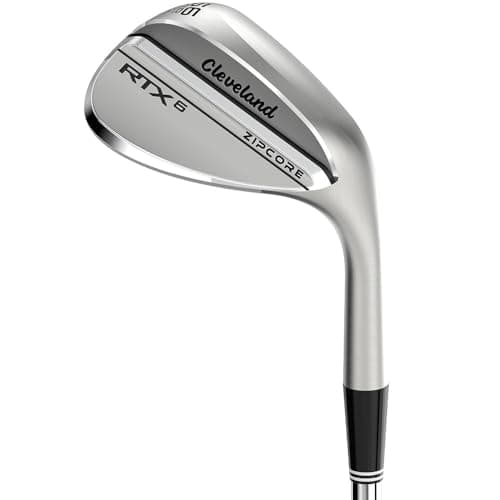
The Cleveland RTX 6 ZipCore is a tour blade wedge, and it is the sharpest-grooved, best-feeling wedge we rank. It is the wedge to buy once you can strike your short shots cleanly — and, just as honestly, the wrong wedge to buy if you can’t. The listing we track is the 56°, the most versatile single wedge loft in the bag. This is a full, honest review: what the RTX 6 is, where it is brilliant, where a tour blade will punish you, and who should buy it against who should walk past it.
What it is
It is Cleveland’s flagship tour wedge, built as a blade — the mass sits behind the sweet spot rather than out at the perimeter, the classic shape a good short game wants. Cleveland markets it around two named technologies: ZipCore, a low-density core that lets them reposition weight for a more precise center of gravity and feel, and their sharpest, most durable grooves (the “UltiZip” family) for maximum greenside spin. It is sold in multiple grind options, so you can match the shape of the sole to your turf and your technique. This listing is the 56° loft, which most golfers play as a sand wedge and the most useful single wedge to own if you buy only one. The technology names and the spin, feel and durability claims here are Cleveland’s own published wording — we did not test them in a lab, as how we rankexplains — but they line up with a long, consistent reputation.
Where it shines
Spin and control are the reason this wedge exists, and they are the reason to buy a dedicated tour wedge at all. Cleveland’s grooves are among the sharpest and most durable in the game, and on a clean strike the RTX 6 grips the ball and stops it on a green the way a worn or budget wedge simply cannot. For a golfer whose scoring leans on the short game — who wants to throw a pitch up and spin it back, or nip a half-shot and have it check — that spin is real strokes, and it is the single best thing about the club.
Feel is the second. A blade puts the weight behind the middle of the face, and the ZipCore construction is Cleveland’s way of refining where that weight sits; the result is a soft, precise, connected feel that tells a good player exactly what the strike did. That feedback is what lets a skilled short game do skilled things: open the face for a flop, flight one down into the wind, control the spin and the trajectory shot by shot. A forgiving cavity-back wedge deliberately mutes that feel; the RTX 6 gives you all of it.
The grind options are the quiet third strength. The way a wedge’s sole is ground — how much material is relieved from the heel, toe and trailing edge — decides how it interacts with the turf and how far you can open the face before the leading edge sits up. By selling the RTX 6 in several grinds, Cleveland lets you match the sole to firm or soft ground and to a shallow or steep angle of attack, which is exactly the kind of fit a good ball-striker notices. It is the difference between a wedge that fights your turf and one that glides through it.
Where it falls short
A tour blade is less forgiving than a cavity-back wedge, full stop. The mass is behind the sweet spot, so a fat or thin strike is punished — you feel it, you lose the shot, and there is no perimeter weighting to bail you out. On a wedge that matters more than on any other club, because the mishits that hurt most around the green are precisely the fat and thin ones. If your short game is a work in progress, the RTX 6 will expose it rather than help it, and a forgiving cavity-back like Cleveland’s own CBX Full-Face will save you far more shots than tour grooves ever will — the two are compared head to head in RTX vs CBX wedges.
It is also priced at the top of the wedge market. You are paying for the grooves, the ZipCore construction and the grind options, and that is money well spent for a player who uses them and wasted on a player who doesn’t. A budget wedge covers the basic 56° gap for a fraction of the price, and while its grooves won’t spin or last like Cleveland’s, a golfer who isn’t yet spinning wedges on demand won’t feel the difference the RTX charges for.
None of this is a criticism of the wedge — it is the honest shape of what a tour blade is. It rewards a skill, and it charges for a level of performance you have to be able to use. Buy it for the short game you have, not the one in the marketing.
Who should buy it
Clean ball-strikers who want tour spin and shot-making. If you strike your chips and pitches out of the middle, if you want to open the face, flight the ball and spin it back, and if your scoring genuinely leans on a good short game, the RTX 6 is the wedge to buy and keep. The 56° listing is the most versatile single loft, a natural sand wedge and the one to start with if you are building a matched set of wedges. This is a wedge a good short game grows with, not out of.
Who should skip it
If you chunk or thin your chips, skip it — and there is no shame in that being most golfers. A tour blade punishes exactly the strikes a developing short game makes, so a game-improvement wedge like the CBX Full-Face from our wedge roundup or an anti-chunk specialist like the Square Strikewill lower your scores more than tour grooves can. Skip it too if the budget is tight and you just need a serviceable 56° gap; a value wedge does that job for far less. Come back to the RTX 6 when your strike has caught up with it, and it will reward every bit of that improvement.